An “eco-friendly” tote, pen, or bottle is only as credible as the evidence behind it. Buyers should be able to verify material content, certification scope, manufacturing, decoration, and end-of-life—not rely on a green icon.
This guide compares eight of the best eco-friendly promotional product vendors across North America, Europe, and China sourcing. It also shows how to evaluate sustainable promotional product suppliers by order size, customization, geography, documentation, and fulfillment. There is no universal greenest vendor; the right partner is the one that can document the exact product and deliver it reliably.
The shortlist at a glance
| Vendor | Best for | Main market or model | Evidence to examine |
|---|---|---|---|
| Fairware | Strategy-led sustainable merch programs | U.S. and Canada | B Corp profile, supplier code, impact reporting |
| Ethical Swag | Transparent North American sourcing and fulfillment | U.S. and Canada | B Corp, product vetting, Good/Better/Best framework |
| Eco Promotional Products | Broad eco-specialist catalog and USA-made options | United States | Product-level attribute icons and origin details |
| PCNA ProudPath | Large distributor-ready catalog | North America | Five-pillar portfolio, SKU documentation, certification scope |
| Gemline betterway | Bags, drinkware, tech, and corporate merchandise | Distributor network | CSR report and product accountability standards |
| Fluid Branding | Managed UK and European merchandise programs | UK, Ireland, Europe | B Corp, ISO 14001, EcoVadis Gold, product grading |
| XD Connects | European distributor supply with traceability tools | Europe | Impact reports, recycled-material tracing, digital passports |
| NicheSources | Custom factory sourcing and private-label development | China sourcing for global buyers | Supplier verification, samples, certifications, QC, freight plan |
Information and vendor pages were checked on September 1, 2026. Availability, minimum order quantities, certifications, and service regions change, so verify the specific product and quote before ordering. A company-level credential does not automatically certify every item in its catalog.
How we selected these vendors
We screened eco-friendly swag companies and sustainable merchandise programs that publish enough information for a buyer to evaluate their service model, geography, product range, and evidence practices.
Vendors were compared on product-level proof, responsible production, customization, fulfillment, disclosure of limitations, and fit for a distinct order type; their public pages were checked on September 1, 2026.
What “eco-friendly promotional product” should mean

“Eco-friendly” is useful search language, but it is too broad to stand alone as a product claim. The U.S. Federal Trade Commission’s Green Guides caution marketers against broad, unqualified environmental-benefit claims because they are difficult to substantiate. A safer and more useful product description names the exact attribute. For example:
For UK orders, the CMA’s Green Claims Code says environmental claims should be truthful, clear, unambiguous, and substantiated across the relevant product lifecycle. For EU campaigns, Directive (EU) 2024/825 restricts generic environmental claims without recognized excellent environmental performance; member-state measures are scheduled to apply from September 27, 2026. Check the destination’s current implementation before approving product pages, packaging, or campaign copy.
- Made with 70% post-consumer recycled plastic.
- Shell fabric certified to the Global Recycled Standard.
- Paper sourced through an FSC-certified chain of custody.
- Organic cotton certified to GOTS.
- Designed with replaceable parts and a documented repair program.
- Manufactured in an audited facility and shipped without individual polybags.
The distinction matters even outside the United States. Procurement teams, regulators, and end users increasingly expect proof behind recycled-content, carbon, biodegradable, compostable, and responsible-sourcing claims.
How to compare sustainable promotional product suppliers
Compare suppliers on evidence, usefulness, production, customization, fulfillment, and transparency. The strongest vendor is not the one with the longest eco catalog; it is the one that can substantiate the finished product your campaign will actually distribute.
Product-level verification
Look for specific material percentages, certification scope, chain-of-custody documents, country of origin, and testing. A supplier’s office being carbon neutral does not prove that a bottle is recycled or that a textile factory meets labor standards.
Product usefulness and durability
A certified product that recipients discard immediately is still poor promotional planning. The item should solve a real need, survive repeated use, and suit the recipient.
Before ordering any item, ask whether recipient choice, on-demand fulfillment, or no physical giveaway would serve the campaign better. Unused surplus is not improved by a greener material label.
Responsible production
Environmental sourcing cannot be separated from worker safety, wages, chemical management, and factory conditions. Ask how suppliers are selected, audited, corrected, and removed.
Decoration and customization
Ink, transfer film, embroidery backing, coatings, adhesives, batteries, and mixed-material packaging can complicate an otherwise strong product story. The finished decorated item—not the blank—needs review.
Fulfillment and geography
Local stock can reduce lead time and air freight, while direct factory sourcing can reduce unit cost and enable deeper customization at volume. Neither route is always lower impact; compare the complete supply chain.
Transparency about tradeoffs
Credible vendors explain limitations. Be cautious when every product is described as sustainable, every material is “biodegradable,” or offsets are used to avoid discussing product and freight emissions.
1. Fairware: best for strategy-led North American programs
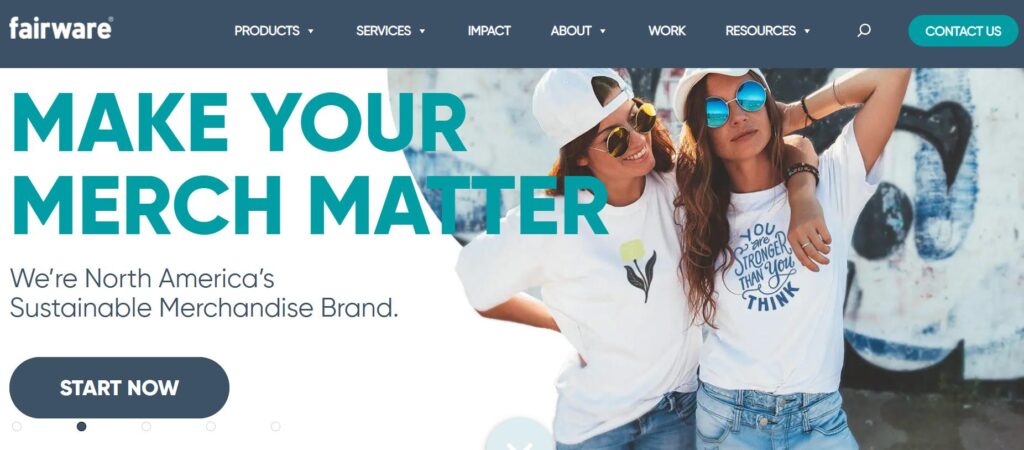
Fairware is a full-service promotional merchandise company serving clients in Canada and the United States. Its current site identifies it as a founding Canadian B Corp and describes sustainable merchandise, company stores, kits, and fulfillment services.
Fairware is a strong fit for organizations that need more than a one-time item. Its public services include campaign merchandise, online stores, kitting, fulfillment, and brand programs. That makes it useful when the procurement team needs merchandise to support a defined audience, behavior, or sustainability goal.
Best for: established brands, universities, nonprofits, employee programs, online merch stores, and campaigns that need consultation.
What to verify: the product-level certification, manufacturing country, decoration materials, order-specific freight plan, and whether impact data needed for reporting can be supplied.
2. Ethical Swag: best for transparent North American buying
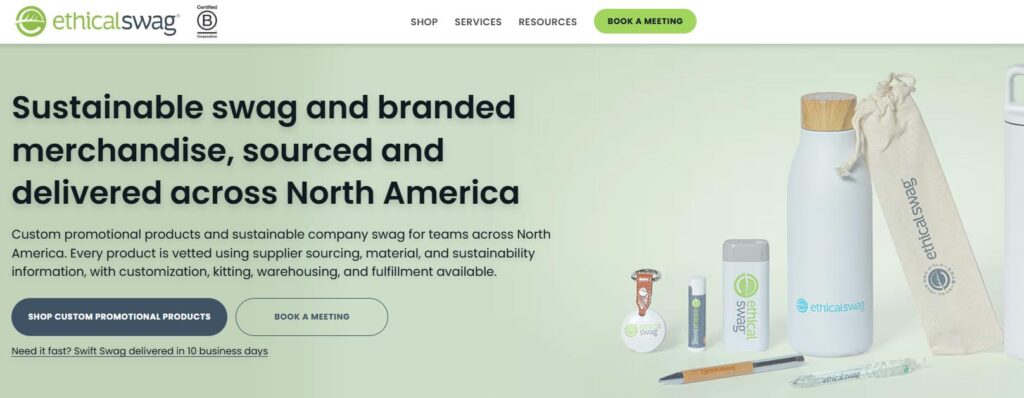
Ethical Swag serves organizations across the United States and Canada with branded merchandise, kitting, warehousing, and distribution. Its current site identifies the company as a Certified B Corporation.
Its strongest differentiator is the way it explains product selection. Ethical Swag states that it reviews products using material, certification, supplier, social, and country-of-origin information. Its Good/Better/Best framework gives buyers a way to compare options without pretending every choice has the same level of evidence.
Many catalog pages display minimum quantities, which can help teams filter ideas earlier. Buyers should still ask which documents are available for the exact SKU and production lot.
Best for: onboarding kits, corporate gifts, event merch, and procurement teams that want a guided decision process.
What to verify: certification numbers and scope, whether the claim applies to the full product or one component, decoration durability, stock availability, and current production time.
3. Eco Promotional Products: best for a broad U.S. eco-specialist catalog
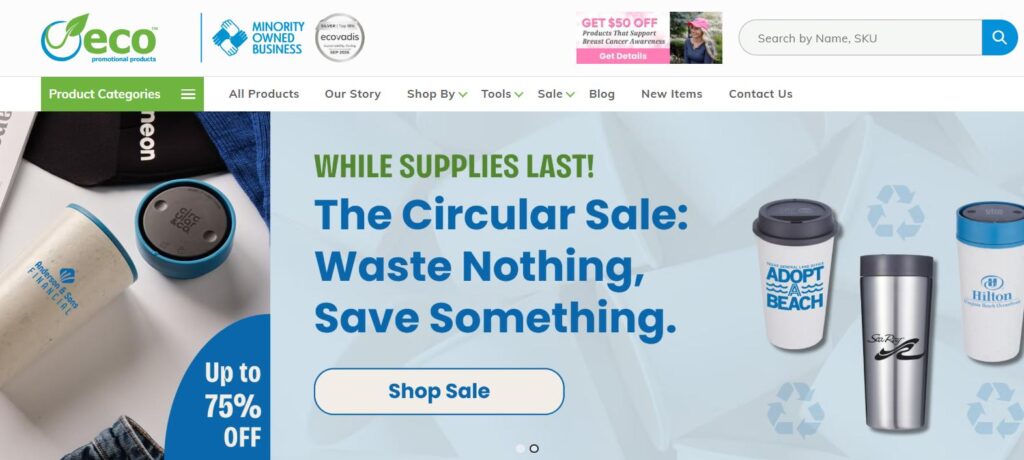
Eco Promotional Products organizes merchandise with attributes such as recycled, recyclable, renewable resource, USA made, social compliance, and diverse-owned. Its catalog covers common giveaways as well as seed paper, awards, event materials, drinkware, apparel, gifts, and conservation-themed products.
The detailed product pages can be especially useful during early comparison because they may show material, origin, production time, decoration method, and attribute icons together. The presence of an icon should start verification rather than replace it. For example, a “recyclable” claim should be checked against the actual materials, decoration, and recycling access in the recipient market.
Best for: U.S. events, public-sector or nonprofit campaigns, USA-made filters, seed-paper products, and buyers who want a catalog focused on environmental attributes.
What to verify: evidence behind each icon, recycled-content percentage, disposal conditions, supplier audit scope, and whether packaging shares the claimed attribute.
4. PCNA ProudPath: best for distributor-ready North American selection
PCNA is a major supplier to the promotional-products industry. Its current ProudPath portfolio organizes participating brands around five environmental and social-responsibility pillars and lets buyers sort products by those attributes.
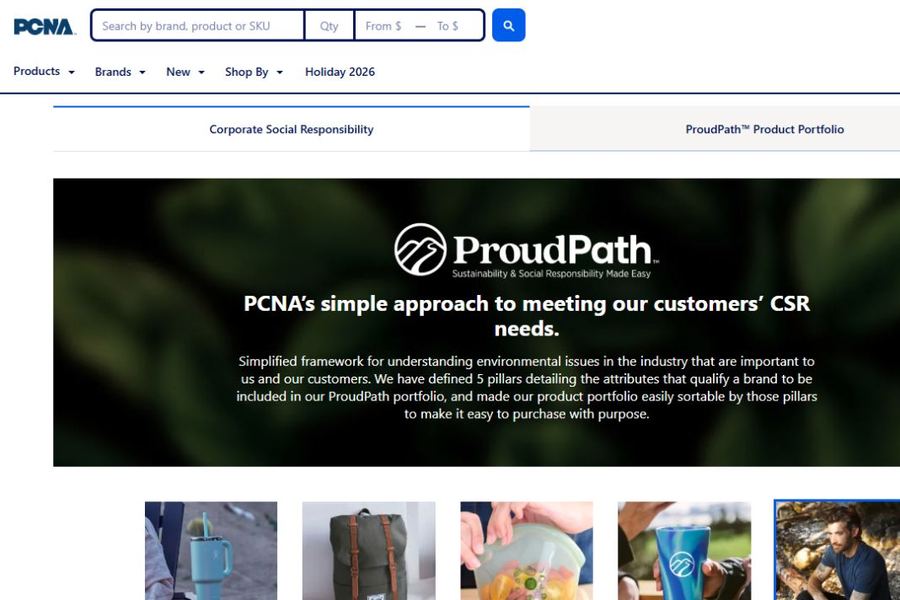
PCNA’s January 2022 environmental policy used the earlier EcoSmart name and said those products required documentation and verification for their sustainability claims. ProudPath is the current program presented on PCNA’s site. The model can work well when a distributor needs broad inventory, established decoration services, and repeatable corporate ordering. End buyers should confirm the correct purchase channel.
Best for: promotional distributors, corporate programs, broad category selection, and repeat orders using stocked products.
What to verify: which ProudPath pillar applies, the supporting documentation for the chosen SKU, exact recycled-content percentage where claimed, product and decoration origin, inventory location, and packaging.
5. Gemline betterway: best for corporate merchandise through distributors
Gemline supplies bags, business accessories, drinkware, technology, lifestyle goods, and retail-brand merchandise through the promotional products channel. Its betterway program publishes corporate responsibility reporting and product accountability standards.
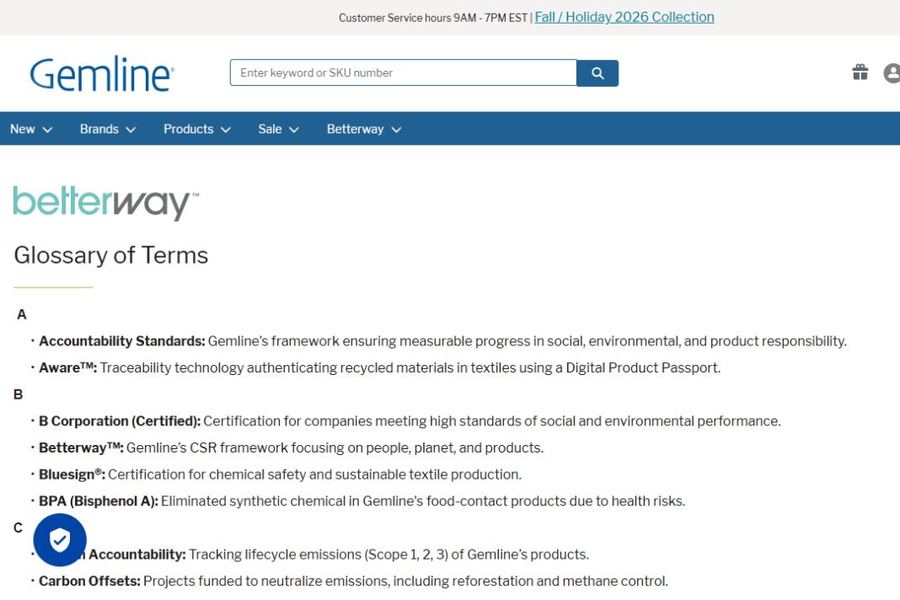
Gemline’s 2025 accountability standards reference preferred materials and third-party frameworks including FSC, GOTS, bluesign, and OEKO-TEX where applicable. That phrase matters: these certifications address different products and supply-chain stages. A brand-level partnership or certification does not make every Gemline SKU equivalent.
Best for: corporate gifting, bags and accessories, retail-brand merchandise, and distributor-managed programs that need recognizable product design.
What to verify: which betterway standard applies to the item, certificate scope, current factory, chemical requirements for decoration, and repair or end-of-life options.
6. Fluid Branding: best for managed UK and European programs
Fluid Branding provides merchandise and managed solutions from offices across the UK, Ireland, and Europe. Its compliance page, checked September 1, 2026, lists B Corp certification, ISO 14001, ISO 9001, Sedex participation, and an EcoVadis Gold rating. Fluid says that rating placed it within EcoVadis’ top 5% at the time of assessment.
Fluid also publishes a Sustainability Key intended to help buyers compare relevant product attributes. Treat the score as a screening aid and request the evidence behind the exact item rather than relying on the badge alone.
Best for: UK and European companies, multi-location programs, managed merchandise stores, and procurement teams with formal compliance requirements.
What to verify: current certificate dates and scope, item-level evidence, route and transport mode, local regulatory labeling, and whether the carbon figure covers the finished decorated product.
7. XD Connects: best for European catalog scale and traceability
XD Connects supplies promotional merchandise through European distributor networks.
Its 2024 impact report describes efforts to expand preferred materials, measure product emissions, and use traceability tools such as AWARE tracer technology and digital product passports on applicable products. Those tools are not necessarily present on every SKU.
Traceability can improve a recycled-material claim by connecting product data to a verification system. It still needs scope clarity. Buyers should check what the tracer verifies, which components it covers, and whether the decorated order matches the item represented in the digital record.
Best for: European distributors, large catalog programs, recycled textiles and accessories, and buyers who value product-level digital information.
What to verify: current impact report, product passport, recycled-content certificate, component coverage, decoration facility, and European market compliance.
8. NicheSources: best for custom factory sourcing and private-label development
Catalog vendors are efficient when an existing product meets the brief. They become less efficient when a brand needs a new shape, proprietary packaging, uncommon material, controlled color, high-volume pricing, or a coordinated product family.
NicheSources is a China sourcing agent rather than an eco-only promotional catalog. Its role is to identify and verify manufacturers, develop or customize products, coordinate samples, conduct quality checks, and arrange international freight. This model can be appropriate for buyers who have enough volume and time to build a product specification instead of selecting a stocked giveaway.
The advantage is control: a buyer can specify certified input material, restricted substances, decoration, packaging, inspection, and shipping. The risk is also control: if the specification says only “eco-friendly bamboo bottle,” the factory may not know what lifecycle outcome or proof the buyer actually needs.
Best for: importers, DTC brands, wholesalers, and promotional companies developing high-volume or differentiated merchandise.
What to verify: factory identity, certificate holder and scope, transaction certificate availability, bill of materials, restricted-substance testing, social audit, approved sample, inspection plan, packaging, incoterm, and freight mode.
NicheSources can support product sourcing, product branding, product development, private-label planning, corporate gift manufacturing, quality coordination, warehousing, and international freight forwarding.
For eco-friendly promotional products, use product pages as specification starting points—not as proof of a claim. Compare packaging options on the wholesale eco-friendly packaging or custom packaging pages, then request the exact material, certification, and test documents for the SKU or custom specification you choose.
Planning custom eco promotional products? Request a sourcing quote to compare material evidence, branding, packaging, inspection, and freight for your order.
Which vendor is best for your order?
Use the order structure—not a universal ranking—to choose.
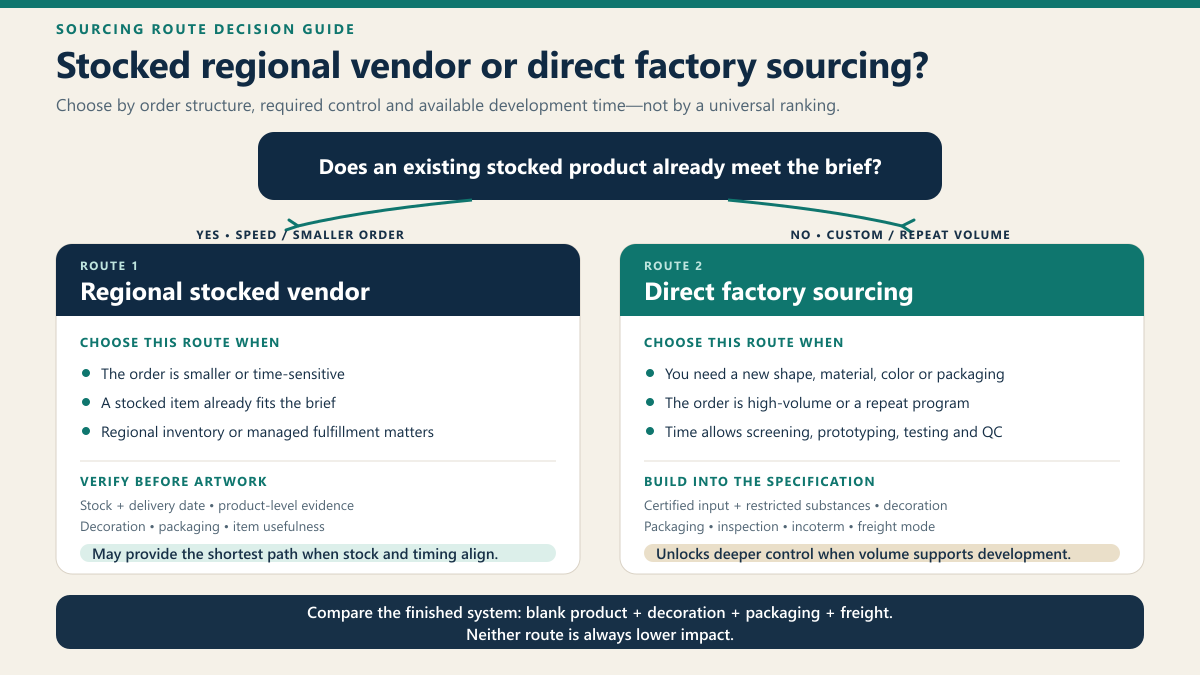
For a smaller, time-sensitive order
Start with a stocked regional distributor. Ethical Swag, Eco Promotional Products, Fairware, or a distributor accessing PCNA and Gemline may provide the shortest path. Confirm stock and delivery before approving artwork, and choose from genuinely useful corporate gift ideas rather than filling a quantity target.
For a managed employee or customer store
Look for technology, inventory management, kitting, address collection, privacy controls, returns, and multi-location distribution. Fairware, Ethical Swag, and Fluid Branding publish services aligned with these programs. If sourcing from China, plan order fulfillment and inventory ownership before production begins.
For a European campaign
Fluid Branding or a distributor using XD Connects may reduce regional complexity. Compare those options with NicheSources’ guide to sustainable promotional products in the UK, then confirm country-specific packaging, product-safety, labeling, and green-claims requirements.
For a custom product or large repeat order
Direct factory sourcing through an agent such as NicheSources can unlock lower unit cost and deeper customization when the volume supports development. Before you buy wholesale from China, build in time for factory screening, material confirmation, prototyping, testing, production, inspection, and consolidated freight.
For the strongest evidence trail
Do not choose by company logo alone. Ask each shortlisted vendor for a product-level evidence pack and compare it line by line.
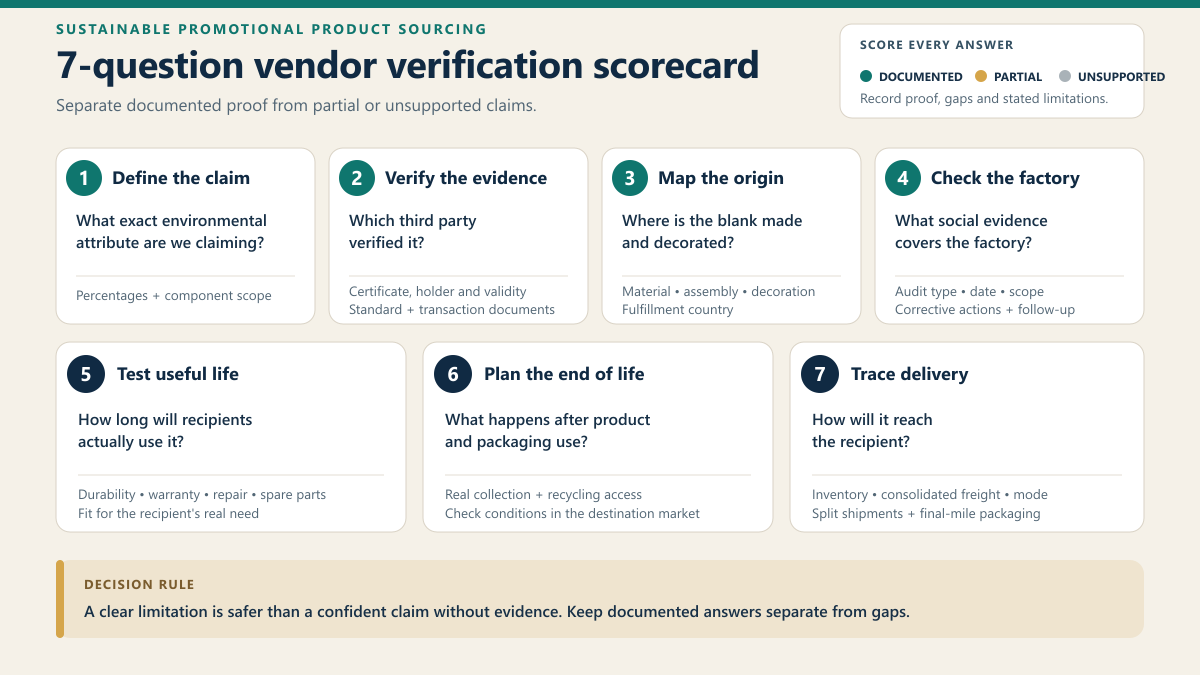
A seven-question vendor scorecard
Ask every vendor the same questions:
- What exact environmental attribute are we claiming? Request percentages and component scope.
- Which third party verified it? Obtain certificate number, holder, validity, standard, and transaction documents if applicable.
- Where is the blank product made and decorated? Separate country of material, assembly, decoration, and fulfillment.
- What social-compliance evidence covers the factory? Ask for audit type, date, scope, corrective actions, and follow-up.
- How long will recipients use it? Review durability, warranty, repair, spare parts, and usefulness.
- What happens to product and packaging after use? Check real collection and recycling access in the destination—not theoretical recyclability.
- How will it reach the recipient? Compare local inventory, consolidated freight, air versus ocean or rail, split shipments, and final-mile packaging.
Score answers as documented, partially documented, or unsupported. A clear limitation is safer than a confident claim without evidence.
Certifications worth understanding
Certifications are not interchangeable.
- FSC: forest-based material and chain of custody. Check whether it covers paper, wood, packaging, or the full product.
- GRS / RCS: recycled content and chain-of-custody controls, with different requirements and scopes.
- GOTS: organic textile processing with environmental and social criteria across certified stages.
- OEKO-TEX STANDARD 100: testing for specified harmful substances in textile components; it is not a complete lifecycle certification.
- bluesign: input and process controls used in textile supply chains.
- B Corp: certification of a company, not automatic certification of each product it sells.
- ISO 14001: an environmental-management system standard, not proof that a specific item has lower impact.
- EcoVadis: a company sustainability assessment and rating, not a product ecolabel.
Always connect the certification to the precise claim you plan to make.
Common sourcing mistakes
Mistake 1: replacing plastic with bamboo without a full specification
“Bamboo” does not explain binders, coatings, adhesives, treatment chemicals, source, durability, or disposal. Specify construction and request evidence.
Mistake 2: ordering a sustainable item nobody wants
Recipient fit comes first. A smaller quantity of a useful, durable product is often better than a large quantity selected because the unit price is low.
Mistake 3: ignoring decoration and packaging
A water-based ink, laser engraving, removable label, mono-material design, or packaging reduction may improve the finished program. Review these choices before sampling.
Mistake 4: using a company certification as a product claim
A B Corp distributor can sell items with very different material profiles. An ISO-certified factory can produce both conventional and preferred-material products. Verify the SKU.
Mistake 5: air-freighting a rushed order by default
Late planning can force high-cost, high-emission transport. Freeze the brief earlier, consolidate cartons, and compare regional stock with direct production before committing.
Frequently asked questions
What is the best eco-friendly promotional product vendor?
There is no universal best. For eco-friendly corporate gifts, Fairware and Ethical Swag are strong for guided North American programs; Fluid Branding and XD Connects fit European channels; PCNA and Gemline support distributor catalogs; Eco Promotional Products offers a focused U.S. selection; and NicheSources fits custom factory sourcing.
Can I buy from every vendor directly?
No. PCNA, Gemline, and XD Connects primarily supply promotional-product distributors, so an end buyer may need to purchase through a local distributor. Fairware, Ethical Swag, Eco Promotional Products, Fluid Branding, and NicheSources can work more directly with qualifying buyers, but order size, geography, and service scope still determine the correct channel.
How should I compare eco-friendly swag vendors?
Give each supplier the same brief and score its response on product-level evidence, useful life, responsible production, decoration, packaging, fulfillment, lead time, and total landed cost. Separate documented answers from unsupported claims. A vendor that clearly explains a limitation is usually easier to evaluate than one that labels every item sustainable.
Can custom eco promotional products be private labeled?
Yes. A sourcing partner can coordinate custom materials, colors, molds, decoration, packaging, and labeling. Start with a written claim and evidence requirement, then follow a structured private-label process covering samples, testing, quality control, production, and freight.
What documents should sustainable branded merchandise companies provide?
Ask for the product specification, bill of materials, certificate and scope, certificate holder, country of origin, social-audit summary, safety or chemical test reports, decoration details, packaging specification, approved sample, inspection report, and freight plan. For recycled promotional products, also request recycled-content and transaction evidence where relevant. Requirements vary by material and destination.
How can I tell whether a promotional product is really sustainable?
Ask for the exact material percentage, product-level certification, certificate scope, factory information, decoration details, packaging, expected lifetime, and realistic end-of-life route. Avoid relying on broad labels.
Are bamboo promotional products always better than plastic?
No. The result depends on construction, chemicals, durability, transport, and disposal. A durable recycled-plastic item may outperform a short-lived bamboo composite. Compare the complete product.
Which certifications should I request?
Match the certification to the material and claim: FSC for forest inputs, GRS or RCS for recycled content, GOTS for organic textiles, and relevant product-safety or chemical tests for the destination market.
Is direct factory sourcing more sustainable than buying locally?
Not always. Direct sourcing can improve material control, customization, packaging, and shipment consolidation at volume. Regional stock can shorten lead time and may avoid emergency air freight for smaller orders. Compare the full product, route, transport mode, packaging, and order size in both scenarios.
What is a reasonable minimum order quantity?
It varies by blank product, decoration method, material, certification, and customization. Stocked products generally allow lower minimums than custom molds, fabrics, colors, or packaging. Request quotes against the same complete specification so the quantities, setup costs, testing, and lead times are comparable.
What to do first, next, and later
First: define the campaign and the claim
Set the audience, intended use, quantity, destination, deadline, and budget. Replace a broad promise such as “eco-friendly” with a specific attribute you can verify, such as recycled content, certified fiber, organic textile input, reusable design, or reduced packaging.
Next: shortlist and verify
Compare vendors by service region, sourcing model, decoration capability, documentation, and fulfillment support. Review the blank product, decoration, packaging, and freight as one specification, then approve a physical sample before making public claims. Teams that need a wider factory search can review NicheSources’ product sourcing service.
Later: approve production and preserve the evidence
Inspect production against the approved sample and tolerance plan. Keep certificates, test reports, material declarations, artwork approvals, and inspection records together so procurement, marketing, and compliance teams can support the finished claim.
Final verdict
The best eco-friendly promotional product vendors do not merely sell greener-looking objects. They help buyers make a defensible choice: a useful product, a verified material story, responsible production, suitable customization, and a supply chain that fits the order.
Use a regional catalog vendor when speed, low quantity, and program management matter. Use direct factory sourcing when volume and differentiation justify deeper development. In both cases, treat transparency as a purchasing requirement—not an optional marketing extra.
Need a custom product, verified factory, branded packaging, quality inspection, and international freight in one workflow? Request a free sourcing quote from NicheSources and include your target market, quantity, material claim, certification, deadline, and budget.