If you’re thinking of selling stockings, private label custom socks, or compression socks, this list of the best private label hosiery manufacturers is exactly what you need.
Selling your own brand of hosiery products is a lucrative eCommerce opportunity since it’s a relatively unsaturated niche.
But, that’s what makes it challenging to find hosiery manufacturing partners with the right production capacity.
So, we’ll help you out by sharing our research. Let’s jump right in.
Our Picks for the Top Private Label Hosiery Suppliers
If you’re still unable to make up your mind then here are our top picks based on customer service, production capability, product quality, and more.
Each of these suppliers has been carefully selected to help you find the perfect partner for your private label hosiery requirements.
| Supplier Name | Best For | Location | Products Offered |
| NicheSources | Ideal for small to large businesses seeking flexibility in order quantities and customization options. | China | All sorts of hosiery and a range of other products |
| VMC Vignoni | Reliable partner for high-quality Italian-made hosiery and seamless garments; flexible order sizes. | Italy | Socks, tights, compression stockings, seamless garments |
| Pamela Mann Wholesale | Perfect for fashion-forward brands wanting trendy, customizable hosiery options. | United Kingdom | Tights, leggings, socks, and more |
| Central Carolina Hosiery | Great for businesses developing a comprehensive range of branded hosiery products. | USA | Tights, leggings, footed pantyhose |
| Mariflos | Best for brands prioritizing sustainability with eco-friendly, customizable hosiery products. | Italy | Footlets, knee highs, hold-ups, stockings for suspender belts |
In private label hosiery, “premium” quality comes down to how a sock is made, finished, and how well it holds up after repeated wear and washing.
In 2026, branding alone doesn’t separate premium socks from mass-market ones, manufacturing decisions do.
When we evaluate factories in the Zhuji Datang cluster, these are the technical factors that consistently determine whether a sock performs at a premium level or not.
Needle Count and Fabric Density
Needle count has a direct impact on fabric smoothness, density, and shape retention, and it also tells you a lot about the type of factory you’re dealing with.
- 144 needle (144N): Common across large export factories. Suitable for basic casual socks and cost-driven programs. Fabric is functional but less refined, with more visible stitch structure.
- 168 needle (168N): Often considered the starting point for premium private label socks. Produces a smoother fabric with better elasticity control and durability. Many sports and lifestyle brands use this range.
- 200 needle (200N): Used for higher-end dress socks and refined fashion lines. These machines run slower and require more experienced operators, which is why they’re more common in smaller, specialized factories.
Agent insight: Factories running true 168N and 200N lines in Zhuji Datang are often not the same ones dominating Alibaba listings. Many focus on smaller runs and selective clients rather than volume contracts.
Toe Construction and Wearing Comfort
Toe construction is one of the clearest indicators of build quality and long-term comfort.
- Hand-linked toes create a flat, seamless finish that reduces friction and pressure points. This is standard for premium dress socks and performance socks.
- Machine-closed toes are faster and cheaper but leave a raised seam that can become uncomfortable with extended wear.
Agent insight: One of the most common quality issues we see is factories switching toe-closing methods between sampling and bulk production. This is why toe construction needs to be verified during production, not just at the sample stage.
Materials and Yarn Quality
Premium socks use higher-grade materials, but consistency matters more than material names.
- Combed cotton is preferred over carded cotton for its smoother feel and better resistance to pilling.
- Bamboo fiber and modal blends are often used for softness and moisture control, but quality varies widely depending on yarn source and blending ratios.
- Elastic fibers (spandex or nylon) must be balanced carefully to provide stretch without stiffness or early fatigue.
Agent insight: Two factories can quote the same material blend and deliver very different results. We evaluate yarn quality through wash and stretch testing, not spec sheets alone.
Elasticity and Shape Retention
A premium sock should maintain its shape over time.
Key things we look for include:
- Even rib tension at the cuff
- Consistent stretch and recovery
- Minimal loosening after repeated washing
Factories capable of controlling elasticity tend to run tighter production schedules and reject unstable yarn batches, which limits how many orders they can take on at once.
Batch Consistency and Finishing
Premium quality must be repeatable across production runs.
This includes:
- Accurate size grading from batch to batch
- Consistent dye penetration, especially in darker colors
- Clean finishing with minimal loose threads or internal friction points
In practice, this level of consistency usually comes from smaller, well-controlled production lines, rather than large exporters optimized for volume.
16 Best Private Label Hosiery Manufacturers
As promised, here’s our list of the best private label hosiery manufacturers we could find on the market in 2024. Choose your pick:
1. Alibaba
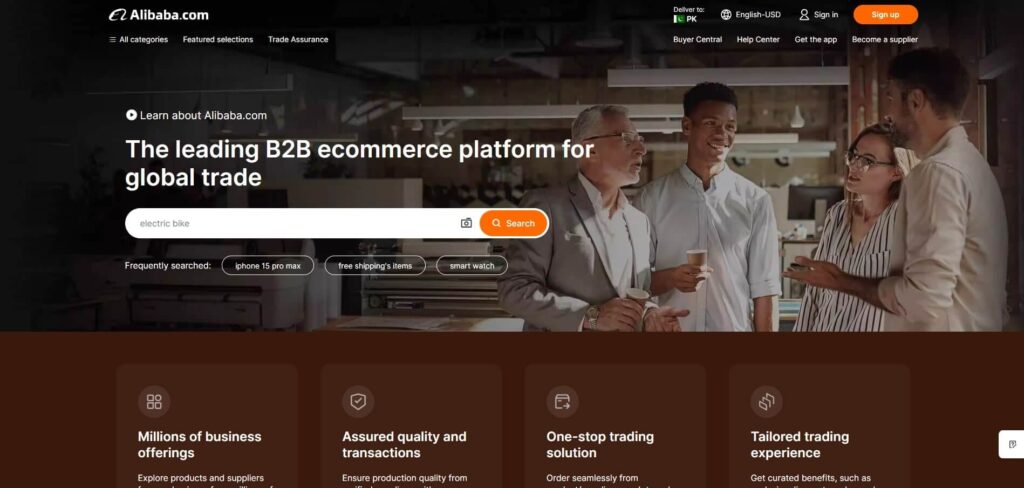
We have to start this list with the leading B2B marketplace globally – Alibaba.
As a platform oriented to bulk orders, Alibaba is a great place to start looking for private label hosiery manufacturers.
When searching Alibaba for suppliers, always look at the product or supplier reviews.
On each product listing, you’ll see options to contact the supplier or chat with them. Use these methods to reach out and ask everything you want to know.
Needle/Machine
Varies by seller, filter for listings that explicitly mention 144N/168N/200N and ask for machine photos/spec sheet before sampling.
MOQ
Varies greatly depending on the supplier, with minimum order quantities ranging from a few hundred to thousands of units.
Pros
- Access to a broad range of suppliers, making it easier to find a manufacturer that suits your brand and budget.
- Due to bulk orders, many suppliers offer competitive pricing, which allows for better profit margins.
- Many suppliers offer a wide range of customization options for private labels.
- Trade assurance helps protect buyers in the event of quality or shipment issues.
Cons
- With so many suppliers, quality can vary significantly based on supplier reviews and ratings.
- Due to many suppliers being based in Asia, shipping times to other regions can be extended.
- Some suppliers may have language barriers, making communication difficult at times.
- Some suppliers on Alibaba set high minimum order quantities, which may not be ideal for smaller businesses.
2. VMC Vignoni
Vignoni has been a trustworthy hosiery manufacturing partner to many European brands and retailers.
They are known for their advanced knitting technologies and innovative designs.
With them as your supplier, you can build a custom hosiery brand from scratch and start selling a variety of personalized hosiery designs.
Needle/Machine
Specs aren’t shared publicly. If you’re sourcing tights/hosiery here, request machine gauge + denier range and confirm toe/waistband finishing standards.
MOQ
Varies depending on the specific requirements, but they are known for offering flexibility in production quantities.
Pros
- High-quality, Italian-made products
- Full customization and flexibility for private label clients
- Strong experience in the European hosiery market
Cons
- Primarily focused on the European market, so shipping and logistics might be less convenient for non-European clients
- Potentially higher pricing compared to non-European manufacturers
3. Mariflos
Mariflos is a well-known Italian private label manufacturer selling wholesale throughout Europe.
With them, you can create a brand and sell knee highs, hold-ups, stockings, tights, leggings, capris, or disposable socks.
Mariflos is a full-service partner that has an in-house graphic design team that can design and print all your custom graphics and branding on the packaging.
They are ideal for brands that prioritize sustainability and wish to offer eco-friendly hosiery products with a “Made in Italy” stamp.
Needle/Machine
Needle count is not published. Ask whether they run 168N+ for premium socks (if socks) or request gauge/denier (if tights).
MOQ
Mariflos doesn’t explicitly state their minimum order quantity (MOQ) on the website, so contacting them directly is recommended for further details.
Pros
- Strong sustainability focus, using recycled materials
- High-quality products with certifications
- Customization and private labeling options available
- OEKO TEX certification for sustainability
Cons
- MOQ details are unclear and might require direct contact
- Their products, while eco-friendly, may be more expensive due to the use of premium materials like recycled polyester
4. Calzificio Argopi
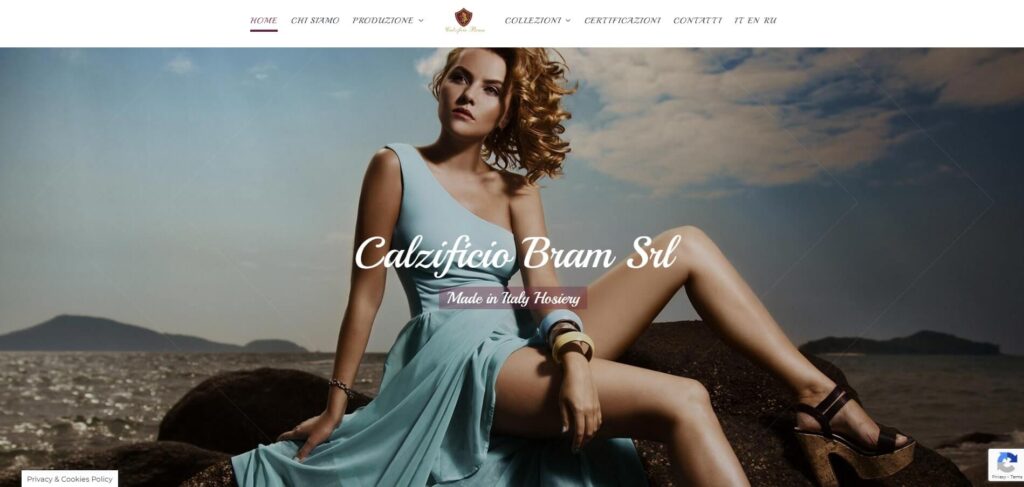
Argopi is another great Italian private label hosiery supplier that can help you customize items like knee highs, socks, leggings, classic tights, and more.
The company is known for its commitment to craftsmanship and the use of advanced technology in production.
This is an ideal manufacturer if you’re interested in selling plus-size hosiery since they have a lot to offer.
Needle/Machine
Not disclosed publicly. Request the factory’s machine range (sock needle counts or hosiery gauge), plus the toe construction method used in bulk runs.
MOQ
- Minimum order quantity of 50 pieces for tights and thigh-highs
- Minimum order quantity of 25 pieces for seamless garments
Pros
- Strong emphasis on quality and comfort in products
- Efficient production and delivery timelines
- Ability to create personalized collections for brands
Cons
- Minimum order quantities may be higher compared to some other suppliers
- Primarily focused on the European market, which might limit shipping options for international clients
5. Sanyleg
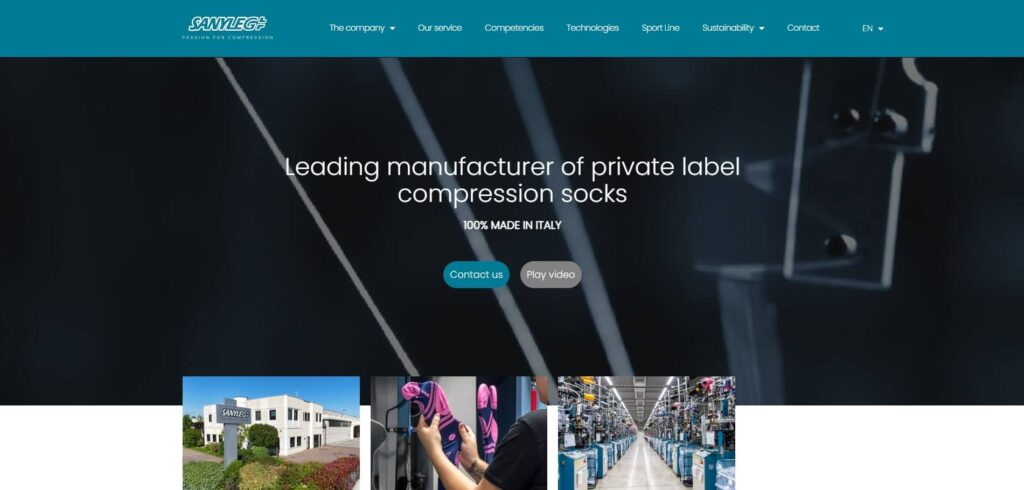
Sanyleg is a bit different from the other suppliers in terms of product types.
If you’re more into the health and wellness niche, you might be interested to know that Sanyleg is a private label and OEM manufacturer of compression socks.
They sell medical stockings, sports stockings, and graduated compression socks under a private label agreement. So, if that sounds interesting, give them a try.
Needle/Machine
Not listed publicly. Ask for needle count options for socks and confirm whether higher-needle lines are available for dress/luxury SKUs.
MOQ
Minimum order quantities typically start from 200 pieces, depending on the product.
Pros
- Commitment to sustainability and ethical production
- Extensive experience in the hosiery industry, ensuring high-quality products
- Strong customer support for new and existing clients
Cons
- Higher minimum order quantities may pose a barrier for smaller brands
- Limited customization options for very small orders
6. Pamela Mann Wholesale
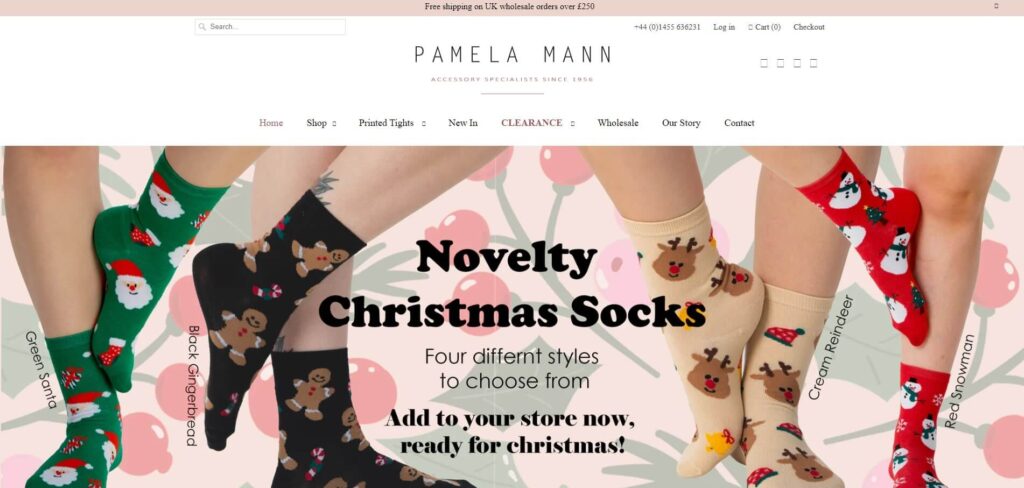
Pamela Mann is one of the largest UK private label hosiery suppliers.
They offer a full-service private label agreement and a wide range of products to choose from: leggings, fishnets, stockings, tights, socks, plus-size hosiery, and more.
With a commitment to innovation and creativity, Pamela Mann is a go-to choice for retailers looking to stand out in the hosiery market.
Needle/Machine
This is a wholesale brand/supplier, not a factory listing, needle count depends on their OEM. Request tech packs/spec sheets per SKU if private label is possible.
MOQ
Starts from a quantity of 60 pairs of standard styles and colors. For exclusive printed designs the quantity rises to 130 pairs.
Pros
- Strong reputation for stylish and unique hosiery options
- Comprehensive private label service with support throughout the process
- Ability to keep up with the latest fashion trends
Cons
- Higher minimum order quantities may limit options for smaller brands
- Pricing may be on the higher end compared to less fashion-focused competitors
7. Stilnovo
Stilnovo is another established Italian manufacturer known for its high-quality hosiery.
They produce items like tights, knee-highs, thigh-highs, socks, and seamless bodywear for women.
Stilnovo offers private labeling and branded packaging, and a choice of different synthetic or natural fiber materials.
Needle/Machine
Not stated publicly. Confirm whether production is socks vs hosiery, then request either 144N/168N/200N (socks) or gauge/denier (tights).
MOQ
They haven’t started the minimum order quantities on their website. It’s best to contact them for confirmation.
Pros
- Strong emphasis on quality and durability
- Flexibility in product design and customization
- Established reputation in the hosiery market
Cons
- Minimum order quantities may not suit very small businesses
- Lead times for production may vary depending on customization complexity
8. Jong Her Hosiery
This hosiery supplier is a bit different than the rest since they’re based in Taiwan.
However, they earned a spot on this list since they offer professional OEM services and customized socks for every need.
With Jong Her, you can private-label items like cycling socks, compression socks, eco-friendly socks, outdoor socks, technical sports socks, women’s hosiery, and more.
Needle/Machine
If they produce socks at scale, ask directly which lines they run (144N/168N/200N) and whether toe linking is hand-linked or machine-closed.
MOQ
Minimum order quantities generally start at around 1,000 pairs, but this may vary based on specific requests.
Pros
- Strong commitment to quality and customer satisfaction
- Capability to produce a wide range of hosiery styles
- Established experience in the hosiery market
Cons
- Higher minimum order quantities may not be feasible for smaller brands
- Lead times can vary depending on production demands
9. Ladykama (b2btights)
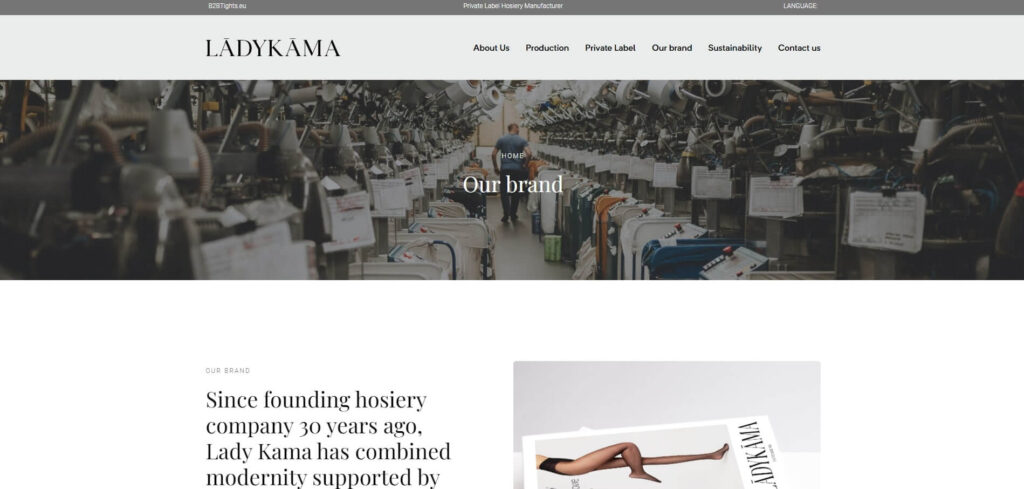
Ladykama is the brand of b2btights, an Eastern European private label hosiery manufacturer selling wholesale throughout Europe.
With them as a supplier, you can private label different hosiery such as smooth tights, patterned tights, stockings, cabaret, leggings, knee-high socks, and socks.
Ladykama emphasizes quality, comfort, and fashionable designs, making it an attractive choice for businesses looking to enter the hosiery market.
Needle/Machine
Tights suppliers usually talk in gauge/denier rather than needle count. Ask for gauge options, denier coverage, and whether toe is reinforced or seamless.
MOQ
Not directly mentioned on their website, but it’s likely to be around 1,000 due to their high production capabilities.
Pros
- Wide range of fashionable designs and styles
- Flexibility in order sizes and customization
- Good reputation for quality and reliability in the market
Cons
- Higher minimum order quantities may limit options for smaller brands
- Pricing may vary significantly based on customization and order specifics
10. Marygold
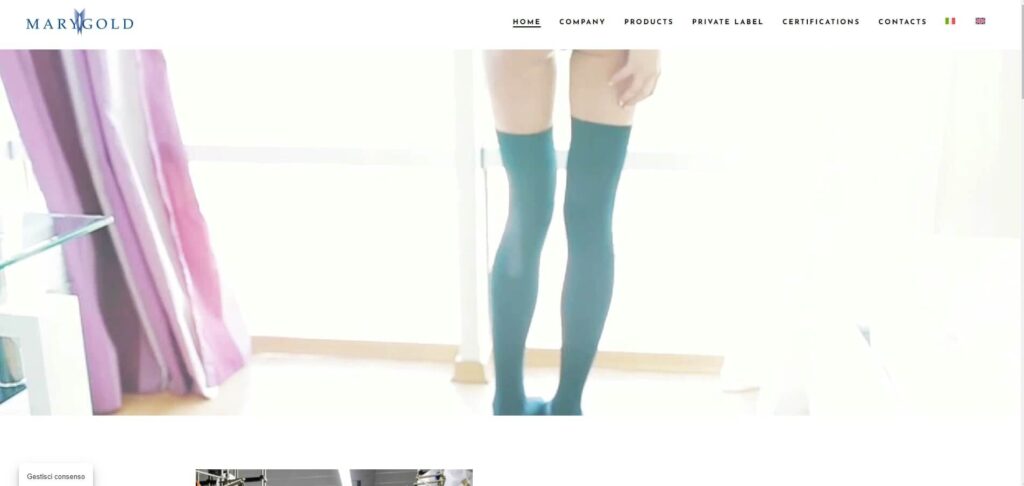
Our next third-party hosiery manufacturer is Marygold – an Italian-based hosiery supplier with a production capacity of an incredible 75,000 pairs of tights per day!
With a commitment to quality and style, MaryGold serves a diverse range of clients, from boutique brands to larger retail chains.
So, if you’re looking for a supplier that can scale together with you, Marigold could be a good option.
Needle/Machine
Not public. Request machine capability (needle count for socks / gauge for hosiery) and confirm batch consistency controls.
MOQ
No info for minimum order quantity is listed. Contact them directly for any inquiries.
Pros
- High-quality materials and craftsmanship
- Wide range of styles and sizes available
- Customization options to cater to specific brand identities
Cons
- Higher minimum order quantities may not be suitable for startups or small brands
- Pricing can be competitive but varies based on customization levels
11. Central Carolina Hosiery
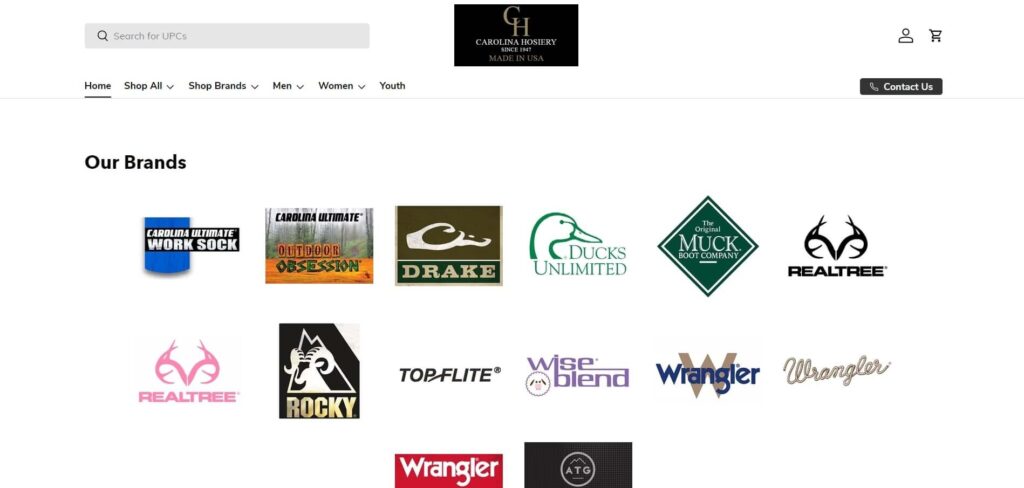
If you’re on the market for a US hosiery supplier, we’ve got your back. Central Carolina Hosiery is a leading American private label pantyhose manufacturer with a wide product selection range.
With Central Carolina as a supplier, you can make a brand reselling tights, fishnets, knee highs, sheer pantyhose, and more.
Needle/Machine
Confirm whether they’re producing socks or hosiery, then request the relevant spec: needle count for socks or machine gauge for hosiery items.
MOQ
Depends on the pack you order such as 6 single pairs, 4 three pair packs and so on.
Pros
- Focus on quality control and customer satisfaction
- Extensive selection of hosiery styles and options
- High-quality hosiery with a strong emphasis on durability and comfort
Cons
- Pricing can be competitive but may vary based on customization and order size
12. Everything Legwear
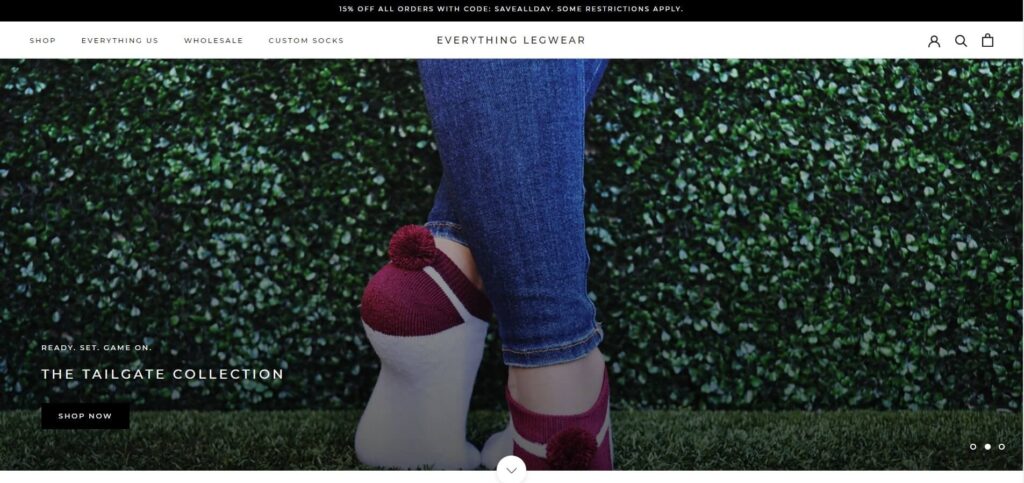
Everything Legwear is a Texas-based private label hosiery manufacturer that offers a full-service experience from concept, design, prototyping, and sampling to packaging and preparation for shipping.
They offer an assortment of products for private labeling including knee-high stockings, tights, socks, thigh highs, and more.
Needle/Machine
Primarily a retailer/wholesaler, needle count depends on the manufacturing partner. If private label is offered, request factory spec sheets and target 168N+ for premium sock lines.
MOQ
Minimum product quantity is 1,000 for all custom products.
Pros
- Diverse product offerings suitable for different markets
- High-quality materials used in production
- Flexible customization for branding and unique designs
Cons
- Higher MOQs may not suit smaller businesses or startups
- Lead times for production can vary depending on order size and complexity
13. Calzificio Bram
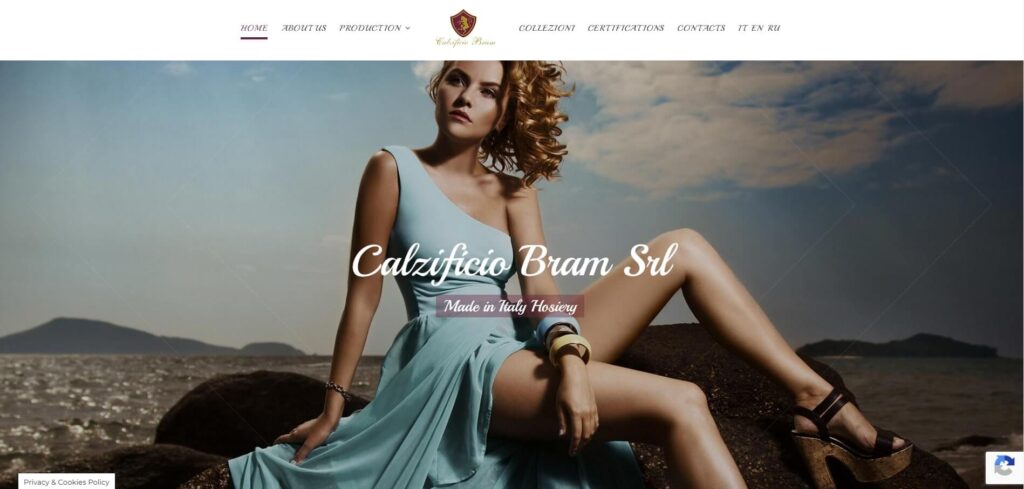
If you choose Bram as your hosiery manufacturer, you can choose between a range of knee highs, socks, women tights, and girl tights.
All in all, they have over 1500 products to choose from and they offer a full-service production cycle – from designing and manufacturing to packaging.
Their dedication to quality and sustainable practices positions them as a reliable partner for businesses in the fashion industry.
Needle/Machine
Not publicly disclosed. Ask which lines they run and request a production spec sheet (needle/gauge) aligned to your target quality tier.
MOQ
They have not exclusively mentioned a minimum order quantity, so it’s likely negotiable.
Pros
- Strong emphasis on quality craftsmanship
- Customization options provide brands with unique offerings
- Established reputation in the hosiery market
Cons
- Higher minimum order quantities may be challenging for smaller brands
- Production lead times may vary depending on customization requests
14. P.L.U.S. Collants
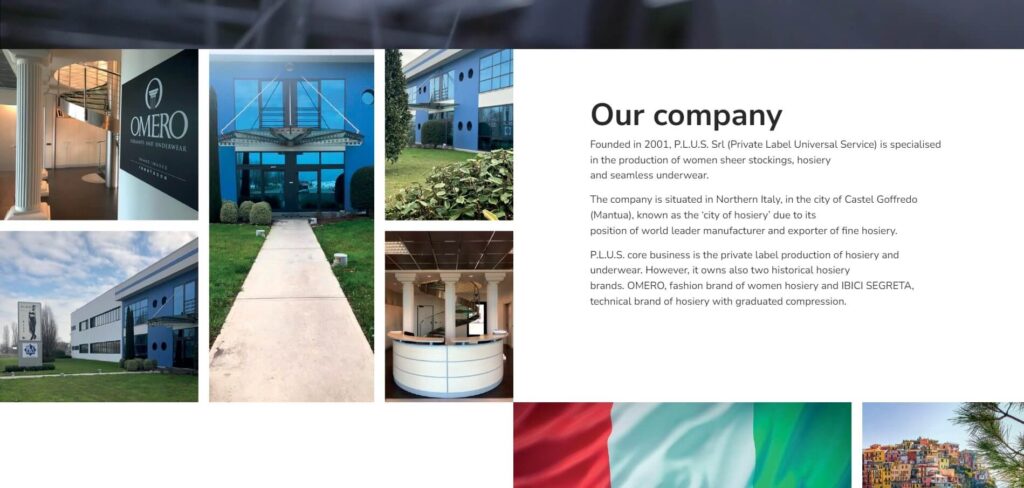
Established in 2001, P.L.U.S. is an Italian women’s hosiery and stocking manufacturer with private labeling as its core business model.
The company operates out of Castel Goffredo, a hub known for hosiery manufacturing.
With P.L.U.S. as a hosiery manufacturing partner, you can customize and develop your products however you want.
Needle/Machine
Collants/tights producers usually specify gauge + denier rather than “needle count.” Request gauge options and finishing details (toe, waistband, run-resistance).
MOQ
They have not shared any direct information about minimum order quantity.
Pros
- Strong focus on eco-friendly production with sustainable materials.
- High standards in dyeing and quality control, certified OEKO-TEX® for safety and quality.
- Wide range of customization options.
Cons
- Minimum order quantities may not suit smaller brands.
- Lead times could vary based on order complexity.
15. Madison Hosiery Limited
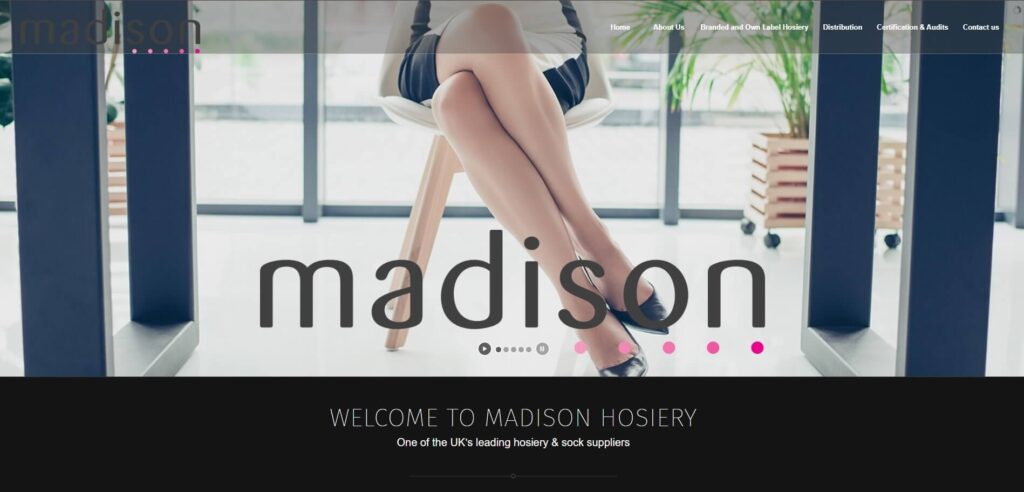
Madison Hosiery is a UK-based private label hosiery manufacturer that works on both Ex-Works and FOB bases.
Established over 50 years ago, it offers a wide range of products such as tights, socks, and leggings for women, men, and children.
Madison works with various retailers across the UK and beyond, focusing on delivering quality products and maintaining ethical manufacturing standards.
Needle/Machine
Not listed publicly. Confirm whether they can support higher-spec programs (e.g., 168N+ socks) and ask for samples tied to the exact machine line used for bulk.
MOQ
Madison Hosiery typically handles large-scale orders, with minimum order quantities (MOQ) starting at around 10,000 pairs depending on the product type and customization requirements.
Pros
- Long-standing experience in the hosiery industry.
- Wide range of products and customization options.
- Strong focus on ethical manufacturing and quality standards.
Cons
- High minimum order quantities may not suit smaller brands.
- Lead times could be affected by the scale of customization and production demand.
16. NicheSources
If you’re still unsure about the hosiery manufacturer that’s suitable for your needs, maybe we can help.
Niche is an industry-leading product sourcing and dropshipping agent that can help you find high-quality hosiery at affordable prices.
Our specialization in private labeling is supported by our extensive experience in the Chinese market You can get started by requesting a free quote.
Needle/Machine
We confirm the right machine setup during sourcing, 144N for standard, 168N for mid-premium, and 200N for high-end sock programs, and gauge/denier for tights, then verify during sampling/production.
MOQ
Our minimum order quantity is negotiable based on product requirements. You can directly contact us for any inquiries.
Pros
- Ability to source a wide range of products.
- Customized solutions for branding and packaging.
- Support for various business sizes, making it accessible for startups.
- Extensive experience in the Chinese manufacturing landscape.
- Logistics management services to streamline shipping and fulfillment processes.
Cons
- Depending on product specifications, lead times may vary.
Why We Source from Zhuji Datang (The World’s Sock Capital)
Zhuji Datang has become the center of global sock manufacturing for a reason.
The entire production chain is concentrated in one area, and that creates a level of consistency and specialization that’s difficult to find elsewhere in China.
For private label hosiery, this is where most of the reliable, technically capable factories are based. Let’s see why Zhuji Datang is the best place to source hosiery.
A Region Built Around One Product
Unlike general textile regions, Zhuji Datang focuses almost entirely on socks. Knitting, toe-linking, boarding, finishing, packaging, everything happens locally.
This makes production smoother and helps factories maintain steadier quality from one batch to the next.
Many Good Factories Aren’t Listed Online
A lot of the better 168N and 200N workshops don’t show up on Alibaba or have English websites. They’re small teams, often family-run, producing for domestic brands or long-term clients. Because they don’t advertise widely, most buyers never come across them when searching on their own.
Agent insight: Some of the most consistent factories we work with in Zhuji have no online presence. We usually find them through local networks and in-person visits.
More Flexibility for Growing Brands
Large export-facing factories are set up for high volume, which usually means higher MOQs and less room for customization. In Zhuji Datang, many of the smaller workshops offer:
- Better control over 168N–200N production
- More careful finishing
- Lower or more flexible minimums
For newer private label brands, this balance of quality and flexibility is hard to beat.
On-Ground Verification Makes a Difference
Because so many capable factories work quietly, confirming details like machine setups, toe construction, and yarn sourcing is still important.
A lot of issues, especially with toe seams or fabric consistency, come from subcontracted work, which is something you can only catch by checking production directly.
The Top Hosiery Factories in Zhuji Datang Area
If you want to source from Zhuji Datang without getting stuck with “export giants only,” these three factories are worth knowing. They’re all based in the sock-capital ecosystem, and each fits a slightly different type of private label program.
Quick note: MOQs and pricing aren’t consistently published for these suppliers, so we treat them as quote-on-request and confirm specs + capacity during outreach.
1) CJSocks (CJ Socks Factory)
Why it’s good: CJ is a strong option when you need broad product coverage + proven capacity, with the ability to run both standard and higher needle counts.
- Needle / machine capability: Lists capability across 84N, 120N, 144N, 168N, 200N.
- Capacity: States 150,000 pairs/day output.
- Certifications: Mentions amfori, SMETA, OEKO-TEX.
- Product range: Sports, compression, liner/low cut, anti-slip, kids/tights, thermal, toe socks, etc.
- Best for: Brands that want one factory to cover multiple sock categories (sports + casual + specialty) with stable production scale.
What we’d confirm before ordering: toe-linking method (hand-linked vs machine), yarn source consistency, and the exact needle count used for your SKU (because “supports 200N” and “runs your order on 200N” are not always the same thing).
2) Zhuji Datang Yuhong Socks Manufacturing Factory
Why it’s good: Yuhong looks like a solid mid-sized Datang producer with export experience and a broad hosiery range.
- Scale: Says ~100 employees and 100+ hosiery machines; established 2009.
- Product coverage: Men’s, women’s, kids/baby socks, sports socks, pantyhose, and more.
- Export footprint: Claims ~90% exported (US, Germany, Netherlands, Japan, etc.).
- Best for: Classic cotton socks + basic sports programs where you want a Datang factory that’s already comfortable with overseas requirements.
What we’d confirm before ordering: needle count options (not listed publicly), finishing consistency across batches, and whether any steps (toe closing / boarding / packaging) are subcontracted.
3) Zhejiang Zhuji Datang GEXIANG Socks Co., Ltd
Why it’s good: GEXIANG is positioned as a category-flexible Datang manufacturer with a very wide catalog, including men’s, women’s, sports, terry, jacquard, etc.
- Needle / spec signal: Their catalog references 168N men’s sock items (a common baseline for better private label quality).
- Range: Cotton, sports, feather yarn, airline, jacquard, terry, kids, etc.
- Best for: Brands that want to explore multiple sock styles (casual + sport + textured/terry) and narrow down the best-performing construction through sampling.
What we’d confirm before ordering: which SKUs can be produced at 168N vs higher needle counts, toe seam construction, and the factory’s realistic MOQ by style (simple cotton socks vs jacquard/terry can be very different).
How NicheSources Helps (so you don’t get stuck with high MOQs)
If you like these factories, we can help you source from them directly and also shortlist other Datang suppliers that don’t advertise online.
Most brands also want to compare samples across 2–3 factories, so we can handle sample consolidation (one combined shipment instead of paying separate courier fees for each factory). And if you’re selling on Amazon, we can also coordinate FBA prep and labeling so units arrive FBA-ready.
How to Avoid Quality Issues in Private Label Hosiery
Quality problems in socks usually come from a few specific points in the production process.
They’re easy to miss if you’re only looking at samples, but they show up later as customer complaints, poor reviews, or inconsistent batches. These are the areas we pay the most attention to when reviewing factories.
Toe Seams Are the First Thing Customers Notice
A raised or bulky toe seam is one of the most common comfort issues in socks. There are two main construction methods:
Hand-linked: Creates a flatter, smoother seam and is typical in better dress socks and higher-end lines.
Machine-closed: Faster and cheaper, but often leaves a thicker ridge that becomes noticeable during wear.
The challenge is that some factories will hand-link samples but switch to machine closure during bulk production to save time. This is why toe construction needs to be checked during production, not just at the sampling stage.
Elasticity Fatigue Happens When the Yarn or Tension Isn’t Controlled Well
A sock that loses its shape after a few washes is usually the result of uneven rib tension, poor yarn quality, or a blend that doesn’t recover properly.Key signs to look for include:
- Socks that become loose at the cuff
- Uneven stretch between pairs
- Shape distortion after washing
Better factories test elasticity and recovery repeatedly, not just on the final product. Cheaper lines rarely do this, which is why two “identical” 168N socks from different suppliers can perform very differently.
Check for Subcontracting on Critical Steps
In some workshops, knitting is done in-house but toe linking, boarding, or finishing may be subcontracted. This is where consistency tends to slip, especially with color matching in darker shades or seam quality.
A reliable factory will be transparent about which steps they perform themselves and which they outsource, and will be willing to let you inspect those steps.
Agent insight: Many quality issues aren’t visible in samples. They show up when a factory rushes bulk production or splits the order across multiple subcontractors. On-the-ground checks help catch this early.
Consistency Across Batches Matters as Much as the Initial Sample
Getting a great sample doesn’t guarantee a great bulk run. Variations in yarn lots, machine settings, or finishing can lead to noticeable differences between orders. Good factories control for this by:
- Keeping machine settings fixed across runs
- Using yarn from the same batch when possible
- Checking size grading throughout production
This is especially important for brands selling multi-packs or color sets where uniformity is noticeable.
FAQs about Starting a Private Label Hosiery Business
Now, let’s look at some of the most frequently asked questions on the subject of starting a private label hosiery business.
What Is Hosiery?
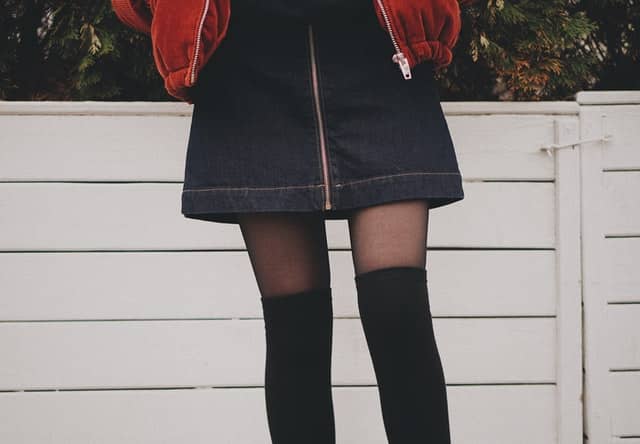
Hosiery, otherwise known as legwear, is everything we wear on our legs and feet. For instance:
- Socks
- Ankle socks
- Knee-high socks
- Stay-ups
- Thigh-highs
- Tights
- Fishnets
- Leggings
- Stockings
What Are Private Label Hosiery Manufacturers?
Private label hosiery manufacturers are companies with capacities to produce high quantities of a certain type of product which they then private label and customize with a client’s brand.
Typically, private-label suppliers sell custom products with a certain MOQ and make product branding and personalization agreements with brands.
What Is a Private Label Brand?
A private label brand, in this case, a hosiery brand, sources its products through a third party (aka. private label supplier) instead of manufacturing them in-house.
For example, Nike is a good example of a private label brand.
They source their shoes from a third-party supplier, then modify them, and their logo, and sell them under the Nike brand.
How Do I Start a Hosiery Business?
Let’s see the whole process step by step:
Step 1: Product and supplier research
This time, we’re going to skip the whole “finding a niche” step since we already have a broad niche.
Now, what you need to do is find the sub-niches or hosiery products you want to sell.
The easiest way to find what you like is by checking out the suppliers and what they have to offer. Then, decide on what makes the most sense for you to sell and has satisfying profit margins.
Always make sure to read product and/or supplier reviews, and order a sample before placing a bulk order.
Step 2: Get in touch with a supplier
Once you’ve isolated one (or several) suppliers that offer the types of hosiery you need, it’s time to reach out.
At this point, we encourage you to ask as many questions as possible upfront and map out all the details:
- What is their production capacity?
- Do they offer private labeling and white labeling?
- Can they help you make the customizations needed?
- What’s their production lead time?
- Can they help you drop ship and fulfill orders?
- Can they warehouse your bulk order?
- What are their prices?
- What’s their MOQ?
- What shipping methods do they offer?
- Can they send you a sample first?
- What’s their quality control process?
Step 3: Requirements and a quote
Now, it’s time to submit your product specifications and ask for a quote.
Be as specific and as detailed as possible when explaining the product you expect. Give exact materials, photos, designs, color codes, sizes (in inches and cm), etc.
This is the point where you show them your branding and customization requirements.
Make it as clear as possible to avoid miscommunication and misunderstandings.
Then, wait for a quote.
Step 4: Order a sample
If the quote you received is ok for you, it’s time to order a sample.
We recommend against ordering in bulk without seeing a sample first.
By asking for a sample, you’ll check the product quality and the delivery and shipping time. Like this, you’ll know what your customers will receive.
Step 5: Place an order
Liked the sample you got? Then it’s time to place your first order.
Agree on everything written upfront to protect your assets and get what you’ve ordered.
Step 6: Storage, warehousing, and order fulfillment
Before your order arrives, you need to take care of storage. There are typically three options in play:
- Your manufacturer will agree to store and dropship
- You will organize storage and warehousing on your own
- You will collaborate with a product sourcing and dropshipping agent
Next, you need to take care of order fulfillment – who will package and ship the products to your customers?
You have several choices:
- A supplier that’s also a fulfillment agent
- Fulfill orders manually by yourself (you organize storage and shipping services)
- Work with a dropshipping agent
Step 7: Online store and product import
Now, it’s time to build your store and add your products.
First, choose a store builder like Shopify or WooCommerce, and connect your domain.
Then, use the sample you’ve ordered (order more if necessary) to take great product photos.
Upload them, and write catchy and SEO product headings and product descriptions.
Optimize the checkout process, place strategic CTAs, and you’re good to go.
The next thing is to optimize your brand’s online presence. Create social media accounts on the platforms where your audience hangs out, and start posting valuable content.
Build engagement before launching the actual store.
Step 9: Launch, market, sell
Finally, it’s time to launch, start marketing, and start selling.
You can use different organic or paid methods to bring traffic to your hosiery store.
Both are great. Just know that paid gives instant results, while organic (for instance, SEO) takes time to work.
It all depends on your goals and expectations.
What Are the Best Private Label Hosiery Manufacturers?
Above, we’ve given you a long list of some great private label hosiery manufacturers you can use. For instance – Alibaba, Mariflos, Sanyleg, Madison Hosiery, Everything Legwear, Marygold, and others.
To search for more, try searching Google for “private label hosiery manufacturers” and see what results you get.
How to Choose the Best Stocking Manufacturer?
Here are some things to be careful of when choosing a good private label hosiery supplier for your brand:
- Supplier or product reviews
- Minimum order quantity (MOQ)
- Price vs. quality ratio
- Manufacturing time
- Production capacity
- Shipping methods
- Payment dynamics and options
- Services offered (private label, white-label, packaging, dropshipping, etc.)
All of the above points have to fit your needs and budget. If you feel like you aren’t getting high-quality products yet still paying a lot, remember that you have tons of options out there.
Where Can I Find Private Label Custom Socks?
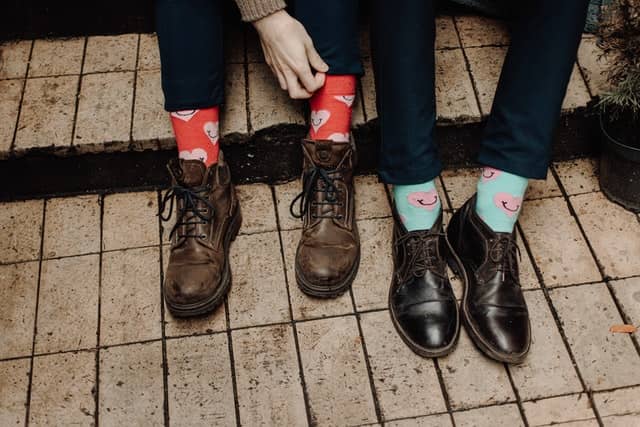
The majority of the hosiery manufacturers we mentioned above will be able to offer customized socks and private labeling.
However, if you’re looking for a more specific supplier or more options, try Googling, checking marketplaces like Alibaba, or working with a product sourcing agent.
What Are the Best Italian Hosiery Manufacturers?
Some of the best Italian hosiery manufacturers with private label services are Vignoni, Mariflos, Argopi, Sanyleg (for compression socks), Stilnovo, Marygold, P.L.U.S. Collants, etc.
What Are the Best Hosiery Manufacturers in the USA?
Some great hosiery manufacturers in the USA are Everything Legwear or Central Carolina Hosiery.
You could also search on B2B marketplaces like Alibaba for private label hosiery suppliers with warehouses in the USA.
Where Can I Find a Compression Socks Manufacturer?
You can use Sanyleg, an Italian private label manufacturer for compression socks we’ve mentioned above.
Another option would be searching on B2B marketplaces like Alibaba or IndiaMart.
And, finally, you can always turn to Google and search for something like “private label compression socks manufacturer”.
Can a Product Sourcing Agent Help Me Find Good Private Label Hosiery Manufacturers?
Of course. Collaborating with a full-service product sourcing agent who offers private labeling, white labeling, and product development services can help you build a proper brand from the ground up with much less effort.
With Niche as your agent, you can get started with zero costs and upfront obligations. You can request a free quote and see if you like what we offer.
To Summarize
If you’ve done your research on well-branded hosiery stores, you probably know how lucrative and full of possibilities this business can be.
The only thing you need is the right trustworthy supplier who’s ready to meet (and exceed) your needs.
Hopefully, this list of the 16 best hosiery suppliers will be useful to you. If you’re still struggling, get in touch.
Let us know your product details, and we’ll shoot over a free quote. We can find affordable private label hosiery manufacturers from China who sell consistent high-quality.

Your blog is a breath of fresh air in the crowded online space. I appreciate the unique perspective you bring to every topic you cover. Keep up the fantastic work!