A shipping mark pallet is a critical logistics tool that connects physical cargo to your Bill of Lading, ensuring accurate tracking and customs compliance.
For B2B buyers sourcing from China, even a minor typo or a label hidden under stretch wrap can trigger secondary inspections under 19 CFR Part 134, leading to hundreds of dollars in avoidable port storage fees.
This guide provides a professional blueprint for formatting your ship marks, verifying them against your packing list, and coordinating with Chinese suppliers to ensure your palletized goods arrive ready for immediate fulfillment without document disputes.
Key Takeaways
- A shipping mark pallet links physical cargo to your Bill of Lading. To avoid customs penalties, ensure marks match your paperwork character for character.
- You design the template; your China factory applies it.
- Don’t confuse shipping labels with ISPM 15 stamps. Stamps prove wood treatment, while labels track the shipment.
- Amazon FBA shipments may require specific pallet and box labels generated through the current Send to Amazon workflow.
- Use waterproof materials. Standard paper labels often smudge or tear during humid sea transit, leading to unidentified cargo at the port.
What Is a Pallet Shipping Mark?
A shipping mark pallet is a label or stencil placed on your bulk cargo so handlers can identify the shipment without opening any boxes. It links the shipment to your paperwork.
For U.S. imports, check whether the goods or their applicable containers require country-of-origin marking under 19 CFR Part 134. When required, the marking must identify the English name of the country of origin.
Why Are Shipping Marks Important?
A shipping mark pallet is essential as an ID card for your cargo. Imagine your factory in China is shipping 3 different orders to you at once. A proper mark tells everyone what they are looking at before they even touch it.
This is vital for shared container shipping where your goods sit alongside other importers’ products. These marks answer one specific question: “Whose cargo is this?“
Clear labeling helps various parties move your goods efficiently:
- Customs: Verifies legal “Made in China” markings required by 19 CFR 134.11.
- Forwarders: Prevents mixing your pallets with another buyer’s order during consolidation.
- Warehouses: Speeds up receiving, so your stock is ready for sale faster.
Don’t confuse a pallet mark with a carton mark. If you ship 200 boxes on 4 pallets, each box needs its own identification, while the pallets should be numbered “1 of 4” through “4 of 4.”
This two-tier system ensures that if a pallet is broken down for final delivery, the individual boxes still reach their destination. Keeping these marks synced with your B/L avoids costly document disputes and port storage fees.
Learn More: If you are sourcing through digital platforms, check out our guide on how Alibaba shipping works to better manage your logistics.
What Information Should a Pallet Shipping Mark Include?
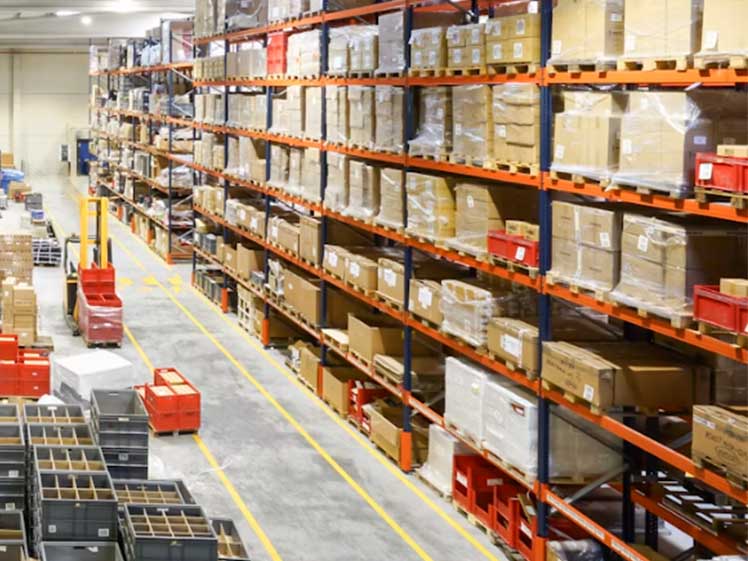
Clear pallet marks help warehouse and logistics teams identify and route cargo without opening the shipment. If labels are vague or missing, your goods might sit in a “mystery corner” of a warehouse for weeks while staff try to find the owner. Clear labeling ensures your cargo moves from the container to the shelf without manual searches.
Essential Data for Every Label
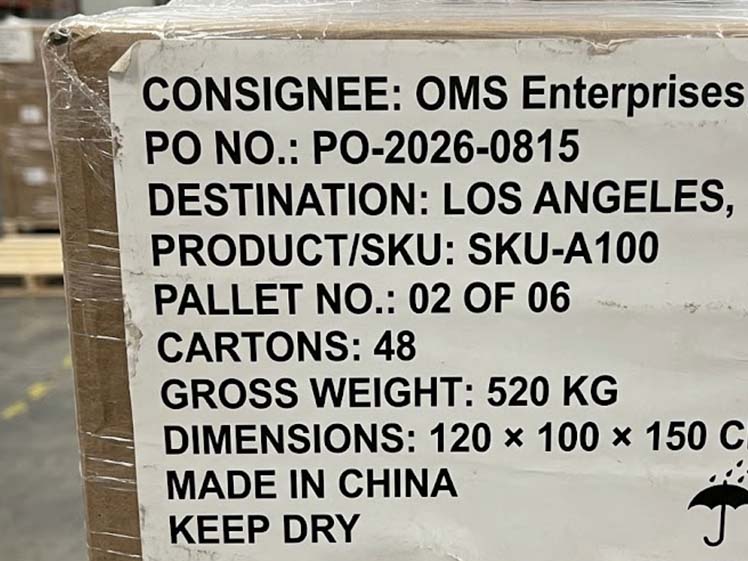
To keep your supply chain moving, include these specific fields on every unit:
- Consignee Reference: Use your legal business name. Avoid nicknames that don’t match your B/L.
- PO No.: This is the most critical field. It links physical boxes to your specific contract and prevents mixing old stock with new orders.
- Destination: List the warehouse or port code (e.g., “Port of Savannah” or “Amazon GYR3”).
- Pallet Sequence: Mark units as “1 of 5,” “2 of 5,” and so on. This helps drivers verify the piece count instantly.
- Country of Origin: For goods subject to U.S. country-of-origin marking requirements, “Made in China” may be used when China is the applicable country of origin.
Sorting Operational vs. Compliance Marks
| Types of Shipping Marks | Why It Matters | Practical Example |
| Operational | Logistics Tracking | PO-2026-0815 |
| Compliance | Customs Clearance | Made in China |
| Safety | Cargo Protection | Handling Icons (e.g., Keep Dry) |
| Inventory | Automated Receiving | SKU-A100 or SSCC Barcode |
Shipping Mark vs. ISPM-15 Stamp: What Is the Difference?
Importers often mix up a shipping mark pallet with an ISPM-15 stamp, but they serve different purposes. One helps your warehouse find your order. The other helps customs prevent the spread of invasive pests. If you ship solid wood pallets internationally, you need both.
What is an ISPM 15 Mark?
ISPM 15 is a global standard for treating raw wood packaging. According to the International Plant Protection Convention (IPPC), wood pallets must be treated to kill insects before they cross borders. While a shipping mark is usually a paper label, an ISPM 15 mark is a permanent stamp burned or inked into the wood.
A compliant heat-treated pallet stamp includes:
- The IPPC Symbol: A logo that looks like an ear of wheat.
- Country Code: For example, “CN” for China.
- Producer/Treatment Code: A unique ID for the treatment facility.
- Treatment Type: Usually “HT” for heat treatment.
Why This Matters for China Sourcing
Noncompliant WPM can delay cargo clearance and may require re-export or other corrective action. A paper label stating “Heat Treated” is not a substitute for the official ISPM 15 mark applied to compliant wood packaging material.
Before your cargo leaves the factory, ask for a photo of the stamp on the actual pallets. For U.S. imports, APHIS lists materials such as plywood, pressboard, and plastic pallets as alternatives that are not subject to its WPM regulation.
Check the destination country’s requirements before choosing different types of packaging materials.
Top-Rated China Freight Forwarder
Expert Shipping Solutions for Your Needs
Rules for Printing and Applying Pallet Shipping Marks
A perfect shipping mark pallet is useless if it falls off or is hidden under layers of plastic. Your labels must survive a long journey from a factory in China to your warehouse.
If a scanner can’t read the mark or a forklift driver can’t find it, your shipment will likely face delays and extra handling fees.
Durability and Placement
The ocean journey involves high humidity and rough handling. Standard paper labels often peel or smudge in these conditions. Use waterproof, adhesive-backed labels that stick firmly to the packaging.
- Apply On Top of Wrap: Always place labels outside the final layer of stretch film. Labels hidden underneath are often unreadable due to plastic glare.
- Two-Side Recommendation: For pallets, GS1 recommends placing the same logistics data on two sides so that one label remains visible from different handling directions.
These general logistics labels should not be confused with Amazon FBA’s separate pallet-label requirements. If you are shipping to Amazon, follow the current Send to Amazon instructions instead.
GS1 Barcode Standards
If your business uses automated tracking, barcode placement is not a guess. Following GS1 logistics standards ensures every warehouse system can scan your goods.
- Correct Height: For GS1 logistics labels, place the barcode between 400 mm and 800 mm from the pallet base where the pallet height permits.
- Keep It Flat: Never wrap a label around a corner or over a strap. Scanners need a flat surface to read the data correctly.
- Label Size: Choose a size that provides sufficient space for the required data and barcode. GS1 examples include A6 (approximately 4 × 6 inches) and A5 (approximately 6 × 8 inches), depending on the information required.
Verification via Photos
Don’t trust digital PDF proof as evidence of a job well done. Factories sometimes use poor-quality printers that produce unreadable marks. Before your supplier loads the container, ask for high-resolution photos of the wrapped pallets.
Verify that the number is correct and that the labels are positioned exactly where you requested. This simple check prevents “ghost cargo” situations before the goods leave the factory.
Bill of Lading Verification: Why Marks Must Match
Your physical shipping marks should be consistent with the shipment information provided to your carrier, forwarder, and customs broker. Differences between the cargo marks and shipping documents can create verification questions, handling issues, or delays.
This isn’t just about being organized. It’s about avoiding additional correction, handling, or documentation charges to fix errors after the ship has sailed.
Carriers, forwarders, brokers, and customs authorities may use shipment marks and numbers alongside other shipping and entry information to identify and reconcile cargo. If physical marks differ from the shipment documents, the discrepancy may require clarification and can contribute to handling or clearance delays.
Verification checklist:
| Item | Physical cargo | Document to check |
| Buyer | OMS Enterprises, LLC | PO and commercial invoice |
| PO No. | PO-2026-0815 | PO and B/L instructions |
| Destination | Los Angeles | B/L instructions |
| Pallet count | 6 | Packing list |
| Pallet number | 02 of 06 | Packing list |
| Carton count | 48 | Packing list |
| Product reference | SKU-A100 | Invoice and packing list |
| Origin marking | Made in China | Import-marking requirements |

Chinese Factory Default Practices & Shipping Mark Template
Chinese factories move fast, which often leads them to reuse old templates for your shipping mark pallet. While this saves them time, it creates a massive headache for you when an old number or the wrong destination shows up at the port.
Mismatched data between your physical cargo and the B/L is a leading cause of Customs exams, which can cost you thousands in inspection fees. Watch out for these common factory errors:
- Recycled PO No.: Suppliers often copy and paste from your previous order. Always send a fresh PDF template for every new shipment.
- Hidden Labels: Workers may mark cartons and then wrap the pallet in opaque plastic. Ensure the final shipping-mark pallet is placed outside the stretch wrap.
- Duplicate Numbering: You might see two “Pallet 1 of 5” units but no “Pallet 3.” This causes major inventory disputes during warehouse check-ins.
- Missing ISPM 15 Stamps: Some factories assume a “Made in China” sticker covers everything. Remind them that wooden pallets must have the official ISPM 15 mark permanently applied to the wood, not just a paper label.
The best solution is to make labeling part of your quality check. Ask your agent or factory for high-resolution photos of the fully wrapped pallets before they leave the warehouse. Spotting a typo while the goods are still in China is an easy fix.
Which Shipping Mark Approach Should You Use?
Choosing the right strategy for your shipping mark pallet depends on your shipping route. A one-size-fits-all label often leads to rejected cargo or extra port fees. By tailoring your approach to your specific freight method, you ensure a smooth hand-off between the factory, the carrier, and your warehouse.
Here is how to handle the most common scenarios:
If You Are Importing From China
Give the factory requirements before they finish packing. If you use a sourcing agent like NicheSources, they can manage labeling and quality inspection across different suppliers at their consolidation warehouse.
If You Are Using LCL
Ask your forwarder for their specific “Consolidation Instructions.” Because shared container shipping involves multiple sorting stages, a missing pallet number can result in lost goods.
If You Are Shipping to Amazon FBA
For Amazon FBA pallet labels, use the labels generated through the current Send to Amazon workflow rather than creating replacement FBA barcode labels yourself.
If You Use Wooden Pallets Internationally
Verify that the official ISPM 15 mark is permanently applied to the wood packaging material. Customs will reject a paper label for phytosanitary compliance.
If Your Supplier Asks for Instructions
Don’t just send your company name. Provide a clear template to keep these details consistent across the shipment documents.
Always request a high-resolution photo of the pallet after it is wrapped. This final check is the most effective way to catch typos before the cargo enters the international logistics chain.
Top-Rated China Freight Forwarder
Expert Shipping Solutions for Your Needs
How NicheSources Can Help With Pallet Shipping From China
A shipping mark pallet is the final link in a long supply chain. Managing sourcing, quality control, and logistics as separate tasks often leads to “disconnects” where the product is fine, but the paperwork fails.
Integrating these steps through one coordinated workflow helps ensure that what is inside the box matches what is written on the outside.
Coordinating Packaging and Sourcing
Efficiency starts at the factory. If a supplier uses inconsistent box sizes, the resulting pallets are often unstable and waste expensive container space. NicheSources coordinates packaging sourcing during the production phase to ensure cartons fit perfectly on standard pallets.
This careful planning reduces your total freight volume and makes it easier for workers to apply labels in a consistent, visible spot.
Verification During Quality Checks
A pre-shipment inspection should look at the pallet as well as the product. Before the container is sealed, it is vital to verify:
- Does PO No. match the current order, or did the factory reuse an old template?
- Are labels placed on at least two sides and kept outside the final stretch wrap?
- Do wooden pallets have the official ISPM 15 stamp required by customs?
- Can the warehouse scan the labels without manual data entry?
Logistics and Consolidation
Choosing between FCL and LCL impacts how you manage your marks. If you source from multiple factories, consolidating goods into one warehouse lets you apply a unified shipping-mark pallet system. This prevents confusion when three different suppliers use three different labeling formats for the same shipment.
The best time to catch a typo is while the goods are still in China. By syncing your physical pallet marks with your Bill of Lading before the ship sails, you reduce the risk of document discrepancies and avoidable delays.
Next Step:FCL vs LCL: Choose the Best Option for Your Shipping Needs
Pallet Shipping Mark Inspection Checklist
Before you seal the container, a final inspection prevents expensive port delays. A single typo in a shipping mark on a pallet can cause your cargo to fail a customs entry or lead to “cargo not found” errors at the warehouse.
Use this checklist to verify your shipment is legally compliant and ready for pickup:
Identification
- Buyer or consignee is correct.
- PO No. is correct.
- Destination is correct.
- SKU or product reference is correct where required.
- Pallet numbers are sequential.
Quantity
- The carton count matches the packing list.
- Pallet count is correct.
- Weight and dimensions are accurate where required.
Visibility
- Labels are easy to see.
- Labels remain visible after stretch wrapping.
- Text is readable.
- Barcodes are scannable.
- Labels are flat and not folded over corners.
- Straps do not cover critical information.
Compliance
- Country-of-origin requirements were checked.
- ISPM 15 requirements were checked for regulated wood packaging.
- Dangerous-goods marks are present if required.
- FBA labels follow the current Amazon instructions if applicable.
Documents
- Physical marks match the PO.
- Physical marks match the packing list.
- Relevant marks and numbers match the B/L instructions.
- The latest shipping-mark template was used.
- Supplier photos were reviewed before release.
Conclusion
Standardizing your shipping mark pallet labels ensures your supply chain speaks one language. By aligning physical marks with your digital manifest while goods are still at the factory, you can reduce the risk of document disputes and receiving problems.
This proactive approach prevents customs holds and keeps storage fees low. Coordinating these requirements across multiple suppliers lets you scale imports with less operational work, ensuring every pallet arrives ready for immediate, high-volume fulfillment.
Ready to standardize pallet marking requirements for your next shipment? Speak with our sourcing team to align labeling rules with your suppliers before production starts.
FAQs
How do you label a pallet for shipping?
To label a shipping-mark pallet, place high-contrast labels on two opposite sides. Keep your business name, PO No., and “Made in China,” details consistent throughout the shipment documents. Position them 400 to 800 mm from the floor to meet GS1 standards. Apply labels outside the stretch wrap so warehouse scanners can read them without any glare or obstruction.
What do the different markings on pallets mean?
Markings serve two distinct roles: logistics and compliance. A shipping mark pallet contains your shipment documents for tracking. In contrast, an ISPM 15 stamp is a permanent mark on wood proving heat treatment against pests. Finally, GS1 barcodes provide automated data for retail warehouses. Never treat a cargo label as a substitute for a legal phytosanitary stamp.
Is a shipping mark the same as a shipping label?
No. A shipping mark identifies the cargo and its owner. A shipping label, like those from Amazon FBA, contains specific routing barcodes for carrier systems. A mark is for manual identification, while a label is for automated tracking. For smooth receiving, your shipping mark pallet often needs to carry both to satisfy customs and carriers during transit.
Who creates the shipping mark, the buyer or supplier?
The buyer usually creates the shipping mark pallet template because they know the destination and shipping documents. The supplier then prints and applies it. To prevent errors, send a PDF template to your China factory. Ask for a photo of the wrapped pallet before it leaves. This ensures labels match the Bill of Lading character for character to avoid delays.
Do pallet marks need to match the Bill of Lading?
Yes, they must match exactly. U.S. Customs (CBP) uses the “Marks and Numbers” on the Bill of Lading to verify your physical cargo. If your pallet says “PO123” but your shipment documents say “PO-123,” the discrepancy may require clarification and can delay cargo identification or document processing. These discrepancies lead to expensive port storage fees and “cargo not found” errors during warehouse check-in.