Most Costa Del Mar sunglasses are hand-assembled in the United States — currently at a Luxottica-operated facility in Foothill Ranch, California, following the closure of their original Daytona Beach, Florida plant in early 2020.
However, the majority of their components are manufactured globally: frames from Taiwan, Japan, China, and Mauritius; specialty lens materials sourced through EssilorLuxottica’s international supply chain; and certain Pro Series models stamped “Made in Italy.”
The “assembled in USA” label reflects final QC and assembly, not end-to-end domestic manufacturing.
That distinction matters. For private label sellers, Costa is a useful case study in how premium eyewear is built: global sourcing for components, centralized final assembly, strict quality control, and brand positioning that supports a much higher retail price.
The Costa Reality: Who Actually Makes These Sunglasses?
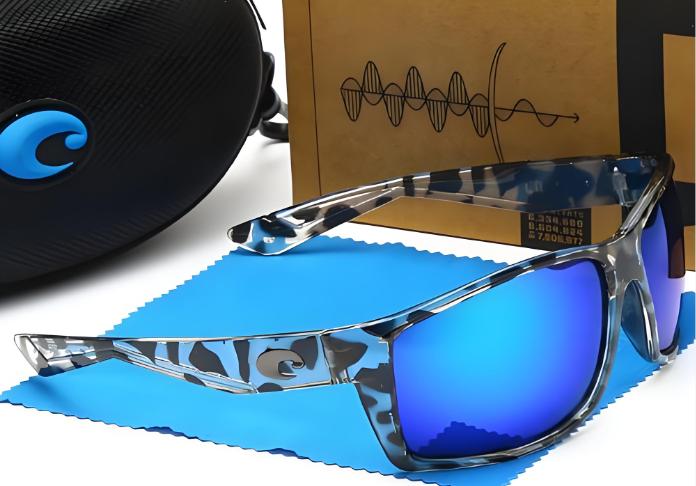
Costa Del Mar was founded in 1983 in Florida as an independent performance fishing eyewear brand. In 2014, it was acquired by Luxottica — the Italian eyewear giant that also owns Ray-Ban, Oakley, and Persol. Following Luxottica’s merger with Essilor in 2018, Costa became part of EssilorLuxottica.
Who owns 80% of the eyeglass market?
EssilorLuxottica. The group owns or licenses most major eyewear brands, and manufactures frames across facilities in Italy, China, Brazil, Thailand, and the United States. Even brands that feel distinctly “American” or “European” are, at the component level, largely manufactured in Asia.
Costa’s production structure reflects this:
- Frames: Produced in Taiwan (high-durability nylon / TR90), Japan (lightweight rubber and precision hinges), China (acetate and injection-molded TR90), and Mauritius for certain lines
- Lenses: Costa’s proprietary 580 lens technology — available in glass and polycarbonate — is sourced and processed through Luxottica’s global lens supply chain, with some prescription lens assembly still handled in Florida
- Assembly: Final assembly and QC currently based in Foothill Ranch, California
- Italy: Newer Pro Series and fashion-forward lines are increasingly stamped “Made in Italy” under Luxottica’s premium production facilities
The practical implication: the manufacturing expertise behind a $200+ pair of Costa sunglasses already exists in China and Taiwan. EssilorLuxottica uses it at scale. Independent sellers can access the same tier of factories — if they know where to look and how to verify them.
Similar to what we found with Ray-Ban's manufacturing model, the global eyewear supply chain is built on Asian manufacturing infrastructure — the "Made in Italy" or "Assembled in USA" label reflects brand positioning, not exclusive production capability.
How to Tell If Costa Sunglasses Are Real — And What B2B Buyers Should Learn From It
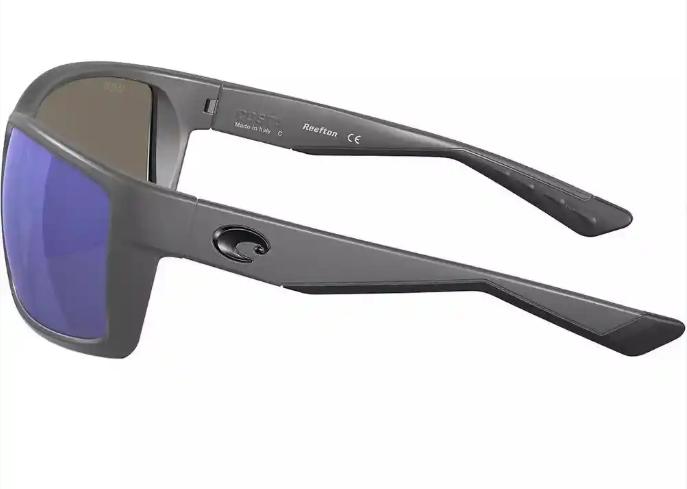
How do you tell if Costa sunglasses are real?
Authentic Costa pairs have several consistent markers:
- A “C” logo embossed on the temple tip
- A country of origin stamp (USA, Italy, or Taiwan depending on model)
- A serial number on the inner temple
- 580 lens technology markings on the lens itself
- The hinges on authentic pairs use barrel hinge construction with smooth, firm resistance — not the loose, wobbly movement typical of counterfeits.
For B2B buyers sourcing private label sunglasses in China, this authentication checklist reveals something important: the difference between a $3 Alibaba pair and a $200 premium pair is entirely traceable to three production variables.
1. Frame material — TR90 vs. cheap PC injection molding
TR90 is a Swiss-developed thermoplastic used by Costa, Oakley, and other performance brands for its memory-return properties, heat resistance, and chemical stability. A genuine TR90 frame returns to its original shape after bending and will not discolor or degrade with UV exposure. Cheap polycarbonate (PC) looks identical in photos but becomes brittle within months. On Alibaba, most listings labeled “TR90” are standard PC unless you verify the material certificate at source.
2. Lens quality — UV400 transmittance vs. surface coating
Authentic UV400 protection means the lens material itself blocks wavelengths up to 400nm — not a thin surface coating that wears off. Costa’s 580 glass lenses filter specifically at the 580nm wavelength to enhance contrast for fishing conditions. At the factory level, lens transmittance is verified with a spectrophotometer. Most promotional suppliers do not have this equipment on-site, meaning their “UV400” claim cannot be independently verified without a third-party lab test.
3. Hinge construction and fatigue tolerance
Costa’s barrel hinges are engineered to withstand thousands of open/close cycles without loosening. The standard test used by premium factories is a hinge fatigue test: 5,000+ cycles with consistent resistance tolerance. Budget factories skip this test entirely. The result is the most common complaint on Amazon reviews of cheap sunglasses: “the hinge broke after 3 months.”
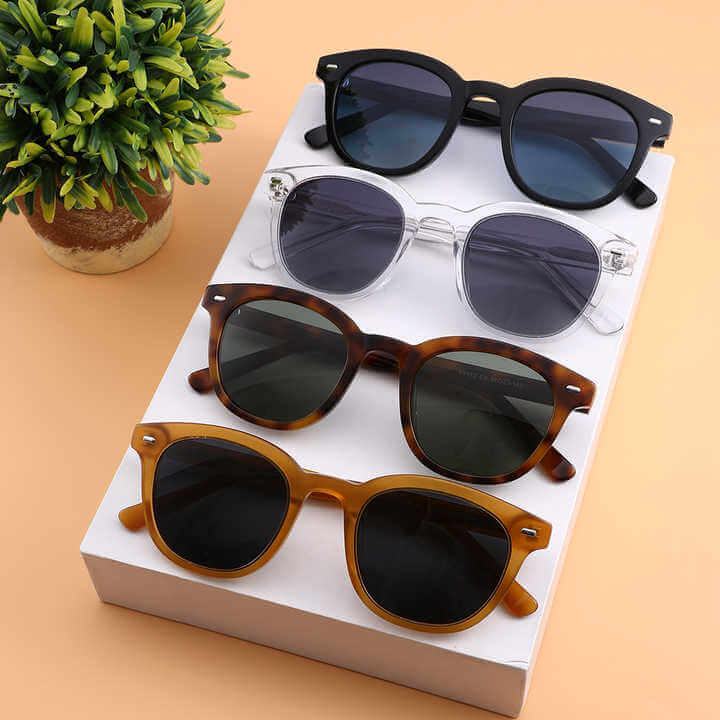
White-Label Agents
Most sourcing agents operate in the $1–$3 per unit range. Their model is finding existing stock, adding your logo, and shipping it. This works for promotional giveaways and low-ticket gifting. It does not work for building a brand that commands $80–$200 retail pricing.
The gap is structural, not a matter of finding a slightly better factory on the same platform.
Trading company vs. factory
A significant portion of Alibaba “factory” listings are trading companies purchasing from actual manufacturers and reselling with markup. The consequence for buyers: the sample you approve is from the real factory; the bulk order is subcontracted to a lower-tier supplier. This is the single most common source of “the bulk shipment looks nothing like the sample” complaints in the eyewear category.
The compliance barrier for premium eyewear Genuine premium sunglasses must pass:
- FDA Drop Ball Test (21 CFR 801.410): A 5/8″ steel ball dropped from 50 inches must not crack the lens. Required for all sunglasses sold in the US market. Most promotional suppliers cannot certify this without third-party testing.
- CE EN ISO 12312-1: European standard covering UV transmittance, luminous transmittance, and optical power. Required for EU market entry.
- ANSI Z80.3: American National Standard for non-prescription sunglasses, covering optical distortion limits.
Promotional factories producing $1 sunglasses are not operating to these standards. Finding a factory that genuinely passes these tests — and can provide batch-level documentation — requires on-the-ground factory verification, not a product listing review.
For a curated list of verified factories already operating at this standard, see our guide to the 10+ Best Sunglasses Manufacturers in China and the USA (2026).
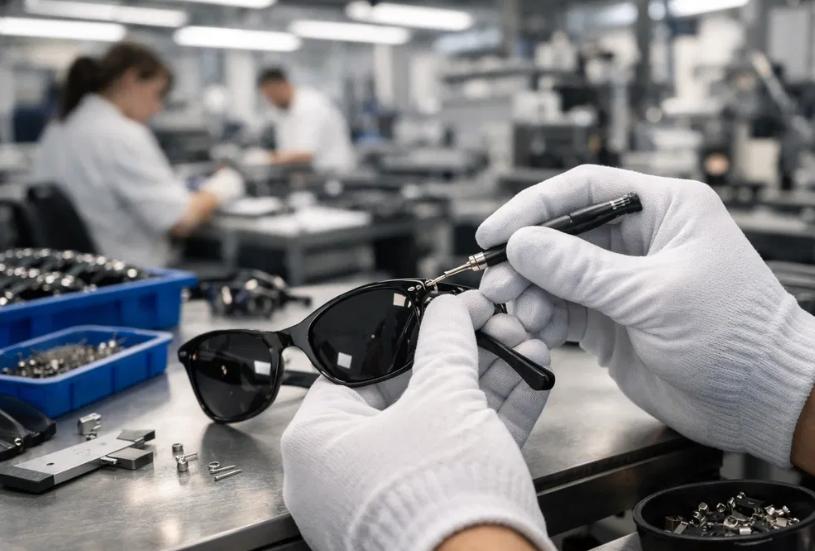
NicheSources operates as your on-the-ground partner in China’s eyewear manufacturing hubs — primarily Wenzhou (frames), Shenzhen (lens processing), and Dongguan (acetate specialists). Unlike sourcing agents who earn margin on product price, NicheSources charges a service fee and passes factory pricing directly to clients.
Factory Verification
Before recommending any factory, NicheSources conducts an on-site audit covering: business license and export certification verification, production line inspection (equipment age, capacity, and actual capabilities), raw material sourcing documentation (TR90 grade certificates, acetate supplier records), and QC lab equipment check (spectrophotometer, drop ball test apparatus, hinge fatigue rig).
This step eliminates the trading-company problem before it costs you a bulk order.
Complex OEM and ODM Development
Building a premium private label eyewear line means more than printing a logo. NicheSources manages:
- Custom mold development for proprietary frame shapes (typical tooling cost: $800–$2,500 per mold depending on complexity)
- Material selection and certification — specifying TR90 grade, acetate thickness, and hinge type with factory documentation
- Lens sourcing from Wenzhou optical lens suppliers, including polarized and gradient options with spectrophotometer-verified transmittance
- Packaging development, including case, cloth, and retail box design
What sunglasses are trending in 2026? Oversized retro acetate frames, sport wraparound TR90 with interchangeable lenses, and eco-conscious lines using recycled fishing nets (similar to Costa’s own Untangled Collection) are the dominant growth categories. NicheSources can develop OEM samples in these categories within 3–4 weeks from confirmed brief.
Strict AQL Quality Control
NicheSources applies AQL 2.5 inspection standards at three stages: incoming raw materials, mid-production, and pre-shipment. For eyewear specifically, our inspection checklist covers:
- Frame dimension tolerance (±0.3mm from approved sample)
- Hinge fatigue test: 3,000 open/close cycles minimum
- Lens UV transmittance: spectrophotometer verification per batch
- Drop ball test: conducted on final assembled units
- Surface finish: scratch, delamination, and color consistency check
- Packaging integrity: case fit, lens cloth inclusion, labeling accuracy
Are Costa sunglasses high quality? Yes — and the reason is traceable to consistent factory-level QC, not brand mystique. The same quality is achievable with the right factory partner and a properly structured inspection protocol.
Frequently Asked Questions
Do all Costa sunglasses say “Made in Italy”?
No. Only certain Pro Series and fashion models are made in Italy under Luxottica’s Italian facilities. The majority of Costa’s performance fishing line is assembled in the USA from components manufactured in Taiwan, Japan, China, and Mauritius.
Is Costa more expensive than Oakley?
Generally yes, at equivalent product tiers. Costa’s core positioning is premium performance fishing eyewear, with retail pricing typically $150–$350. Oakley covers a broader range ($80–$300+) including lifestyle and sport categories. Both are EssilorLuxottica brands, and both use Asian manufacturing infrastructure for components.
Are there any sunglasses made entirely in the USA?
Very few. Randolph Engineering (Randolph, Massachusetts) manufactures entirely in the US and supplies to the US military. Barton Perreira has design and finishing in California. For the vast majority of brands — including premium ones — full domestic manufacturing is not economically viable at commercial volumes.
What is the No. 1 brand of sunglasses?
By global revenue, Ray-Ban. By unit volume across all price points, generic private label sunglasses sold through mass-market retail. The premium independent brand space — the segment most relevant to private label sellers — is growing fastest, driven by DTC e-commerce.
Are Costa sunglasses worth the money?
For end users who fish or spend extended time on water, yes — the 580 lens technology provides demonstrable contrast enhancement that generic polarized lenses do not replicate. For brand sellers, the more relevant question is whether you can build a product line that delivers comparable optical performance at a lower retail price. With the right OEM partner, the answer is yes.
What is the minimum order for custom logo sunglasses from China?
For white-label stock with logo printing: typically 50–200 units per style. For full OEM with custom molds and certified materials: 300–1,000 units per style minimum, depending on factory and complexity. NicheSources can advise on MOQ structure based on your specific brief.
The Takeaway for Private Label Sellers
Costa’s supply chain tells a clear story: premium performance eyewear is manufactured in Asia, assembled and QC’d to a consistent standard, and sold at a premium tied to brand trust. The manufacturing capability is not proprietary to EssilorLuxottica. It exists in Wenzhou, Shenzhen, and Dongguan — accessible to independent brands willing to do the verification work.
The difference between a $3 Alibaba pair and an $80 private label product is not the factory location. It is factory selection, material specification, compliance testing, and ongoing quality control.
Don’t gamble your brand’s reputation on unverified suppliers. NicheSources provides free factory matching for private label eyewear projects. Get your free sourcing quote here.