China is one of the world’s main sourcing hubs for cosmetic packaging, covering everything from skincare bottles and cream jars to tubes, pumps, airless containers, and color-cosmetic components. Chinese suppliers typically offer stock packaging, OEM/ODM customization, decoration, and private-label support, with production concentrated across Guangdong, Zhejiang, and Jiangsu.
Quick Facts
- Suppliers reviewed: 17
- Verified factories: 12
- Suppliers/traders: 5, clearly labeled
- Typical MOQ: 1,000–5,000 units for stock packaging; 10,000+ for fully custom molds
- Typical unit cost: about $0.10–$3.00+, depending on material, construction, and decoration
- Custom-project lead time: roughly 2.5–4 months door-to-door
- Verification date: August 2026
- Verification signals used: customs records, SGS/TÜV reports, marketplace data, registry records, and current trading activity
We also want to be transparent about how this list was built. NicheSources is a China-based product sourcing service headquartered in Yiwu, so we work in the same supplier ecosystem covered in this guide. We have not included or ranked NicheSources as one of the 17 suppliers.
Instead, our goal is to make the shortlist more useful for buyers by showing something many supplier roundups leave unclear: which companies are actual manufacturers and which operate mainly as suppliers or trading companies. We also flag verification issues where we find them rather than repeating supplier marketing claims at face value.
How We Verified This List
Most supplier roundups rely heavily on company websites and marketplace descriptions. For this update, we cross-checked each supplier using multiple independent signals and completed the review in August 2026.
Our verification process included:
- Customs and trade records: we looked for recent export activity where records were available, including documented US shipments.
- Third-party verification: we reviewed SGS and TÜV Rheinland onsite reports, Alibaba supplier records, certification listings, and marketplace tenure.
- Company and registry data: we cross-checked legal entities, founding information, locations, ownership, and public filings where applicable.
- Current activity signals: we checked recent trade-show appearances, active storefronts, updated catalogs, and transaction history to confirm that suppliers still appear operational.
This process also changed how we present the list. We identified companies that market themselves like manufacturers but operate mainly as traders or sourcing suppliers, so we label them accordingly rather than treating every company as a factory.
We also found cases where additional caution was necessary. One former supplier was removed after a stock-exchange delisting-risk warning, while another supplier’s website appeared compromised, so we use its verified marketplace profile instead.
No verification method removes all sourcing risk. Certifications can expire, ownership can change, and a legitimate factory can still produce an inconsistent batch. We therefore treat verification as the first screening step, followed by samples, a golden sample approval, and pre-shipment inspection before a larger order.
A Quick Look at Cosmetic Packaging Basics
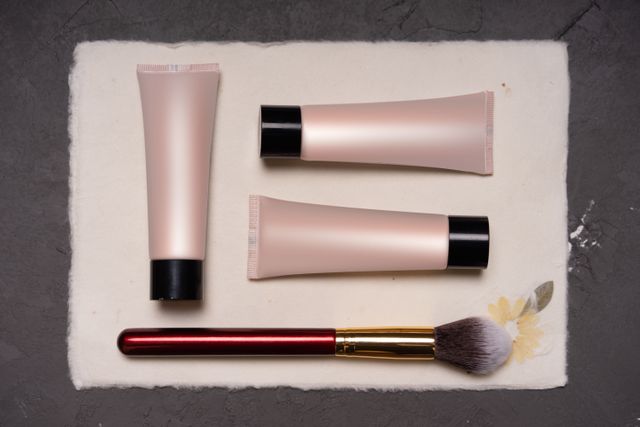
Before we jump into our list of top suppliers, let’s cover the essentials of cosmetic packaging. The right packaging protects your product and elevates your brand. Here’s a quick overview:
The Layers of Packaging
Cosmetic packaging typically has three layers:
- Primary (direct contact with the product, like bottles or jars)
- Secondary (outer boxes for branding and protection)
- Tertiary (for shipping and storage)
Each layer plays a key role in balancing functionality and presentation.
Materials to Consider
Your material choice depends on your product and audience:
- Glass: Luxurious, recyclable, and perfect for high-end serums or perfumes. It’s heavier, though, which might impact shipping costs.
- Plastic: Lightweight and budget-friendly, with options like PET (clear, for toners) or PP (heat-resistant, for jars). Consider eco-friendly alternatives, as sustainability matters to 72% of consumers (Nielsen Global Sustainability Report 2020).
- Metal: Premium and durable, ideal for luxury creams or aerosols. Aluminum is recyclable but costlier.
- Biodegradable Materials: Eco-friendly options like bamboo, silicon, or wood cater to niche, eco-conscious markets, great for sustainable branding.
Read More
Curious about sustainable options? See The Benefits of Sustainable Packaging for Business Growth.
Types of Packaging
Packaging comes in various forms:
- Bottles for liquids, jars for creams, pumps for lotions, tubes for thick formulas, and more.
- Mixing materials is a smart movelike glass for luxury items and plastic for travel sizes to balance cost and appeal.
Want to dive deeper? We’ve broken down the three layers, material pros and cons, and 11 types of makeup packaging in this detailed guide. Check it out to find the best fit for your brand!
Top Picks by Category
If you want to narrow the 17 suppliers quickly, we’d shortlist them by packaging specialty, MOQ, and business model rather than treating one company as the best fit for every project. These picks are based on the supplier capabilities and verification data reviewed in August 2026.
| Category | Top Pick | Why It Stands Out | Watch-Out |
| Best for luxury packaging | Jarsking | Runs in-house glass, plastic, mold-making, decoration, and carton workshops, making it suitable for premium one-stop custom projects. | MOQ is around 10,000 units per SKU, even with existing molds. |
| Best for skincare airless packaging | Shaoxing Jinsheng | Specializes in airless and vacuum packaging with in-house tooling and offers mono-material PP options. | Better suited to mid-to-high-volume custom projects than small test orders. |
| Best for color cosmetics | Libo Cosmetics | Focuses on compacts, palettes, lipstick, mascara, aluminum packaging, refillables, and PCR materials. | Primarily relevant to makeup brands rather than general skincare packaging. |
| Best for sustainable packaging | UKPACK | Offers mono-material pumps, refillable systems, PCR and bio-based materials, backed by GRS, BSCI and EcoVadis verification. | Typical volumes are around 10,000 units for many projects. |
| Best for low-MOQ orders | Hebei Welllive | As a disclosed trader, it can combine glass and plastic products from partner factories and handle smaller mixed orders. | You are buying through a trader rather than directly controlling production at one factory. |
| Best for pumps & sprayers | Somewang Packaging | Operates three factories covering pumps, sprayers, bottles and tubes, with MOQs ranging roughly from 1,000–10,000 units by item. | MOQ varies significantly by component and customization level. |
| Best for custom glass | Jiangsu Roetell Glassware | Operates its own glass, mold, carton and closure facilities, making it well suited to custom glass projects at scale. | Glass increases freight weight and breakage risk compared with plastic. |
For smaller brands, we would also consider Ningbo Kinpack alongside Welllive. Kinpack coordinates 46 partner factories, which can make it easier to source matched bottles, pumps, caps, and other components through one supplier rather than meeting each factory’s MOQ separately.
These are category-specific picks, not absolute rankings. Before choosing one, compare the supplier’s MOQ, material specialization, customization capability, and whether you prefer factory-direct production or the flexibility of a trading company.
Types of Cosmetic Packaging Suppliers in China
Before comparing individual suppliers, we suggest understanding who you are actually buying from. A factory, trading company, and sourcing agent can all be useful, but they offer different levels of control, MOQ flexibility, and supplier management.
| Supplier Type | How It Works | Main Advantage | Main Trade-Off | Best Fit |
| Factory / Manufacturer | Owns production equipment and manufactures the packaging directly | Better control over tooling, materials, customization, and volume pricing | Usually higher MOQs and a narrower product range | Established brands ordering one packaging category at scale |
| Trading Company / Supplier | Sources products from one or more partner factories and sells them to buyers | Easier mixed orders and often more flexible MOQs | Added markup and less direct control over production | Smaller brands or buyers sourcing several components |
| Sourcing Agent | Represents the buyer and finds, verifies, negotiates with, and coordinates factories | One team can manage sourcing, QC, consolidation, and shipping | Adds a service fee to the sourcing process | Buyers who need multiple suppliers or on-ground support in China |
Factory / Manufacturer
A genuine cosmetic packaging factory owns or directly operates the equipment used to make its products. Depending on its specialty, this could include injection molding, blow molding, glass production, mold development, printing, coating, or assembly.
We usually prefer factory-direct sourcing when a buyer needs custom molds, tighter production control, or repeat orders at higher volumes. The trade-off is that factories often specialize: a strong airless-bottle manufacturer may not also be the right source for glass jars, cartons, and pumps.
Of the 17 companies reviewed in this guide, 12 are classified as factories based on the verification evidence we reviewed.
Trading Company / Supplier
A trading company buys or coordinates products from partner factories rather than manufacturing every component itself.
That is not automatically a disadvantage. For a smaller order, a trader may be able to combine bottles, pumps, caps, jars, and other components without forcing you to meet the production MOQ of several separate factories.
The important issue is disclosure. Five companies in our list operate primarily as suppliers or traders, and we label them that way instead of presenting them as manufacturers.
Sourcing Agent
A sourcing agent works on the buyer’s side of the transaction. Instead of selling its own packaging line, the agent identifies suitable factories, verifies them, negotiates quotations, coordinates samples, manages quality inspection, consolidates orders, and arranges shipping.
This model becomes particularly useful when your packaging requires products from several factories—for example, a bottle from one manufacturer, a pump from another, and a printed carton from a third.
At NicheSources, this is the role we play. We are not ranked as one of the suppliers in this list; our job is to help buyers compare and manage suitable manufacturers when direct factory sourcing becomes difficult to coordinate.
How Can You Tell a Factory from a Trading Company?
We normally check several signals rather than relying on what a supplier calls itself:
- Business-license scope: look for manufacturing activities rather than trading only.
- Factory address: determine whether the registered location is an industrial facility or primarily an office.
- Live production-floor verification: ask to see molding, decoration, assembly, and warehouse areas during a video call.
- Third-party audit reports: SGS or TÜV onsite reports can provide stronger evidence of actual production capabilities.
- MOQ logic: factories typically quote around production runs, material minimums, and mold requirements, while traders can often offer smaller mixed quantities sourced across several factories.
Neither model is inherently better. What matters is knowing which model you are dealing with before comparing price, MOQ, customization, and risk.
The 17 Verified Cosmetic Packaging Suppliers in China
We’ve grouped these companies by verified factories first, followed by suppliers and trading companies. That distinction matters because it affects MOQ flexibility, customization depth, pricing, and how directly you control production.
Verified Factories
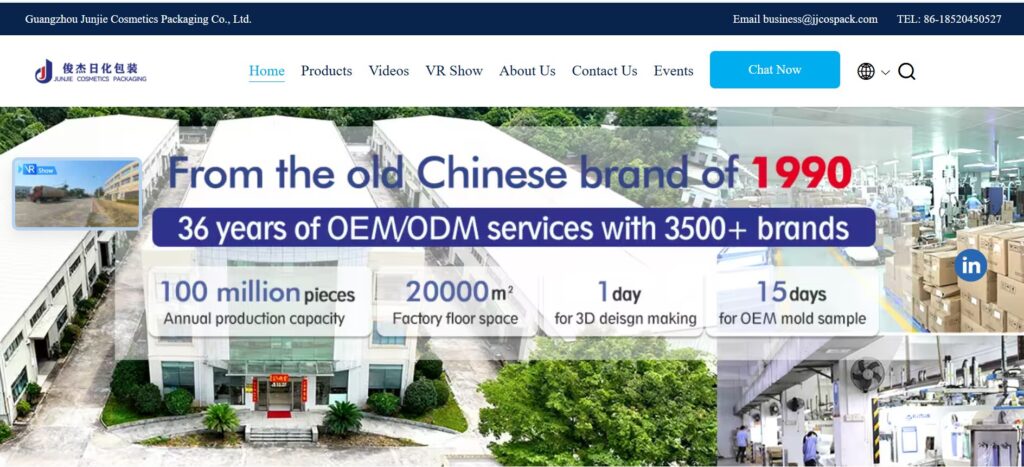
1. Guangzhou Junjie Cosmetics Packaging Co., Ltd.
Type: Factory
Ideal For: Skincare brands looking for an established plastic and acrylic packaging manufacturer.
Guangzhou Junjie was established in 2004 in Huadu, Guangzhou. Based on the verification records reviewed for this update, it operates an approximately 19,000 m² facility with 30 production lines, and its SGS onsite verification was renewed in March 2026.
Products & Services:
- PET and PETG bottles and jars
- Acrylic cream jars
- Airless bottles
- Lotion bottles
- Cosmetic tubes
- Mold development and decoration
Key Features:
- SGS onsite-verified manufacturer
- In-house mold making, injection molding, blow molding, and decoration
- Its marketplace profile lists ISO 9001, RoHS, and CE records
- Reported export mix includes Southeast Asia and North America
For buyers, the main advantage is the breadth of processes handled under one roof. That can reduce coordination problems when a project needs both molding and decorative finishing.
2. Zhejiang Fuquan Plastic Industry Co., Ltd.
Type: Factory
Ideal For: Mid-size skincare brands sourcing acrylic and airless packaging.
Founded in 2010 in Shangyu, Shaoxing, Zhejiang Fuquan operates a 20,000+ m² facility completed in 2019. Its production chain covers the major stages required for customized acrylic packaging rather than outsourcing each process separately.
Products & Services:
- Acrylic bottles and jars
- Cream jars
- Airless and vacuum bottles
- Lotion bottles
- Mold making
- UV coating, hot stamping, printing, and assembly
Key Features:
- In-house production from tooling through decoration
- Platform records indicate 201–500 employees
- Reported export markets include Europe, the US, Australia, Korea, and Southeast Asia
We’d consider Fuquan when consistency across molding, coating, printing, and assembly is more important than sourcing each process from the lowest-cost subcontractor.
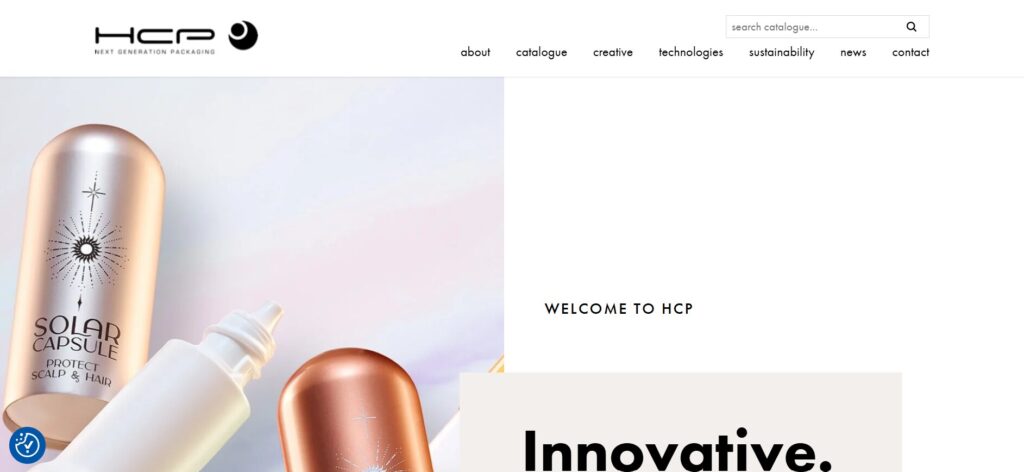
3. HCP Packaging Group
Type: Global Manufacturer
Ideal For: Established beauty brands needing enterprise-scale color-cosmetics packaging.
HCP was founded in Taiwan in 1960 and is now headquartered in Shanghai. It operates 10 plants across China, the US, Mexico, Germany, and France, and has been owned by Carlyle since 2022.
Products & Services:
- Compacts and palettes
- Lipstick components
- Mascara and lip-gloss packaging
- Cosmetic jars
- Closures and pumps
- Refillable packaging systems
Key Features:
- Works at global beauty-brand scale
- Supplier relationships include Estée Lauder, L’Oréal, and Shiseido according to the verification data
- ISCC PLUS certification across plants
- EcoVadis Gold rating
HCP is structurally different from most companies on this list. We’d look at it for larger, more mature packaging programs rather than small-volume startup sourcing.
4. Shaoxing Jin Sheng Plastic Industry Co., Ltd.
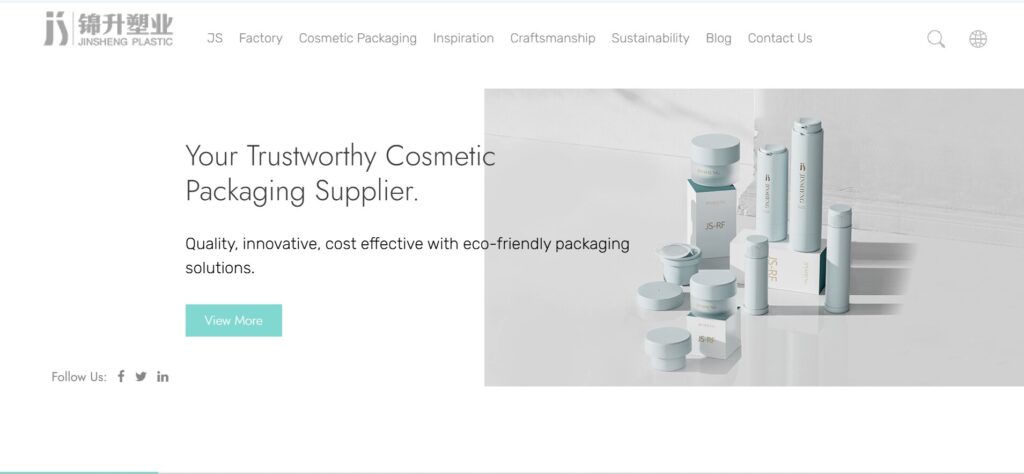
Type: Factory
Ideal For: Premium skincare brands needing specialized airless or vacuum packaging.
Jinsheng was founded in 2003 in Shangyu, Shaoxing. Its documented expansion history includes five phases through 2022, and its strongest specialization is airless and vacuum packaging supported by in-house tooling.
Products & Services:
- Airless bottles
- Vacuum cream jars
- Lotion bottles
- Pumps
- Mono-material PP airless options
Key Features:
- Works with PMMA, SAN, ABS, PETG, PCTA, and PP
- In-house tooling supports customized packaging development
- The company states that it has supplied brands including AVON and FENTY BEAUTY; we treat these as self-reported claims
For airless projects, specialist tooling capability usually matters more than having the broadest catalog. That is where Jinsheng stands out within this list.
5. Yuyao Jingyi Plastic Industry Co., Ltd. (Joly Beauty)
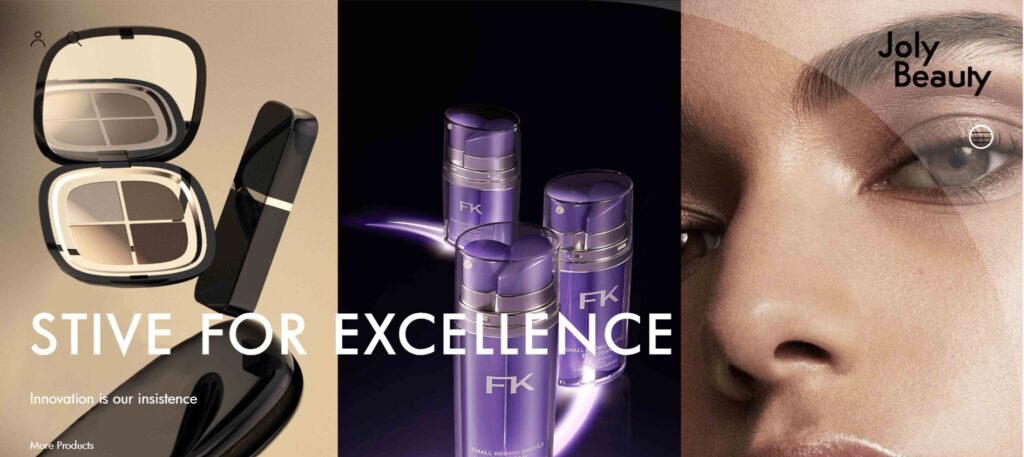
Type: Factory
Ideal For: Brands looking for an airless and sprayer specialist with recent export evidence.
Founded in 1999 in Yuyao, Zhejiang, Jingyi specializes in airless packaging and trades in Europe under the Joly Beauty name. US customs records reviewed for this update show shipments to packaging distributors as recently as June 2026, providing a useful independent signal of current activity.
Products & Services:
- Airless bottles
- Lotion bottles and pumps
- Cosmetic jars
- Mist sprayers
- Perfume sprayers
- Lipstick and compact cases
Key Features:
- Integrated processes from mold development through assembly
- Recent US customs activity
- Corporate website was offline during verification
6. Jiangsu Roetell Glassware Co., Ltd. (Roetell)
Type: Factory
Ideal For: Brands sourcing custom cosmetic glass at medium-to-large volumes.
Roetell is based in Xuzhou, Jiangsu. The current Jiangsu Roetell Glassware entity was established in 2008, while the company traces its production roots to a collective glassworks established in 1984.
Products & Services:
- Cosmetic glass jars from 5g to 200g
- Lotion bottles
- Perfume bottles
- Glass vials
- Custom molds
- Closures and retail cartons
Key Features:
- Own glass production
- In-house mold facility
- In-house carton and closure production
- Suitable for integrated glass packaging projects
The practical advantage is consolidation. A buyer needing a custom glass container, mold, closure, and carton can potentially coordinate these elements through one manufacturer instead of several subcontractors.
7. Zhejiang UKPACK Packaging Co., Ltd.
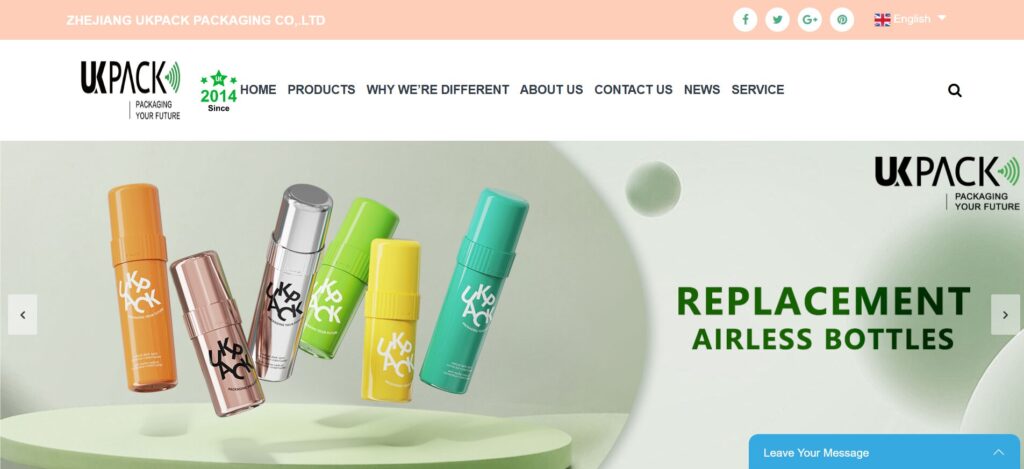
Type: Factory
Ideal For: Skincare brands prioritizing sustainable airless, pump, and refillable packaging.
UKPACK was founded in 2014 and is headquartered in Shangyu, Shaoxing, with its manufacturing facility in Yuyao, Ningbo. Its product development is particularly focused on sustainable packaging formats.
Products & Services:
- Airless bottles and jars
- Mono-material PP lotion pumps
- Cream jars
- Cosmetic tubes
- Droppers
- Refillable packaging systems
- PCR and bio-based material options
Key Features:
- ISO 9001, ISO 14001, and ISO 45001
- BSCI audit
- GRS certification
- EcoVadis Silver
- SGS onsite verification
We’d shortlist UKPACK when sustainability claims need documentation behind them, particularly for brands evaluating PCR, mono-material, or refillable packaging.
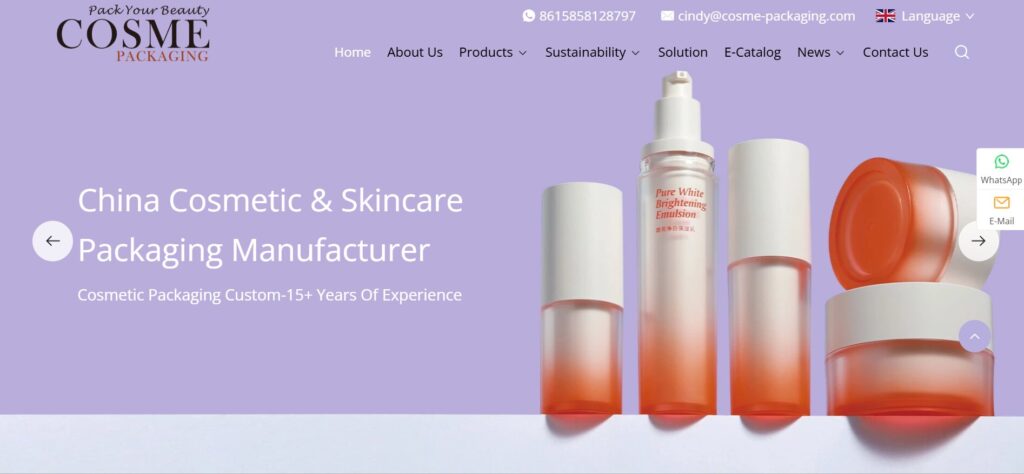
8. Zhejiang COSME Packaging Co., Ltd.
Type: Factory
Ideal For: Brands wanting acrylic packaging with alternative eco-material options.
COSME operates manufacturing in Shangyu, Shaoxing, with a sales office in Ningbo. The available supplier data supports more than 15 years of industry experience, but we have intentionally avoided assigning a specific founding year that could not be verified confidently.
Products & Services:
- Acrylic jars
- Cream jars
- Lotion bottles
- Airless pump bottles
- PP, PET, and PETG packaging
- Cosmetic tubes
Key Features:
- Broad acrylic and plastic packaging range
- PCR material options
- PLA and PHA alternatives
COSME is worth evaluating when a brand wants the appearance of acrylic packaging while also comparing lower-impact material options within the same sourcing conversation.
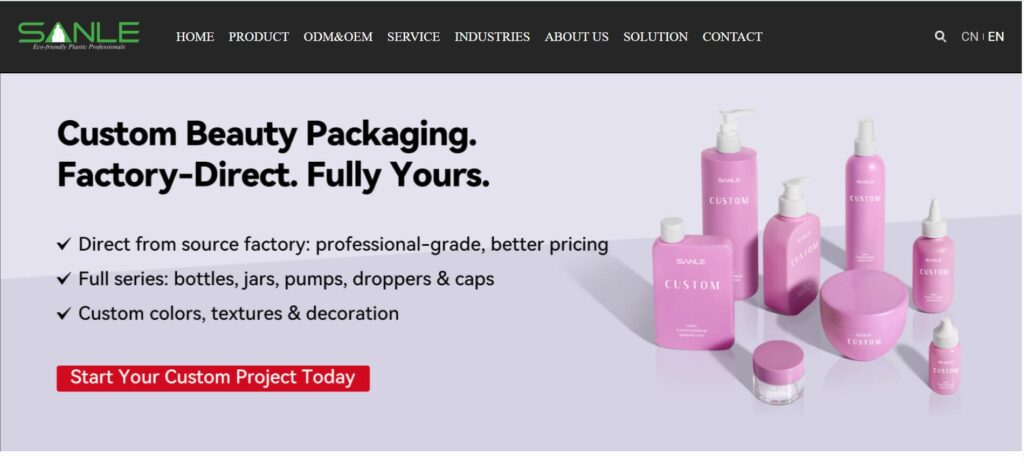
9. Zhejiang Sanle Plastic Co., Ltd.
Type: Factory
Ideal For: Brands sourcing PCR or other sustainability-focused plastic packaging.
Sanle traces its origins to 1993, while its current registered entity dates to 2003. It operates from Yuhuan, Taizhou, Zhejiang and has a long-standing verified marketplace presence.
Products & Services:
- Plastic jars
- Plastic bottles
- Caps and closures
- PCR packaging
- PLA packaging
- Ocean-bound and compostable packaging ranges
Key Features:
- 21-year Alibaba Gold Supplier record
- ISO 9001 and ISO 14001 listed
- BSCI audit listed on its verified profile
- Strong sustainability-oriented product range
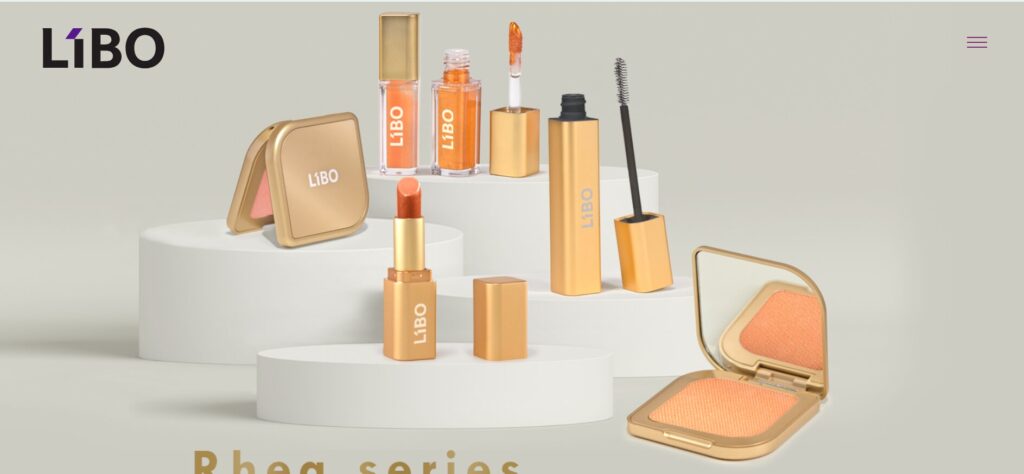
10. Libo Cosmetics
Type: Factory
Ideal For: Mid-to-premium makeup brands sourcing compacts, palettes, and lipstick packaging.
Libo was established around 2000 and is headquartered in Taichung, Taiwan, with manufacturing facilities in mainland China and the US. Its specialization is strongly oriented toward color cosmetics rather than general bottles and jars.
Products & Services:
- Compacts
- Makeup palettes
- Lipstick components
- Lip-gloss and mascara packaging
- Aluminum packaging
- Refillable systems
- PCR and mono-material PET ranges
Key Features:
- 40,000+ m² of facilities
- Winner of a MakeUp in Paris 2023 IT Award for packaging
- Exhibited at MakeUp in Paris and Luxe Pack New York in 2026
We’d look at Libo when the packaging itself plays a major role in product presentation, especially for pressed powder, lip, and palette formats.
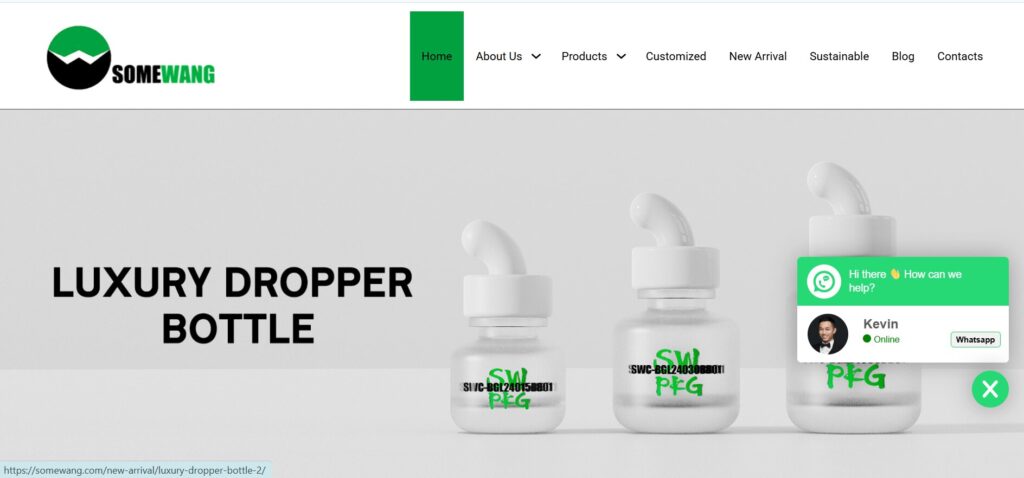
11. Somewang Packaging
Type: Factory
Ideal For: Haircare, body-care, and personal-care brands needing bottles matched with pumps or sprayers.
Founded in 2006 in Ningbo, Somewang operates three factories covering injection and blow molding, tubes, and pump/sprayer production. Its SGS onsite verification was valid through November 2026 at the time this list was reviewed.
Products & Services:
- Lotion pumps
- Mist and trigger sprayers
- Foam pumps
- PET, PE, and PETG bottles
- Jars
- Tubes
- Airless bottles
Key Features:
- SGS onsite verified
- ISO 9001 certificate HIC241973
- CE certificates listed
- Reported annual export revenue of approximately US$31 million
- MOQ generally ranges from 1,000–10,000 units depending on the item
Somewang makes particular sense when the closure and dispensing system are as important as the bottle itself, since those components can be developed within the same supplier group.
12. Jarsking
Type: Factory
Ideal For: Established premium skincare and fragrance brands needing one-stop custom packaging.
Jarsking is headquartered in Guangzhou and also maintains offices in Dubai and Los Angeles. According to the supplier information reviewed, it operates 100,000 m² of self-owned facilities across glass, plastic, mold-making, decoration, and carton production.
Products & Services:
- Luxury glass bottles and jars
- Plastic packaging
- Airless systems
- Droppers
- Perfume packaging
- Secondary packaging
- Custom mold development
Key Features:
- Five in-house production workshops
- Large library of existing molds
- Custom tooling quoted at around 30–45 days
- BSCI audited
- PCR, bamboo, and aluminum options
- MOQ around 10,000 units per SKU, including many existing-mold projects
The MOQ is the main filter here. We’d consider Jarsking for an established launch or repeat-order program rather than an early-stage packaging test.
Suppliers & Trading Companies
The following companies can still be useful sourcing partners, but our verification indicates that they operate primarily as suppliers, traders, or coordinators of partner factories. We disclose that distinction so buyers can evaluate them on the right terms.
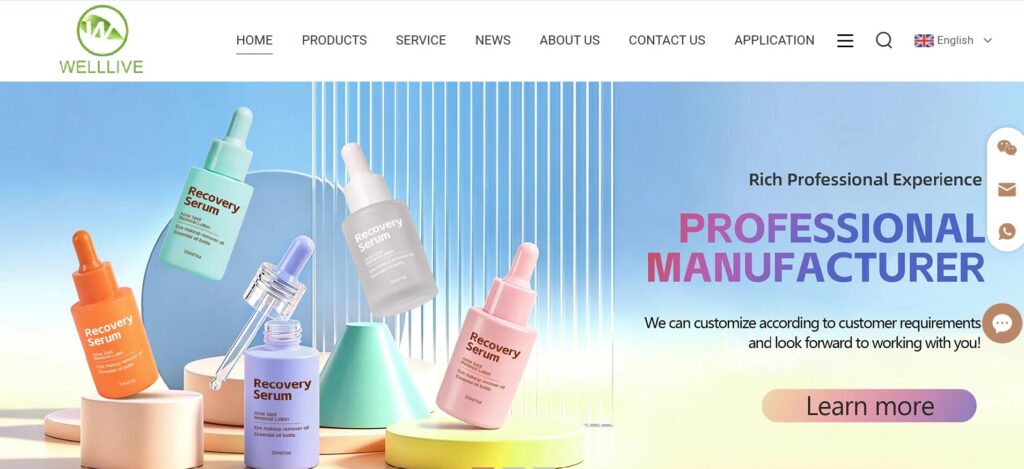
13. Hebei Welllive Trade Co., Ltd.
Type: Trading Company
Ideal For: Small businesses needing lower-MOQ mixed glass and plastic packaging orders.
Welllive is a Shijiazhuang-based export trader rather than a direct manufacturer. It sources cosmetic packaging across glass, plastic, aluminum, and other materials through partner factories.
Products & Services:
- Glass dropper bottles
- Cream jars
- Aluminum tins
- Roller bottles
- PET jars
- Foam pumps
- Bamboo-lid packaging
Key Features:
- Eight years as an Alibaba Gold Supplier
- Marketplace rating around 4.5/5
- Reported reorder rate of approximately 21–25%
- Ability to combine multiple packaging categories
The advantage is flexibility. A smaller buyer may find it easier to consolidate several packaging types through Welllive than meet individual factory MOQs for every component.
14. Ningbo Kinpack Commodity Co., Ltd.
Type: Supplier / Trading Company
Ideal For: Buyers sourcing matched bottles, pumps, caps, and other components through one contact.
Kinpack was established in 2020 in Yuyao, Zhejiang. It is TÜV Rheinland verified and coordinates production through a network of 46 partner factories rather than presenting itself here as a direct manufacturer of every product it sells.
Products & Services:
- Airless bottles
- Lotion and spray pumps
- Trigger sprayers
- Foam pumps
- Jars
- Droppers
- Tubes
- Plastic, glass, and aluminum packaging
Key Features:
- TÜV Rheinland verification
- Network of 46 partner factories
- Broad multi-component sourcing capability
For buyers, its value is coordination. This model can make sense when you need a bottle, pump, and closure that fit together but do not necessarily come from one production line.
15. Shanghai Feemio Group
Type: Trading Group
Ideal For: Brands looking for design-led custom glass sourcing through a Shanghai-based team.
Feemio describes itself as a global-oriented trading group. Its Shanghai sales operation was established in 2018, while the company claims family glass-industry roots dating to 1988 and works with a partner factory in Fengyang, Anhui. We treat the earlier history as a company claim rather than independently verified founding data.
Products & Services:
- Cosmetic glass jars
- Glass bottles
- Perfume bottles
- Custom container design
- Warehousing and transport support
Key Features:
- Broad glass sourcing range
- Design support
- Partner-factory production model
Feemio may suit buyers who value a sales and design team coordinating glass production rather than dealing directly with a single factory.
16. Shaoxing Yicai Plastics Co., Ltd.
Type: Supplier / Trading Company
Ideal For: Buyers wanting a broad packaging catalog with relatively flexible order quantities.
Platform records date Yicai to 2012, although the company itself claims roots going back to 1991. It is based in Shangyu, Shaoxing and offers products across PETG, acrylic, glass, and airless packaging.
Products & Services:
- PETG jars
- Acrylic bottles and jars
- Glass bottles and jars
- Airless bottles
- Lotion bottles
- Tubes
- Roll-ons
- Decoration coordination
Key Features:
- Marketplace rating of 5.0/5 in the reviewed data
- 100% on-time delivery shown on its platform profile
- Coordinates UV coating, hot stamping, silk screening, and injection-related processes
Yicai’s strength is breadth rather than a single manufacturing specialty, which can be useful when a buyer wants to compare several packaging materials through one supplier.
17. Ningbo Sepshion Commodity Co., Ltd.
Type: Supplier
Ideal For: Startups looking for flexible OEM/ODM branding on existing packaging designs.
Sepshion is a relatively young Ningbo-based supplier founded around 2019. Its offering centers on a broad catalog of stock packaging combined with logo printing, design, and other small-scale OEM/ODM customization.
Products & Services:
- Plastic bottles
- Caps and closures
- Sprayers and pumps
- Cosmetic jars
- Tubes
- Airless bottles
- Perfume bottles
- Logo and design customization
Key Features:
- Three-year Alibaba supplier record in the reviewed data
- Marketplace rating around 4.7/5
- Reported on-time delivery of approximately 92–97%
- Flexible customization compared with factory-scale programs
We’d evaluate Sepshion primarily for stock-shape customization and smaller test projects. For technically complex molds or high-volume production, a direct specialist factory may offer more production control.
Cosmetic Packaging Basics: Layers, Materials, and Types
Before comparing suppliers, separate what touches the formula, what carries the branding, and what protects the product during shipping. These layers may come from different processes or suppliers.
What Are the Three Layers of Cosmetic Packaging?
- Primary packaging contacts the formula directly, including bottles, jars, tubes, pumps, and airless containers. Material compatibility and dispensing performance are key.
- Secondary packaging includes outer boxes, sleeves, and cartons used for branding, retail presentation, and added protection.
- Tertiary packaging includes master cartons, dividers, pallets, and other materials used for warehousing and shipping.
For sourcing, prioritize primary packaging because leakage, formula interaction, poor pump output, or cracking can make the finished product unusable.
Which Cosmetic Packaging Material Should You Choose?
| Material | Main Advantages | Main Trade-Offs | Common Uses |
| Glass | Premium appearance, chemically inert, recyclable | Heavier freight and higher breakage risk | Serums, oils, perfume, creams |
| PET / PETG | Lightweight, clear, and glass-like | Lower heat resistance than some alternatives | Toners, lotions, bottles, jars |
| PP | Durable and relatively heat resistant | Less premium-looking than glass or acrylic | Jars, caps, closures, pumps |
| Acrylic (PMMA) | High-end appearance without glass’s weight | Can scratch and is not widely recyclable | Premium jars and display-focused bottles |
| Airless systems | Limits air exposure and supports controlled dispensing | More complex and expensive than standard pumps | Serums and oxygen-sensitive skincare |
| Aluminum | Lightweight, recyclable, premium finish | Higher cost and can dent | Compacts, creams, specialty packaging |
| PCR / bio-based materials | Reduces virgin-plastic use and supports sustainability goals | Certification, MOQ, and consistency require review | Eco-positioned skincare and personal care |
These materials are represented across the suppliers reviewed in this guide, including glass specialists, acrylic manufacturers, airless factories, and suppliers offering PCR or bio-based options.
What Are the Main Types of Cosmetic Packaging?
Common formats include:
- Bottles for lotions, toners, cleansers, oils, and fragrances
- Jars for creams, balms, masks, and powders
- Tubes for creams, gels, cleansers, and travel products
- Airless bottles and jars for formulas that benefit from reduced air exposure
- Pumps and sprayers for lotions, mists, foams, and liquids
- Droppers and roller bottles for serums, oils, and concentrated formulas
- Compacts, palettes, and lipstick components for color cosmetics
- Refillable packaging for brands focused on reuse or reduced material consumption
The right format depends on more than appearance. Evaluate formula compatibility, dispensing method, target retail price, shipping weight, MOQ, and decoration requirements before choosing a structure.
For a deeper comparison, see Types of Makeup Packaging: Materials, Pros & Cons. For sustainability considerations, see The Benefits of Sustainable Packaging for Business Growth and What Is Eco-Friendly Packaging?.
Where Is Cosmetic Packaging Made in China?
Cosmetic packaging production in China is highly clustered. We usually start supplier searches by matching the packaging type to the region that specializes in it, because this can improve supplier choice, simplify component sourcing, and reduce domestic logistics between factories.
| Production Cluster | Main Specialties | Suppliers on This List |
| Guangzhou / Baiyun, Guangdong | Plastic packaging, custom design, decoration, one-stop packaging | Guangzhou Junjie, Jarsking |
| Yuyao / Ningbo, Zhejiang | Pumps, sprayers, bottles, airless systems | Jingyi, Somewang, Kinpack |
| Shaoxing / Shangyu, Zhejiang | Acrylic, airless, vacuum, and skincare packaging | Fuquan, Jinsheng, UKPACK, COSME, Yicai |
| Xuzhou, Jiangsu | Cosmetic and perfume glass | Roetell |
| Yuhuan / Taizhou, Zhejiang | Plastic packaging, including sustainability-focused materials | Sanle Plastic |
Guangzhou / Baiyun: Plastic and One-Stop Packaging
Guangzhou has a dense beauty-industry supply chain covering bottles, jars, decoration, molds, and secondary packaging. Junjie and Jarsking are based in this cluster.
We’d look here when a project requires plastic packaging plus extensive decoration or multiple packaging components rather than one highly specialized item.
Yuyao / Ningbo: Pumps, Sprayers, and Bottles
Yuyao and Ningbo are particularly relevant for dispensing systems, including lotion pumps, mist sprayers, foam pumps, and airless bottles. Jingyi and Somewang manufacture in this area, while Kinpack coordinates products through partner factories.
For products such as body lotions, cleansers, haircare, or mists, this cluster gives buyers access to suppliers that understand the interaction between the bottle, closure, and dispensing mechanism.
Shaoxing / Shangyu: Acrylic and Airless Packaging
Shaoxing’s Shangyu area is the strongest concentration on our list for acrylic, vacuum, and airless skincare packaging. Fuquan, Jinsheng, UKPACK, COSME, and Yicai all operate from this cluster.
We’d prioritize Shangyu when sourcing premium skincare packaging where molding, coating, printing, and airless-system performance all need to work together.
Xuzhou: Cosmetic Glass
Xuzhou, Jiangsu is the main glass-production cluster represented in this list. Roetell operates its glass, mold, closure, and carton facilities there.
For custom glass jars, serum bottles, or fragrance packaging, sourcing close to an established glass-production base can make more sense than working through a general packaging supplier elsewhere.
Yuhuan / Taizhou: Plastic and Eco-Focused Packaging
Yuhuan in Taizhou is represented here by Sanle Plastic, which produces conventional plastic packaging alongside PCR, PLA, ocean-bound, and compostable ranges.
This cluster is worth considering when plastic remains the practical packaging choice but the brand also wants to evaluate recycled or alternative-material options.
The region alone should never decide the supplier. We still compare production capability, MOQ, material documentation, tooling, decoration processes, and QC systems before placing an order.
How to Order Custom Cosmetic Packaging from China
Most packaging delays happen before production because specifications are incomplete, samples keep changing, or the packaging is not tested with the formula.
To avoid delays, provide suppliers with the key details upfront: capacity, dimensions, material, closure, decoration, color reference, quantity, and destination market.
What Is the OEM/ODM Ordering Process?
- Send specifications: Include the packaging type, material, capacity, closure, decoration, quantity, and target market.
- Compare quotes: Request prices for different quantities, such as 1,000, 5,000, and 10,000 units.
- Order samples: Check the packaging and test it with your formula.
- Develop tooling if needed: Custom shapes usually require a new mold.
- Approve the final sample: Confirm dimensions, color, printing, finish, pump output, and tolerances.
- Start production: Production begins after sample approval and payment terms are confirmed.
- Inspect before shipment: Compare the finished goods with the approved sample before paying the balance.
- Arrange shipping: Sea freight is usually the most practical option for bulk packaging.
How Long Does Custom Cosmetic Packaging Take?
| Stage | Indicative Lead Time |
| Stock sample | 3–7 days |
| Custom sample | 7–15 days |
| New mold development | 15–30 days |
| Mass production | 20–45 days |
| Sea freight to US/EU ports | 25–40 days |
A fully customized project typically takes 2.5–4 months door-to-door. Stock packaging with logo printing may take only 2–4 weeks before international shipping.
Allow extra time for compatibility testing, decoration changes, or mold revisions.
What MOQs and Prices Should You Expect?
The following are indicative 2026 benchmarks, not fixed quotations. Final costs depend on the material, size, closure, decoration, quantity, and tooling.
| Packaging Requirement | Typical MOQ | Indicative Unit Cost |
| Stock bottle or jar, undecorated | 1,000–5,000 pcs | $0.10–$0.60 |
| Stock packaging with custom color or printing | 5,000–10,000 pcs | $0.30–$1.50 |
| Premium glass or airless packaging | 5,000–10,000 pcs | $0.80–$3.00+ |
| Fully custom mold | Usually 10,000+ pcs | $800–$5,000+ mold fee |
Use these figures for budgeting only. Request a current quote based on your exact specifications.
How Does Decoration Affect Packaging Cost?
Decoration can significantly increase packaging costs. Common options, from simpler to more complex, include:
Labels/stickers → silk-screen printing → hot stamping → spraying/frosting → metallization/electroplating → mold-level embossing
More decoration processes require additional sampling and quality control. Metallic finishes, gradients, precise Pantone matching, and multi-component decoration can also increase batch variation.
For new brands, using an existing bottle or jar mold is often more cost-effective. You can create a custom look through printing, labels, and secondary packaging without committing to expensive tooling.
Ready to source cosmetic packaging from China? NicheSources offers free product sourcing with quotes in 2 business days. Request a free quote, or explore our custom packaging service and product branding services.
How to Verify a Cosmetic Packaging Supplier in China
A professional website or marketplace badge is not enough to prove that a supplier owns a factory or can maintain consistent quality. Before placing a production order, verify both who you are buying from and whether they can reproduce the approved packaging at scale.
1. Confirm Whether It Is a Factory or Trading Company
Check several signals together:
- Business license: Look for manufacturing activities in the registered business scope.
- Registered address: A factory should normally have an industrial production location, not only an office address.
- Production-floor video: Ask for a live video showing molding, printing, assembly, QC, and warehousing.
- Third-party reports: SGS or TÜV Rheinland onsite verification can help confirm production capabilities.
- MOQ structure: Factories often base MOQs on production runs, materials, and molds, while traders may offer smaller mixed quantities through partner factories.
A trading company can still be useful. The problem is when a supplier presents itself as a manufacturer and you make pricing or QC decisions on that assumption.
2. Order Samples and Test Them with Your Formula
Do not evaluate cosmetic packaging on appearance alone. Test samples using the actual formula wherever possible.
Check for:
- Leakage
- Cracking or swelling
- Discoloration or odor
- Pump or sprayer output
- Closure fit
- Decoration adhesion
- Formula compatibility
We suggest comparing samples from several shortlisted suppliers before deciding which one should move into production.
3. Approve a Golden Sample
A golden sample is the final approved version that becomes the quality reference for mass production.
Document important specifications such as:
- Dimensions and capacity
- Material
- Pantone or color reference
- Print position and size
- Surface finish
- Pump dosage or spray pattern
- Decoration tolerances
- Acceptable cosmetic defects
Keep one approved sample with the buyer and one with the supplier. This gives both sides a physical reference if production quality is disputed later.
4. Verify Certificates and Material Claims
Ask for supporting documents rather than accepting claims such as “recycled,” “food grade,” or “biodegradable” at face value.
For example, if a supplier offers PCR packaging, check whether the relevant recycled-content certification is current and applies to the actual material being quoted. The same principle applies to quality-management, environmental, and material-compliance documentation.
5. Run a Pre-Shipment Inspection
A pre-shipment inspection (PSI) checks finished goods before the final balance is paid and the shipment leaves China.
The inspection should compare production against the approved sample and purchase specifications, including:
- Quantity
- Dimensions
- Appearance and decoration
- Closures and dispensing performance
- Packaging and carton markings
- Basic functional tests
- Agreed defect limits
This is especially important on the first production order. A sample can be excellent while the mass-production batch still has color variation, printing defects, leaking pumps, or assembly problems.
6. Verify the Company Before Sending Payment
Before paying a deposit, confirm that the legal company name, business license, invoice, and bank-account beneficiary match.
If payment details suddenly change, verify the new information through a known contact before transferring funds. This simple check can prevent payment from being sent to an unrelated account.
From our experience sourcing in China, the biggest risk is often not finding a supplier it is making sure the supplier you selected can reproduce the approved standard across thousands of units. That is why we treat supplier verification, golden-sample approval, and pre-shipment inspection as separate steps rather than one check.
NicheSources can handle factory verification and on-ground quality inspection as part of the sourcing process. Discuss your project.
Cosmetic Packaging Trends in 2026
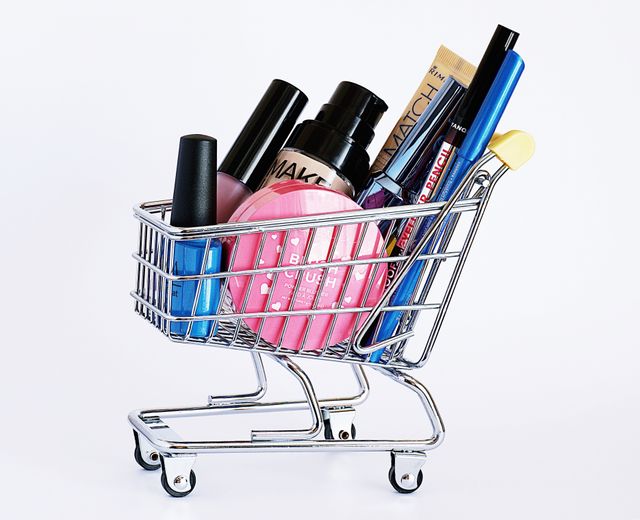
In 2026, cosmetic packaging buyers should be thinking beyond appearance and unit cost. Recyclability, recycled content, and refillability are increasingly becoming design requirements, especially for brands selling into Europe.
1. PPWR Is Pushing Packaging Toward Recyclability
The EU Packaging and Packaging Waste Regulation (PPWR) began applying from mid-2026 and introduces progressively stricter requirements around recyclability, packaging reduction, recycled content, and reuse. From 2030, packaging placed on the EU market will need to meet defined recyclability performance requirements.
For cosmetic brands, this makes mono-material packaging increasingly relevant. Pumps and airless systems traditionally combine several plastics, springs, and other components that are difficult to separate.
Several suppliers on our list are already developing alternatives:
- UKPACK: mono-material PP pumps and refillable systems
- Jinsheng: mono-material PP airless packaging
- Libo Cosmetics: mono-material PET and refillable color-cosmetics packaging
If Europe is an important market, we would ask suppliers about recyclability at the design stage instead of trying to redesign the package after launch.
2. PCR Content Is Moving from an Option to a Procurement Requirement
PCR, or post-consumer recycled plastic, is becoming more important as regulators and brands try to reduce reliance on virgin resin.
The PPWR establishes minimum recycled-content requirements for plastic packaging beginning in 2030, with percentages varying by packaging type and material. That means brands developing packaging platforms in 2026 should already consider whether suppliers can provide documented recycled-content options.
Relevant suppliers on this list include:
- UKPACK: PCR materials with GRS certification
- Sanle Plastic: PCR alongside other alternative-material ranges
- COSME: PCR options alongside PLA and PHA
- Libo Cosmetics: PCR ranges for color-cosmetics packaging
- Jarsking: PCR options for premium packaging projects
We would still verify the documentation for the specific resin and order being quoted. A supplier offering PCR somewhere in its catalog does not mean every bottle automatically contains certified recycled material.
3. Refillable Packaging Is Expanding Beyond Luxury
Refillable packaging is becoming more relevant in skincare and color cosmetics as brands try to reduce the amount of packaging used over a product’s lifetime. The PPWR also explicitly encourages reuse and refill systems as part of the EU’s broader packaging-reduction strategy.
On our list, UKPACK, HCP Packaging, and Libo Cosmetics all offer refillable formats, while Jarsking provides the broader custom-development capability needed for premium packaging programs.
The sourcing challenge is making the refill system practical. We would test insert removal, closure durability, leakage, repeated use, and refill availability before treating a refillable design as commercially ready.
4. Sustainable Claims Need Better Documentation
Suppliers increasingly advertise terms such as PCR, biodegradable, compostable, bamboo, or bio-based. Buyers should treat these as material claims that need evidence, rather than assuming the wording itself proves environmental performance.
Sanle, for example, lists PCR, PLA, ocean-bound, and compostable packaging, while UKPACK has GRS verification and other sustainability-related certifications in the records reviewed for this article.
For procurement in 2026, our approach is simple: choose the packaging structure first, then verify the sustainability claim behind it. Ask what percentage of recycled material is actually used, which component it applies to, and what certification or test report supports the claim.
For smaller brands exploring these options, see our guide to Eco-Friendly Packaging for Small Business.
FAQS
Can startups source cosmetic packaging from China with a low MOQ?
Yes, but startups usually get the most flexibility by choosing stock packaging rather than developing a custom mold. Some suppliers and trading companies can handle smaller quantities, particularly when you use an existing bottle or jar and add logo printing, labels, or secondary packaging.
Custom shapes generally require higher volumes because tooling and production setup have to be justified. For an early launch, we usually suggest testing the market with stock components first, then moving to custom molds once repeat-order volume supports the investment.
Can Chinese suppliers add my logo without creating a custom mold?
Yes, most brands can customize existing packaging without paying for a new mold. Common options include silk-screen printing, hot stamping, labels, spraying, frosting, and other surface treatments.
This is often the most practical route for a new brand because you keep the supplier’s existing bottle or jar shape while changing the visual identity.
We generally suggest confirming the decoration method during sampling, since colors and metallic finishes can look different on glass, PET, acrylic, or PP. Always approve the finished decoration before mass production.
Who owns the mold when I pay for custom cosmetic packaging?
You should clarify mold ownership in writing before paying any tooling fee. In a true custom OEM project, the buyer usually funds the tooling and should specify ownership, exclusivity, storage, maintenance, and what happens if production moves to another factory.
Do not assume that paying a mold fee automatically gives you unrestricted control. We recommend putting these terms into the purchase agreement and confirming whether the factory can use the mold for other customers. This matters especially when the packaging shape is part of your brand differentiation.
How many suppliers should I sample before placing an order?
We suggest sampling from at least three serious candidates before choosing a cosmetic packaging supplier. The goal is not simply to compare appearance; you also want to evaluate dimensions, material feel, printing, pump output, closure fit, leakage, and communication quality.
Use the same specification and formula tests for each supplier so the comparison is fair.
Once you choose one, approve a golden sample that both sides can use as the production reference. A slightly higher sample cost is usually worth it before committing to thousands of units.
How should I test cosmetic packaging with my formula?
Test the packaging with the actual formula whenever possible before approving mass production. Look for leakage, swelling, cracking, odor, discoloration, evaporation, pump consistency, and changes to the container or closure over time.
Airless systems and pumps also need functional testing because a bottle can look correct while dispensing poorly. We normally treat formula compatibility as separate from visual QC: the supplier can confirm material specifications, but the brand remains responsible for confirming that its specific formulation and packaging work together under expected storage and use conditions.
What documents should I request from a cosmetic packaging supplier?
Request documents that support the specific claims relevant to your packaging, rather than collecting certificates for their own sake.
Useful records can include the business license, third-party factory verification, quality-management certificates, material specifications, and supporting documentation for PCR or other sustainability claims.
If a supplier says a material is recycled, biodegradable, or compliant with a particular standard, ask what certificate covers the exact product being quoted. We also compare the legal company name on the documents with the company receiving payment before placing an order.
What HS codes are commonly used for cosmetic packaging?
The HS code depends mainly on the packaging material and product construction, so confirm classification before importing. Common headings referenced for cosmetic packaging include 3923.30 for certain plastic bottles, 7010.90 for certain glass containers, and 7612.90 for some aluminum containers.
These should be treated as starting points rather than automatic classifications for every product. A pump, closure, assembled airless system, or multi-material package may need different treatment. We recommend confirming the final code and applicable duties with your freight forwarder or customs broker before pricing the landed cost.
What payment terms are common with Chinese cosmetic packaging suppliers?
A common structure is a deposit before production with the remaining balance paid before shipment, but exact terms vary by supplier and order size.
The source data for this article uses 30% T/T upfront and 70% before shipment as a typical benchmark, while mold fees may follow their own payment schedule.
For a first order, we prefer payment methods that leave a clear commercial record. Always confirm that the bank beneficiary matches the supplier’s legal entity, and independently verify any last-minute request to change payment details.
Should I use FOB or DDP shipping for cosmetic packaging?
FOB gives experienced importers more control, while DDP can simplify logistics for buyers who want one landed quote. With FOB, you normally manage the international freight, customs clearance, duties, and destination delivery through your own forwarder.
DDP places more of that coordination with the supplier or logistics provider. Cosmetic packaging is bulky relative to its unit value, so freight can materially change the economics of an order.
We suggest comparing landed cost rather than supplier price alone and confirming exactly which charges are included before accepting either shipping term.
Should the bottle, pump, and cap come from the same supplier?
They do not have to come from the same factory, but sourcing matched components through one coordinator can reduce compatibility problems.
Pumps, neck finishes, collars, caps, and bottles must fit together correctly, and small dimensional differences can cause leakage or assembly issues. A vertically integrated manufacturer can simplify this, while traders such as Kinpack can coordinate components across partner factories.
If you source each part separately, send final samples between suppliers and test the assembled set before mass production. Never assume two components are compatible simply because their nominal dimensions match.
How often should I re-verify a cosmetic packaging supplier?
Re-check important supplier information before every major new project, especially if significant time has passed since your last order. Factory ownership, certification status, websites, staff, production capacity, and financial condition can all change.
In our August 2026 review, verification uncovered a compromised supplier website, trading companies presented as manufacturers, and a former entry affected by a delisting-risk warning.
That is why we treat supplier verification as a dated snapshot, not permanent approval. For repeat orders, at minimum confirm legal details, active certifications, payment information, and production capability again.
Is air freight worth using for empty cosmetic packaging?
Air freight usually makes sense for samples or urgent small shipments, while sea freight is more practical for bulk empty packaging.
Bottles and jars take up significant volume without carrying much product value, so air freight can quickly make the landed cost unattractive. For a normal production order, we would plan around sea shipping and build enough launch buffers for transit.
Air freight is useful when you need pre-production samples, replacement components, or a small quantity to protect a launch date, but it should generally be treated as an exception rather than the default logistics plan.

1 thought on “17 Cosmetic Packaging Suppliers in China: Verified List 2026”