Alibaba is better for beginners and international buyers who want a simpler sourcing process. 1688 is better for buyers who want lower factory-direct prices and can work with a China-based sourcing agent.
Alibaba supports English communication, international payments, export shipping, and Trade Assurance. 1688 is usually cheaper because it serves China’s domestic wholesale market, but most suppliers communicate in Chinese, expect local payment methods, and ship only within China.
In short: choose Alibaba for convenience. Choose 1688 for better margins, bulk sourcing, and OEM/private label products, if you can manage payment, verification, QC, and shipping through a sourcing partner.
Key Takeaways
- Alibaba is easier for international buyers because it supports English communication, global payment methods, international shipping, and Trade Assurance.
- 1688 is usually cheaper at the product-price level because it is built for China’s domestic wholesale market, where prices are closer to factory-direct rates.
- The real comparison is the landed cost, not the listing price. 1688 may look cheaper, but buyers still need to factor in agent fees, domestic China shipping, QC, consolidation, and international freight.
- Alibaba is better for beginners and small test orders, while 1688 is better for bulk sourcing, margin-focused buyers, and businesses that already understand importing.
- 1688 can be stronger for OEM and private label sourcing, but supplier verification is important because not every low-priced listing comes from a real factory.
- Most foreign buyers need a sourcing agent for 1688 to handle Chinese communication, Alipay payments, supplier checks, quality control, and shipping coordination.
What Are Alibaba and 1688?
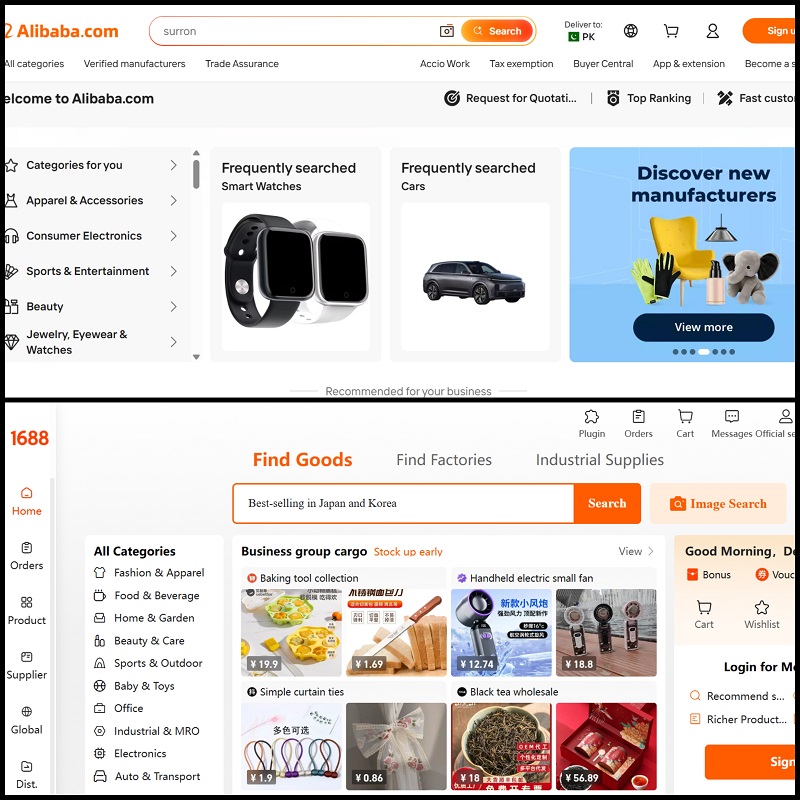
Alibaba and 1688 are both B2B sourcing platforms owned by Alibaba Group, but they are built for different buyers.
Alibaba.com is designed for international trade, helping global buyers source products from Chinese manufacturers, wholesalers, and trading companies.
1688.com is mainly built for China’s domestic wholesale market. Its suppliers usually sell to local Chinese businesses, factories, retailers, and resellers, which is why prices can be lower than Alibaba.
The trade-off is that the platform is mostly in Chinese, payments are usually handled through local methods like Alipay, and most suppliers only ship within China.
So while both platforms can help you source products from China, Alibaba is the export-friendly option, while 1688 is the domestic wholesale option with lower pricing but more operational barriers.
| Factor | Alibaba | 1688 |
| Main Audience | International buyers, importers, dropshippers, Amazon sellers, and businesses sourcing globally | Domestic Chinese businesses, wholesalers, retailers, factories, and local resellers |
| Language | English-friendly, with many suppliers used to foreign buyers | Mostly Mandarin Chinese, with limited English support from suppliers |
| Pricing | Usually higher because prices often include export support, platform costs, and trading company margins | Usually lower because prices are closer to China’s domestic wholesale or factory-direct rates |
| MOQ | Often flexible, especially for export buyers and sample orders | Varies by supplier, but many listings support wholesale quantities for local buyers |
| Payment Methods | Credit card, bank transfer, PayPal in some cases, and Alibaba Trade Assurance | Mostly Alipay, RMB payments, or local Chinese payment methods |
| Buyer Protection | Trade Assurance is available on eligible orders | Limited protection for foreign buyers, especially without a local account or sourcing partner |
| Shipping | Many suppliers can arrange international shipping | Most suppliers only ship within China |
| Supplier Type | Mix of manufacturers, trading companies, and export-focused suppliers | Mix of factories, wholesalers, and domestic suppliers |
| Best For | Beginners, small test orders, easier communication, and export-ready sourcing | Bulk sourcing, better margins, factory-direct pricing, and OEM/private label sourcing with support |
| Main Challenge | Prices can be higher, and some suppliers are intermediaries | Language, payment, supplier verification, QC, and international shipping require extra support |
Is 1688 Really Cheaper? Landed Cost Breakdown
Yes, 1688 is often cheaper than Alibaba at the product-price level, but the real question is landed cost. A lower listing price only matters if the final cost still makes sense after agent fees, domestic shipping, quality control, consolidation, and international freight.
Here’s a simple example for a product order that costs around $1,000 on Alibaba:
| Cost Component | Alibaba Route | 1688 + Sourcing Agent Route |
| Product price | $1,000 | $700 |
| Sourcing agent fee | $0 | $35–$70 |
| Domestic China shipping | Often included or bundled | $20–$40 |
| QC / inspection | Optional | Optional but recommended |
| Total before international freight | ~$1,000 | ~$755–$810 |
In this example, 1688 still comes out cheaper before international freight. The reason is simple: Alibaba is built for export buyers, so prices often include supplier markup, English support, export handling, platform costs, and sometimes trading company margins.
1688 is different. It serves China’s domestic wholesale market, so pricing is often closer to factory or local wholesale rates. This is why many buyers see stronger margins when sourcing through 1688, especially on repeat orders or bulk purchases.
That said, 1688 is not automatically cheaper in every case. If your order is very small, the extra costs of agent support, warehouse handling, inspection, and shipping coordination can reduce the savings. But for larger orders, private label products, and repeat sourcing, 1688 can offer a better total cost structure than Alibaba.
Why Is 1688 Cheaper Than Alibaba?
1688 is usually cheaper than Alibaba because it is built for China’s domestic wholesale market, where suppliers price in RMB for local retailers, wholesalers, and factories. Alibaba, on the other hand, is built for global buyers, so prices often include export handling, English-speaking sales support, international service costs, and trading company markups.
The difference is not only about the platform. It is about who the platform serves.
Key reasons 1688 prices are lower:
- Domestic pricing: 1688 suppliers usually price for Chinese buyers, not international importers. This often means lower base prices before export costs are added.
- Fewer export middlemen: Many Alibaba listings come from trading companies that source from factories and resell to overseas buyers. On 1688, buyers can often get closer to the original factory or domestic wholesaler.
- Lower service overhead: 1688 suppliers usually do not provide English-speaking sales teams, export paperwork support, or international customer service. That keeps prices lower, but it also makes buying harder for foreign buyers.
- High local competition: 1688 suppliers compete in China’s domestic market, where buyers compare prices aggressively. This can push suppliers to offer thinner margins.
- Smaller domestic wholesale orders: Some 1688 suppliers are used to serving smaller Chinese businesses, so MOQs can be flexible depending on the product category. However, this varies by supplier and should always be confirmed before ordering.
In practice, this is why the same product can appear cheaper on 1688 than Alibaba. But the lower price only becomes useful if you can also manage supplier verification, payment, quality control, and shipping.
Alibaba vs 1688 for OEM and Private Label
Alibaba is better for beginners and international convenience, while 1688 is better for experienced buyers who want lower costs and more direct factory access. For OEM and private label sourcing, the choice depends on whether you need an easier export-ready process or deeper cost control.
| Feature | Alibaba | 1688 |
| MOQ | Medium to high, but often negotiable | Low to medium, depending on supplier |
| Customization | Strong, especially with export-ready suppliers | Strong, but harder to manage without Chinese communication |
| Payment & Shipping | Easier through Trade Assurance and international shipping options | More complex; usually requires Alipay, local payment, and China-based shipping support |
| Best For | New importers, simple private label orders, export-ready sourcing | Cost-focused buyers, repeat orders, deeper factory sourcing, and OEM projects with sourcing support |
Alibaba for OEM and Private Label
Alibaba is easier for OEM and private label sourcing because it is built for international trade. Many suppliers are used to handling logo printing, custom packaging, product samples, export documents, compliance requests, and overseas shipping.
Pros:
- Easier communication with English-speaking sales teams.
- More export-ready suppliers familiar with international buyers.
- Trade Assurance may offer protection on eligible orders.
- Better for beginners testing private label products.
Cons:
- Prices are usually higher than 1688.
- Some suppliers are trading companies rather than direct factories.
- Customization costs may include extra service and export handling fees.
1688 for OEM and Private Label
1688 can be stronger for OEM and private label sourcing when your goal is to find lower-cost factories or domestic suppliers closer to the production source. This can be useful for repeat orders, bulk sourcing, and products where small unit-cost savings matter.
Pros:
- Lower product prices in many categories.
- Better chance of finding domestic factories and original wholesale sources.
- Useful for comparing Alibaba prices against China-market pricing.
- Can support deeper customization when managed through proper supplier communication.
Cons:
- The platform and supplier communication are mostly in Chinese.
- Most suppliers do not handle international shipping.
- Payments usually require Alipay or local Chinese payment methods.
- Supplier verification and quality control are harder without local support.
Which One Should You Choose for OEM or Private Label?
Choose Alibaba if you are new to importing, need English communication, want easier sample ordering, or prefer suppliers that already understand export requirements.
Choose 1688 if you want lower unit costs, better margins, or closer factory access, and you can work with a China-based sourcing agent to manage communication, payment, inspection, and shipping.
Best strategy: use Alibaba to research product categories, supplier claims, and customization options. Then use 1688 with a sourcing agent to compare factory-level pricing and check whether similar suppliers are available at a lower cost.
Challenges of Buying from 1688 as a Foreigner
The main challenge with 1688 is that it was not built for foreign buyers. It is a domestic Chinese wholesale platform, so the buying process assumes you can read Chinese, pay in RMB, communicate with local suppliers, and receive goods at a China-based address.
Here are the biggest issues international buyers face:
- Language barrier: 1688’s interface is mostly in Mandarin Chinese, and many suppliers do not respond to English messages. Even if translation tools help with browsing, they are not reliable enough for negotiating specs, packaging, lead times, and quality standards.
- Local payment requirements: Many suppliers expect payment through Alipay, Chinese bank transfer, or other local payment methods. This can be difficult if you do not have a verified Chinese payment account.
- Domestic shipping only: Most 1688 suppliers ship within China, not directly to overseas buyers. You usually need a consolidation warehouse, freight forwarder, or sourcing agent to receive the goods and arrange international shipping.
- Limited buyer protection: Unlike Alibaba, 1688 does not offer the same international buyer protection structure. If product quality is poor or the supplier sends the wrong goods, solving the issue from overseas can be difficult.
- Supplier verification is harder: Low prices can attract buyers, but not every supplier is a real factory or reliable manufacturer. You need to check business details, product specialization, transaction history, reviews, and factory capability before placing a serious order.
- Quality control happens before shipping: Once goods leave China, fixing quality issues becomes expensive. For 1688 orders, pre-shipment inspection is especially important because disputes are harder to manage after export.
For small test orders, these challenges may feel manageable. But for bulk orders, private label products, or Amazon FBA sourcing, 1688 usually works best when you have someone in China handling communication, payment, inspection, consolidation, and freight coordination.
Alibaba Trade Assurance: Strengths and Limits
Alibaba Trade Assurance is a free buyer protection service that helps reduce risk on eligible Alibaba orders. It works by keeping the transaction on Alibaba, documenting the agreed order terms, and giving buyers a dispute channel if the supplier fails to meet the agreed shipping date or product quality standards.
However, Trade Assurance is not a complete guarantee. It works best when the order contract clearly defines product specs, packaging, inspection standards, shipping timelines, and refund terms.
Strengths of Alibaba Trade Assurance
- Payment protection: Payment is processed through Alibaba, so buyers have a formal transaction record instead of sending money directly to a supplier’s personal or external account.
- Shipping protection: If the supplier misses the agreed shipment date, buyers may be able to open a dispute based on the order terms.
- Product quality protection: If the delivered goods do not match the agreed specifications, buyers can use the documented order details as evidence.
- Dispute mediation: Alibaba can step in as a mediator between the buyer and supplier instead of leaving the buyer to handle the issue alone.
- Verified supplier visibility: Trade Assurance is often used alongside Alibaba’s supplier verification badges, which can help buyers filter suppliers more confidently.
Limits of Alibaba Trade Assurance
- Only applies to on-platform orders: If you pay outside Alibaba, Trade Assurance protection does not apply.
- Protection depends on written terms: If your order details are vague, it becomes harder to prove that the supplier failed to meet the agreement.
- Custom products are harder to dispute: OEM and private label orders need very clear specs, samples, artwork files, materials, colors, packaging details, and defect limits.
- Disputes require evidence: Photos, videos, inspection reports, chat history, and signed order terms all matter. Without strong evidence, the outcome may not favor the buyer.
- It does not replace quality control: Trade Assurance can help after a problem happens, but it does not prevent defective products from being produced or shipped.
Best Practices for Using Trade Assurance
- Keep all payments and communication on Alibaba.
- Define product specs, packaging, colors, quantities, and shipping dates clearly in the order.
- Use samples before bulk production.
- Arrange pre-shipment inspection before goods leave China.
- Add AQL standards or acceptable defect limits for larger orders.
- Check the supplier’s Trade Assurance coverage amount before placing a high-value order.
How to Buy from 1688 Safely
The safest way to buy from 1688 as a foreign buyer is to treat it as a China domestic sourcing platform, not a ready-made international ordering site. That means you need to verify the supplier, confirm product details in Chinese, arrange local payment, inspect the goods, and ship through a warehouse or sourcing agent.
Here’s the basic process:
- Search with Chinese keywords or image search: English searches usually return weak results on 1688. Use translated product keywords or upload a product image to find similar listings.
- Shortlist multiple suppliers: Do not choose only the cheapest listing. Compare supplier history, product specialization, transaction activity, reviews, response quality, and whether the store focuses on your product category.
- Confirm the supplier is suitable: Ask whether they are a factory, wholesaler, or trading company. For OEM/private label orders, also confirm customization options, MOQ, lead time, packaging, material options, and sample availability.
- Get a clear quotation: Confirm unit price, MOQ, domestic shipping cost, production time, packaging details, and whether the price includes any customization. Small details matter because 1688 listings are often written for local buyers who already understand the market.
- Arrange payment through a trusted local channel: Many 1688 suppliers expect Alipay, RMB transfer, or local Chinese payment methods. Foreign buyers usually need a sourcing agent or China-based partner to handle payment safely.
- Send goods to a China warehouse: Most 1688 suppliers only ship domestically. Your goods normally need to be sent to a consolidation warehouse before international shipping.
- Inspect before international shipment: Check quantity, product appearance, packaging, labeling, and major defects before goods leave China. For larger orders, use AQL inspection standards instead of relying only on supplier photos.
- Consolidate and ship internationally: If buying from multiple suppliers, consolidate the goods first to reduce shipping complexity. Then choose the right freight method based on order size, urgency, and destination.
The key rule is simple: do not judge 1688 only by the listed price. A safe order depends on supplier verification, clear specifications, payment control, quality inspection, and reliable shipping coordination.
When Should You Use a Sourcing Agent?

You should use a sourcing agent for 1688 if you cannot handle Chinese communication, local payments, supplier verification, quality control, or China-based shipping on your own. 1688 can offer better prices, but the platform is not built for overseas buyers, so the savings only matter if the order is managed properly.
A sourcing agent is especially useful when:
- You are buying from 1688 as a foreigner and need help communicating with suppliers in Chinese.
- You cannot pay through Alipay or RMB bank transfer and need a local payment solution.
- You are ordering from multiple suppliers and need warehouse consolidation before international shipping.
- You are sourcing OEM or private label products and need help confirming materials, packaging, logos, samples, and production details.
- You are placing a bulk order where product defects, wrong quantities, or poor packaging could become expensive after export.
- You need supplier verification to check whether a supplier is a real factory, wholesaler, or trading company.
A good sourcing agent should do more than simply place the order. They should help compare suppliers, negotiate pricing, confirm specifications, arrange payment, receive goods in China, inspect quality, consolidate shipments, and coordinate international freight.
There are also red flags to watch for. Avoid agents who are unclear about fees, refuse to explain their inspection process, push only one supplier without comparison, avoid sharing basic order details, or cannot provide a clear warehouse and shipping workflow.
For simple sample orders, you may not need full sourcing support. But for bulk sourcing, Amazon FBA, OEM/private label products, or multi-supplier orders, a sourcing agent can reduce risk and make 1688 much easier to use.
How NicheSources Helps Buyers Source from 1688
NicheSources helps international buyers access 1688 without needing to manage the China-side sourcing process alone. Instead of only giving you supplier links, our team helps handle the parts that usually make 1688 difficult for foreign buyers: communication, payment, verification, inspection, consolidation, and shipping.
Here’s where NicheSources fits into the process:
- Supplier sourcing and comparison: We help find suitable 1688 suppliers, compare pricing, check product options, and identify whether a supplier looks like a factory, wholesaler, or trading company.
- Chinese communication: Our team communicates with suppliers in Chinese to confirm MOQ, materials, customization, packaging, lead time, sample costs, and domestic shipping fees.
- Local payment support: Since many 1688 suppliers require Alipay or RMB payments, NicheSources helps coordinate supplier payments through local China-side channels.
- Sample and order coordination: We can help arrange samples, compare quality, confirm specifications, and avoid moving into bulk production too quickly.
- Quality control before export: Before goods leave China, we can check quantity, appearance, packaging, labeling, and basic defects. For larger orders, this can be aligned with AQL inspection standards.
- Warehouse consolidation and shipping: If you source from multiple suppliers, we can receive goods in China, consolidate them, and arrange international shipping based on your destination and order size.
This is especially useful if you are sourcing from 1688 for bulk orders, Amazon FBA, wholesale, or OEM/private label products. The goal is not just to find a lower product price, but to make sure the final landed cost, quality, and shipping plan actually work for your business.
You can submit a Free Sourcing Request to get help finding and comparing suppliers from 1688.
Alibaba vs 1688 vs Taobao vs AliExpress
Alibaba, 1688, Taobao, and AliExpress are all Alibaba Group platforms, but they serve different buying needs. For sourcing products from China, the main difference is whether you are buying for business, personal use, domestic China trade, or international small-order retail.
| Platform | Main Use | Best For | Main Limitation |
| Alibaba | International B2B sourcing | Importers, brands, Amazon sellers, wholesalers, and businesses placing export orders | Prices are often higher than 1688, and some suppliers are trading companies |
| 1688 | Domestic China wholesale sourcing | Buyers who want lower prices, factory-direct options, and bulk sourcing through a China-based agent | Chinese language, local payment, domestic shipping, and limited protection for foreign buyers |
| Taobao | China domestic retail marketplace | Small personal purchases, trend research, and finding consumer products sold in China | Not ideal for wholesale sourcing or international B2B orders |
| AliExpress | International retail and small-order buying | Product testing, dropshipping, and buying single units without MOQ | Higher unit prices and weaker margins for serious bulk sourcing |
In simple terms, Alibaba is the easiest B2B platform for global buyers, 1688 is better for lower-cost China wholesale sourcing, Taobao and 1688 is mainly for domestic retail, and AliExpress is best for small international orders or product testing.
For ecommerce sellers, AliExpress can be useful when testing a product with low upfront risk. But once the product proves demand, moving to Alibaba or 1688 usually makes more sense because you can negotiate better pricing, packaging, and shipping terms.
Final Recommendation: Should You Choose Alibaba or 1688?
If you are a beginner, sourcing small quantities, or placing your first few orders from China, Alibaba is usually the better choice. It is easier to use, more English-friendly, and gives you access to export-ready suppliers, international payment options, and Trade Assurance.
If you are focused on better margins, bulk sourcing, or finding lower factory-direct prices, 1688 can be the better option. The trade-off is that you will likely need help with Chinese communication, Alipay payments, supplier verification, quality control, consolidation, and international shipping.
If you need OEM or private label products, compare both platforms. Alibaba is easier for starting conversations with export-ready suppliers, while 1688 can help you find deeper factory options and better unit costs once you are ready to scale.
For most growing businesses, the practical approach is simple: start with Alibaba for convenience, then use 1688 with a reliable sourcing agent when cost control and supplier depth become more important.
Need help comparing Alibaba and 1688 suppliers? Submit a Free Sourcing Request to NicheSources, and our China-based team can help you find suppliers, verify pricing, inspect products, and arrange shipping before you commit to a bulk order.
FAQs
Which is cheaper, Alibaba or 1688?
1688 is usually cheaper than Alibaba at the product-price level because it serves China’s domestic wholesale market. However, the final cost depends on agent fees, domestic China shipping, quality checks, consolidation, and international freight. For bulk or repeat orders, 1688 often provides better margins.
Can foreigners order directly from 1688?
Foreigners can browse 1688, but ordering directly is difficult. Most suppliers communicate in Chinese, expect RMB payments through Alipay or local bank transfer, and ship only within China. Foreign buyers usually need a sourcing agent, freight forwarder, or China-based partner to complete the order safely.
Is 1688 owned by Alibaba?
Yes, 1688 is owned by Alibaba Group. Alibaba.com is designed for international B2B trade, while 1688.com is designed for China’s domestic wholesale market. That difference explains why Alibaba is easier for global buyers, while 1688 often has lower local-market pricing.
What are the risks of buying from 1688?
The main risks are supplier reliability, language barriers, payment difficulty, limited buyer protection, and quality issues. Since 1688 is built for domestic Chinese buyers, foreign buyers need to verify suppliers carefully, confirm product specs in detail, inspect goods before export, and arrange reliable shipping from China.
Do I need a sourcing agent to buy from 1688?
Most foreign buyers should use a sourcing agent for 1688. An agent can communicate with suppliers in Chinese, handle local payments, verify suppliers, receive goods at a China warehouse, inspect products, consolidate shipments, and arrange international freight. This is especially useful for bulk, OEM, or private label orders.
Is 1688 good for Amazon FBA sourcing?
Yes, 1688 can be useful for Amazon FBA sourcing if you already understand supplier verification, product compliance, packaging, labeling, and freight planning. It can help reduce unit costs, but buyers still need inspections, FBA-ready packaging checks, and reliable shipping coordination before sending goods to Amazon warehouses.
Is Alibaba safer than 1688?
Alibaba is usually safer for beginners because it is built for international buyers. It offers English communication, international payment options, export-ready suppliers, and Trade Assurance on eligible orders. 1688 can still be safe, but it requires stronger China-side support for payment, verification, inspection, and shipping.
Is 1688 better than AliExpress?
1688 is better for wholesale sourcing, while AliExpress is better for small international orders or product testing. AliExpress is easier to use and supports direct international shipping, but unit prices are usually higher. 1688 is harder to use, but it can offer better pricing for bulk orders.