You post an RFQ on Alibaba and receive ten supplier quotes. Sounds promising, until you realize nine of them either ignore your specifications, offer unrelated products, or leave out important costs. Now you’re spending more time filtering suppliers than actually comparing offers.
Alibaba’s built-in AI can help draft your RFQ, making the process even faster. But a completed form doesn’t guarantee useful quotations. You still need clear specifications, realistic quantities, and a way to evaluate the suppliers responding.
An Alibaba RFQ (Request for Quotation) is a free sourcing feature that lets buyers submit one purchasing request and receive competing offers from relevant suppliers. Instead of contacting manufacturers individually, you describe your product, order quantity, and requirements once. Suppliers can then respond with pricing, minimum order quantities (MOQs), and production terms.
Quick Facts: Alibaba RFQ in 2026
| Feature | Details |
| Cost for buyers | Free to post; optional paid boosts |
| Paid boosts | Urgent Request (9.99); Extra Quotes (2.99) |
| Quotes per RFQ | Around 10 is typical; Alibaba marketing also mentions up to approximately 15 on average |
| Approval | RFQs are reviewed before publication |
| Response time | Alibaba advertises multiple quotations within 24 hours |
| Where to post | rfq.alibaba.com |
| Managing requests | Active RFQs can be closed; deletion is not supported |
What Is an RFQ on Alibaba?
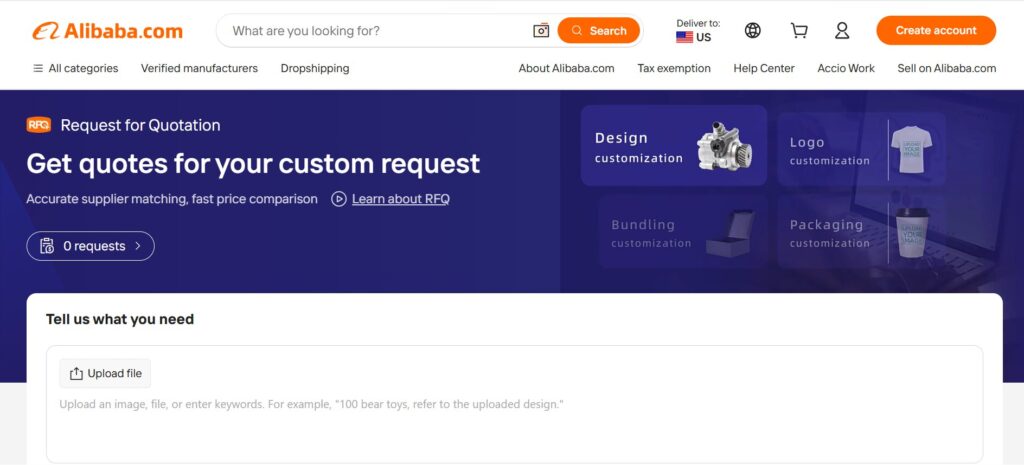
An RFQ (Request for Quotation) on Alibaba is a formal purchasing request that allows buyers to collect price offers from multiple suppliers using the same product requirements.
When you submit an RFQ, Alibaba matches your request with suppliers in the relevant product category. Interested suppliers can respond with quotations covering unit prices, minimum order quantities (MOQs), production lead times, and customization options.
Unlike a regular product inquiry, where you contact suppliers individually, an RFQ allows suppliers to approach you with their offers.
An RFQ does not commit you to purchasing anything. You can review quotations, negotiate pricing, request samples, and shortlist suppliers before deciding whether to place an order.
We recommend treating the RFQ as the first stage of supplier selection. A competitive quotation is useful, but you still need to verify the supplier’s capabilities and confirm that they can consistently meet your product specifications.
The Purpose of RFQ on Alibaba

The purpose of Alibaba RFQ is to help buyers find suitable suppliers, compare quotations, and negotiate better purchasing terms without contacting each supplier individually.
By sharing the same product specifications, quantities, and delivery requirements with multiple suppliers, you can compare their prices, MOQs, and lead times on a consistent basis.
It also helps suppliers assess whether they can meet your requirements before investing time in preparing an offer.
How Does Alibaba RFQ Work?
Alibaba RFQ works in three steps: submit your product requirements, receive quotations from interested suppliers, and negotiate with the most suitable candidates.
Here’s how the process works.
1. Submit Your RFQ
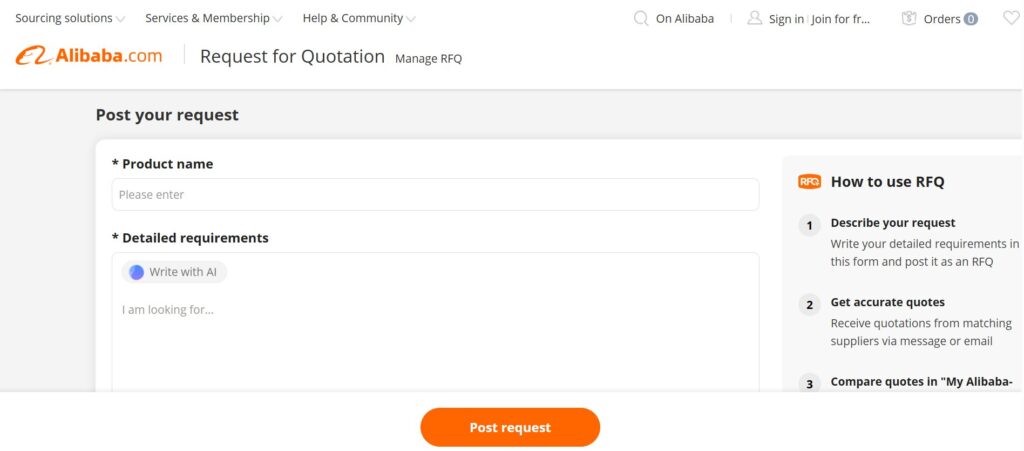
Start by visiting rfq.alibaba.com or accessing the RFQ section through your Alibaba account.
Describe the product you want to source, including its specifications, quantity, customization requirements, and preferred delivery terms. The more specific your request, the easier it is for suppliers to provide accurate pricing.
Alibaba also offers built-in AI assistance to help draft RFQs from a short product description. This can save time, but we recommend reviewing the generated specifications carefully before submitting.
Your RFQ goes through Alibaba’s review process before appearing in the RFQ market. If rejected, you can revise the request and resubmit it for approval.
2. Receive and Compare Quotations
Once approved, your RFQ becomes available to relevant suppliers who can review your requirements and submit quotations.
Alibaba advertises multiple quotations within 24 hours, although actual response times vary depending on the product, order quantity, and supplier availability.
You can review the responses through Alibaba’s Message Center and compare:
- Unit prices and minimum order quantities (MOQs)
- Production lead times
- Customization capabilities
- Shipping terms and additional charges
- Supplier experience and communication quality
We recommend allowing time for additional responses before making your shortlist. Some capable manufacturers may respond later, particularly when your product requires detailed costing.
3. Communicate and Negotiate With Suppliers

Once you identify promising suppliers, contact them through Alibaba’s Message Center to clarify their quotations and discuss purchasing terms.
This is your opportunity to negotiate pricing, confirm product specifications, request samples, and discuss production timelines.
Don’t automatically choose the lowest quotation. A supplier offering a slightly higher unit price may provide better materials, more reliable production schedules, or more favorable shipping terms.
We suggest shortlisting two or three suppliers for further evaluation before committing to an order.
The key platform details are confirmed by Alibaba’s official RFQ pages: requests undergo review before publication, AI-assisted drafting is available, and Alibaba advertises multiple quotes within 24 hours. Actual response times may vary.
When Should I Use Alibaba RFQ?
Alibaba RFQ is most useful when you know what product you want to source and need to compare offers from multiple suppliers.
For example, if you’re sourcing 1,000 custom tote bags with specific dimensions, materials, and branding requirements, an RFQ lets you share those details with several potential suppliers at once.
We recommend using RFQs when you’re:
- Sourcing a new product: You haven’t selected a supplier and want to compare available manufacturers.
- Buying in bulk: You need competitive pricing for larger quantities and want to understand different suppliers’ MOQs.
- Developing a customized product: You want to compare manufacturing capabilities, customization costs, and production timelines.
- Evaluating sourcing costs: You need multiple quotations to establish a realistic price range before placing an order.
However, if you’re still researching products and haven’t finalized your requirements, start with Alibaba’s product search. Suppliers will struggle to provide meaningful quotations without clear specifications.
Alibaba RFQ vs. Contacting Suppliers Directly
Both methods are useful, but the right choice depends on where you are in the sourcing process.
| Situation | Alibaba RFQ | Direct Messaging |
| Finding new suppliers | Best for discovering multiple potential suppliers | Best when you already have specific suppliers in mind |
| Comparing prices | Collect competing quotations for the same specifications | Request pricing from individual suppliers |
| Custom products | Compare capabilities and initial development costs | Discuss technical details with shortlisted manufacturers |
| Small orders | May attract fewer responses due to MOQ requirements | Often more practical for negotiating trial quantities |
| Repeat orders | Useful for benchmarking existing supplier pricing | Better for reordering from a trusted supplier |
| Negotiations | Helps establish a competitive price range | Better for detailed discussions and finalizing terms |
Our recommendation: Use Alibaba RFQ to identify potential suppliers and understand market pricing. Once you’ve shortlisted two or three candidates, communicate with them directly through Alibaba’s Message Center to negotiate terms, confirm specifications, and request samples.
This approach gives you a wider supplier pool without spending unnecessary time negotiating with every business that responds.
Benefits of Using Alibaba RFQ
Alibaba RFQ makes it easier to find suppliers, compare manufacturing costs, and evaluate potential partners without contacting dozens of factories individually.
Here are six benefits worth considering.
1. Saves Time Finding Suppliers

Searching Alibaba manually means reviewing product listings, checking supplier profiles, and sending individual inquiries.
With an RFQ, you submit your requirements once and let interested suppliers approach you with their offers.
This is particularly useful when sourcing products with multiple specifications or customization requirements, where finding suitable manufacturers through search alone can take considerable time.
2. Simplifies the Sourcing Process
You don’t need extensive experience using Alibaba to create an RFQ.
The platform guides you through product specifications, quantities, sourcing requirements, and shipping preferences. Once submitted and approved, your request becomes available to relevant suppliers.
You can then manage quotations and supplier conversations through your Alibaba account instead of tracking separate inquiries.
3. Helps Attract Serious Suppliers

One advantage buyers often overlook is that suppliers have limited RFQ quotation rights.
According to Alibaba’s published supplier rules, standard allocations can include around 20 free quotation opportunities per month, while certain premium membership tiers offer approximately 40–60.
This creates an incentive for suppliers to choose which requests deserve their attention.
For example, a manufacturer is more likely to spend a quotation opportunity on a request specifying 1,000 stainless steel water bottles, capacity, material grade, packaging, and delivery destination than one simply asking for the lowest price on water bottles.
However, receiving a response doesn’t automatically mean the supplier is qualified. You’ll still need to verify their manufacturing capabilities and reliability.
4. Makes Comparing Quotations Easier
When multiple suppliers respond to the same RFQ, you have a consistent starting point for comparing their offers.
You can evaluate unit prices, MOQs, production lead times, customization charges, and shipping arrangements side by side.
We recommend asking suppliers to quote using the same specifications, quantities, and Incoterms. Otherwise, a lower unit price may simply reflect different materials, excluded services, or shipping costs that haven’t been included.
5. Helps Evaluate Supplier Capabilities

A supplier’s response can tell you more than their price.
Pay attention to whether they understand your specifications, answer technical questions, and explain any manufacturing limitations.
For customized products, we recommend prioritizing suppliers who identify potential production challenges early and can explain how they would meet your requirements.
These initial conversations help you decide which suppliers are worth evaluating further through samples and quality inspections.
6. Lets You Assess Supplier Responsiveness
RFQs also give you an opportunity to see how suppliers communicate before placing an order.
You can compare how quickly they respond, whether they answer follow-up questions, and how clearly they explain pricing or production requirements.
A fast response is useful, but accuracy and consistency matter more than speed alone.
For example, a manufacturer who takes longer to prepare a detailed, itemized quotation may be a better candidate than one who replies immediately with a generic price and no explanation.
What Should an Alibaba RFQ Include?
A good Alibaba RFQ should give suppliers enough information to calculate accurate pricing and determine whether they can fulfill your order.
We recommend preparing your product specifications before submitting the request. Missing details often lead to generic quotations, unnecessary follow-up questions, and unexpected costs later.
Use this checklist to make sure your RFQ covers the essentials.
| RFQ Requirement | What to Include | Why It Matters |
| Product specifications | Product name, materials, dimensions, colors, and technical requirements | Helps suppliers identify the right product and calculate accurate costs |
| Order quantity | Expected initial order quantity and estimated repeat orders, if applicable | Determines pricing tiers and whether you meet the supplier’s MOQ |
| Quality requirements | Material grades, performance standards, required certifications, or test reports | Helps identify suppliers capable of meeting your quality and compliance requirements |
| Customization | Logo printing, private labeling, custom colors, or product modifications | Allows suppliers to account for additional production and tooling costs |
| Packaging | Individual packaging, retail boxes, labeling, or carton requirements | Prevents packaging costs from being excluded from the quotation |
| Delivery timeline | Target delivery date or required production lead time | Helps suppliers assess capacity and provide realistic schedules |
| Shipping terms | Preferred Incoterms, such as EXW, FOB, or DDP, and delivery destination | Ensures suppliers quote using comparable shipping responsibilities and costs |
| Sampling requirements | Whether you need samples, sample quantity, and any testing expectations | Helps clarify sample costs and availability before bulk production |
Our advice: Be specific about the requirements that affect manufacturing costs, but avoid overwhelming suppliers with unnecessary details.
For example, if you’re sourcing custom packaging, specifying the material, dimensions, printing method, and order quantity will produce more useful quotations than simply requesting a price for branded boxes.
If certain specifications are still undecided, identify them clearly and ask suppliers to quote available alternatives separately. This makes it easier to compare offers without confusing differences in product quality or production costs.
Alibaba RFQ Rules in 2026: Costs and Limits

Alibaba RFQ is free for buyers, but suppliers have limits on how many requests they can respond to each month. The platform also offers optional paid features and uses a review process before publishing buying requests.
Here’s a breakdown of the key Alibaba RFQ rules in 2026.
| Rule | Buyers | Suppliers |
| Cost | Free to submit RFQs; optional paid upgrades | Quotation allowances depend on supplier membership |
| Posting limits | No fixed general posting limit identified; duplicate requests may be restricted | Approximately 20 RFQ responses per month on eligible entry-level plans |
| Premium allowances | Optional Urgent Request and Extra Quotes features | Certain paid plans include 40–60 RFQ responses monthly |
| Quotes per RFQ | Around 10 is a common benchmark; actual responses vary | Suppliers decide which requests to answer |
| RFQ review | Requests are reviewed before publication; rejected requests can be revised | Suppliers must follow Alibaba’s quotation rules |
| RFQ classifications | Requests may receive Gold, Silver, or Bronze classifications associated with buyer levels L0–L4 | Access to higher-quality RFQs may depend on supplier eligibility |
| Trade Assurance | Available for eligible orders placed after supplier selection | Protection depends on the agreed order terms and Trade Assurance eligibility |
What About Paid RFQ Features?
Alibaba has documented two optional upgrades:
- Urgent Request: Gives your buying request greater visibility to suppliers.
- Extra Quotes: Increases the number of supplier quotations your request can receive.
Pricing should be checked directly in Alibaba’s RFQ form before purchasing. These upgrades may improve visibility or response opportunities, but neither guarantees that you’ll receive suitable offers.
Why Do Supplier Quotation Limits Matter?
Suppliers have a limited number of RFQ responses available under their membership plans, although additional rights may be purchased or awarded.
This means they’re more likely to prioritize requests with clear product specifications, realistic quantities, and credible purchasing requirements.
Our recommendation: Complete your buyer profile, provide accurate business information, and avoid posting duplicate requests. These steps make it easier for suppliers to assess your inquiry and decide whether it’s worth preparing a quotation.
How to Close, Edit, or Cancel an Alibaba RFQ
Alibaba allows you to close an active RFQ, but you cannot permanently delete it. Closing a request stops new quotations from coming in, which is useful once you’ve found suitable suppliers or no longer need the product.
You can also edit and resubmit certain requests if your specifications change or Alibaba rejects your original submission.
How to Close or Cancel an RFQ
According to Alibaba’s documented process, you can close an active RFQ through your account using a desktop browser.
- Log in to your Alibaba account.
- Navigate to My Alibaba → Buying Leads → My RFQs.
- Find the active RFQ you want to cancel.
- Select Close to stop accepting new quotations.
Your existing supplier quotations and conversations remain accessible through Alibaba’s Message Center.
Keep in mind: The Close option is available on desktop for active requests. Once an RFQ has expired, you can no longer close it manually.
How to Edit or Resubmit an RFQ
If you need to correct product details or your RFQ was rejected during Alibaba’s review process, you can revise the request.
- Open My RFQs in your Alibaba account.
- Find the request you want to modify.
- Select the available Edit option.
- Update your specifications, quantity, or other requirements.
- Resubmit the RFQ for review.
If Alibaba rejects your RFQ, check the feedback before resubmitting. Common issues to investigate include incomplete product descriptions, incorrect categories, or requests that may violate platform rules.
When Should You Close an RFQ?
We recommend closing an RFQ once you’ve collected enough comparable quotations and shortlisted two or three suitable suppliers.
Keeping it open unnecessarily can attract additional responses and create more work when you’ve already moved into sampling or negotiations.
If your requirements change significantly after closing the request, consider creating a new RFQ with updated specifications rather than continuing negotiations based on outdated quotations.
What Are the Different Alibaba RFQ Bid Types?

In an earlier version of this guide, we described four RFQ bid types: invited bidding, open bidding, sealed bidding, and reverse auctions.
We need to correct that information. These are general procurement methods used in B2B sourcing, not four bidding options you can select when posting an RFQ on Alibaba.
Alibaba’s RFQ system follows a simpler process: buyers submit their requirements, relevant suppliers respond with quotations, and buyers compare offers before negotiating.
Here’s how the four procurement concepts relate to Alibaba RFQs.
| Bidding Type | What It Means | How It Relates to Alibaba RFQ |
| Invited bidding | A buyer requests quotations from selected suppliers. | You can contact shortlisted Alibaba suppliers directly instead of posting a general RFQ. |
| Open bidding | A purchasing opportunity is available to a broad pool of eligible suppliers. | Alibaba distributes RFQs to relevant suppliers, but suppliers cannot see competing quotations. |
| Sealed bidding | Suppliers submit offers without knowing competitors’ prices. | Alibaba RFQ follows a similar approach because quotations are submitted privately to the buyer. |
| Reverse auction | Suppliers compete by progressively lowering their offers. | Alibaba RFQ doesn’t provide a dedicated reverse-auction process. Buyers can negotiate separately using competing quotations. |
What Does This Mean for Buyers?
You don’t need to select a bidding method when creating an Alibaba RFQ. The platform handles supplier matching, while you decide which quotations are worth pursuing.
We recommend collecting several comparable offers before negotiating. Since suppliers cannot see each other’s prices, you can use the quotations you’ve received to assess market pricing and negotiate more competitive terms.
Just make sure you’re comparing the same product specifications, order quantities, and shipping terms before using one supplier’s price to negotiate with another.
How to Get Supplier Recommendations from Alibaba?
You can get automatic supplier suggestions from Alibaba while you are contacting a supplier for your product. You just have to check the box that says “Recommend matching suppliers if this supplier doesn’t contact me on Message Center within 24 hours.”
This excellent Alibaba feature lets a supplier realize that he is bound to respond to the inquiry within 24 hours. Otherwise, Alibaba will refer the query to some other supplier.
Moreover, the Alibaba algorithm will suggest a better supplier within the same product category for your convenience.
How to Make an RFQ on Alibaba Step-by-Step?
To create an Alibaba RFQ, you need an Alibaba account and a clear description of the product you want to source.
You can start from:
- Alibaba’s RFQ portal: Go directly to the request submission page.
- Your Alibaba account: Navigate to Messages → Inquiries & RFQs → My RFQs → Post an RFQ.
- Alibaba’s homepage: Look for the RFQ or Request for Quotation option.
Alibaba also offers AI-assisted RFQ drafting. You can enter a short product description or upload reference files to generate a request, but we recommend checking every detail before submitting it.
The current RFQ form may initially show only a few fields, with additional details available depending on the form version. Here’s what to prepare for each of the 11 fields covered in the traditional RFQ process.
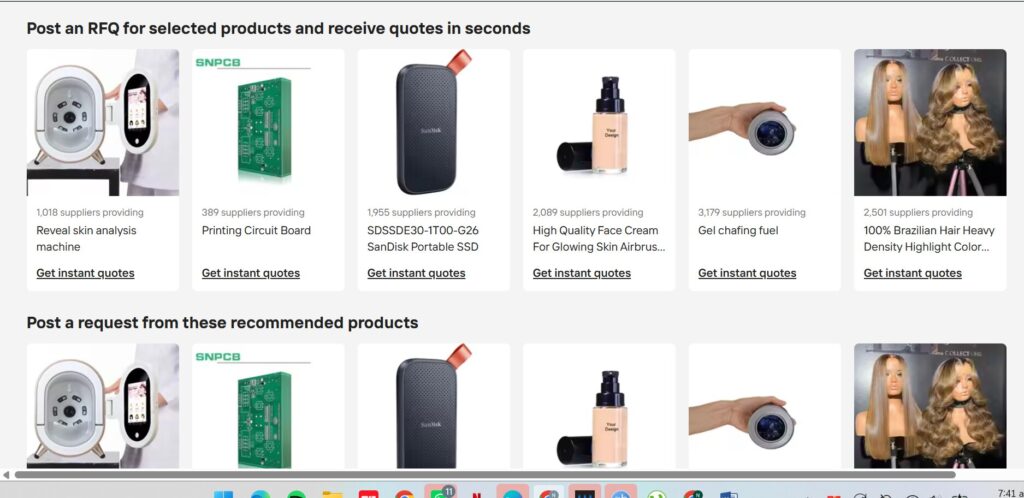
1. Product Name
Enter a clear, specific name that describes what you’re sourcing.
For example, instead of writing “pet bed,” use “Custom Orthopedic Dog Bed with Memory Foam.”
Product keywords help Alibaba identify relevant suppliers. Avoid unnecessary marketing language or descriptions that could lead to incorrect supplier matches.
2. Product Category
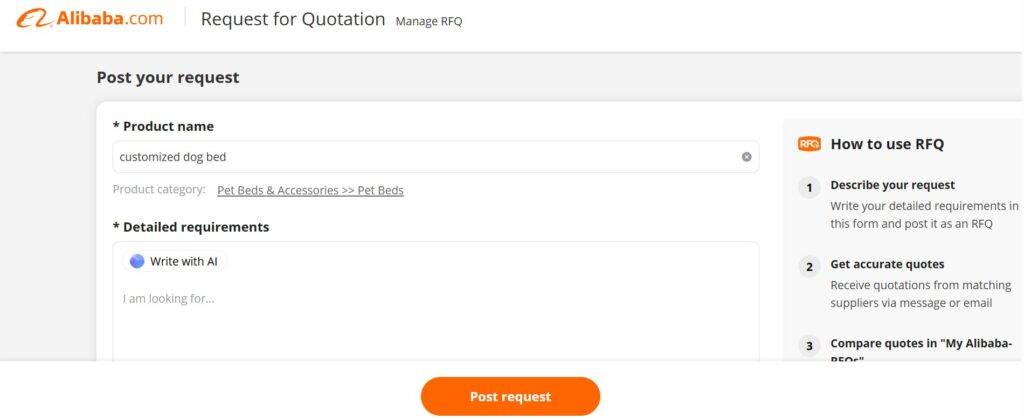
Choose the category that most closely matches your product.
For a customized dog bed, this would typically fall under Pet Products.
Alibaba may suggest categories based on your product name. Review these suggestions carefully because selecting the wrong category can result in quotations from unrelated suppliers.
3. Sourcing Type
Specify whether you’re looking for an existing product or something customized, if the form provides this option.
For example:
- Ready-made products: Existing items with little or no modification.
- Customized products: Items requiring changes to materials, dimensions, colors, or branding.
If you’re developing a private-label product, explain the customization requirements clearly so suppliers can account for additional production costs.
4. Sourcing Purpose
Alibaba’s detailed RFQ form has offered sourcing-purpose options such as Wholesale, Retail, Production Equipment, Raw Materials, Corporate Consumption, and Personal Use.
We generally recommend selecting Wholesale when purchasing inventory in bulk for resale, even if you’re operating an online retail store.
This helps communicate your purchasing intent to suppliers.
For example, if you’re ordering 500 products for your Shopify store, your sourcing purpose is wholesale purchasing rather than buying individual products for personal use.
If this field isn’t available in your form, explain your business purpose in the detailed requirements.
5. Quantity
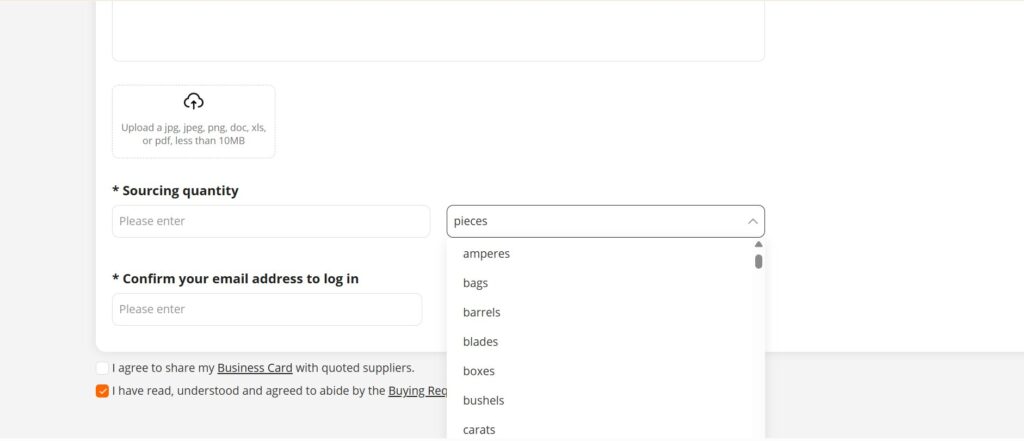
Enter the number of units you expect to purchase and select the appropriate measurement unit.
Quantity directly affects supplier pricing and minimum order quantity (MOQ) eligibility.
One approach is to communicate a potential sourcing volume of 2–4 times your monthly sales forecast, provided that volume reflects a realistic purchasing plan.
For example, if you expect to sell 500 units monthly, you could request pricing for 1,000 and 2,000 units to understand potential volume discounts.
However, don’t present 2,000 units as your confirmed first order if you only intend to purchase 500.
We recommend stating both your initial order quantity and estimated future demand. This allows suppliers to quote realistic prices while considering the possibility of repeat business.
6. Trade Terms
Specify the shipping Incoterms you want suppliers to use when preparing quotations.
Common options include:
- EXW (Ex Works): You arrange collection and most shipping responsibilities from the supplier’s premises.
- FOB (Free on Board): The supplier handles delivery and loading onto the vessel at the agreed port; you handle the main freight and subsequent costs.
- DDP (Delivered Duty Paid): The seller takes responsibility for delivery to the named destination, including applicable import duties and customs clearance obligations.
We recommend requesting the same Incoterm from every supplier so you can compare quotations fairly.
A $4 FOB quote and a $5 DDP quote cover different responsibilities, so their unit prices alone don’t tell you which offer costs less overall.
7. Maximum Budget
If Alibaba asks for a maximum budget, enter an amount that reflects your expected purchasing capacity.
Research approximate market prices before setting your budget.
An unrealistically low budget may discourage manufacturers from responding, while an inflated budget can create misleading expectations about your purchasing volume.
If the field is optional, you can leave it blank and request suppliers’ pricing tiers instead.
8. Product Details
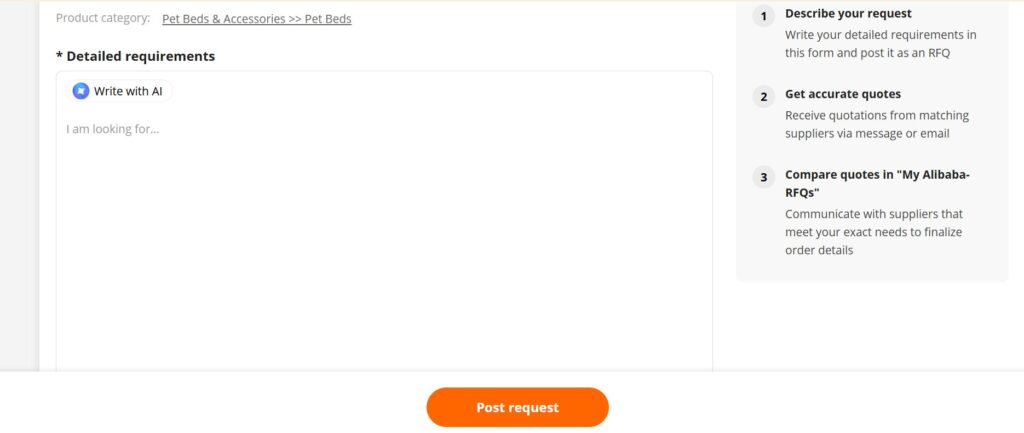
Use the detailed requirements section to explain exactly what you need.
We recommend including:
- Materials and product dimensions
- Colors and available variants
- Customization or branding requirements
- Quality standards and certifications, where applicable
- Packaging and labeling requirements
- Expected production lead time
- Questions about samples and tooling costs
For example, instead of requesting “custom stainless steel bottles,” specify the capacity, steel grade, insulation requirements, lid type, and logo application method.
Keep the description organized and focused on details that affect manufacturing costs.
You should also avoid sharing confidential product designs or proprietary technical files in a broadly distributed RFQ.
9. Attachments
Attach reference images, specification sheets, or documents that help suppliers understand your requirements.
Alibaba’s current RFQ form supports common image and document formats, including JPG, PNG, PDF, DOC, and XLS, with file limits displayed during upload.
For existing products, reference images can help suppliers identify the design and construction you’re looking for.
For custom products, we recommend sharing general product references at this stage. Reserve proprietary drawings and sensitive manufacturing details for vetted suppliers under appropriate confidentiality agreements.
10. Shipping and Payment
Provide your delivery destination, preferred shipping method, and payment expectations wherever the form allows.
If you’re unsure which shipping method to use, request separate quotations for available options.
Also clarify whether the supplier’s quoted lead time covers production only or includes shipping.
For payment, you can ask suppliers which methods they accept and whether they support Alibaba Trade Assurance for the eventual order.
11. Submit Your RFQ
Before submitting, review your product specifications, quantity, budget, and delivery requirements.
Make sure the information is consistent. For example, don’t request 500 units in the quantity field while describing a confirmed first order of 2,000 units elsewhere.
Once submitted, Alibaba reviews your RFQ before publishing it to relevant suppliers.
You can monitor its status and manage responses through your Alibaba account. If your request is rejected, review the feedback, correct the relevant details, and resubmit it.
Our recommendation: Treat your first RFQ as a starting point for supplier discovery. Once quotations arrive, confirm the specifications and request samples from shortlisted suppliers before negotiating a larger order.
How to Make Your RFQ More Attractive to Suppliers?
The main purpose behind posting an RFQ on Alibaba is to get supplier options from whom you can choose the best one. But how to attract good suppliers on Alibaba via your RFQ?
You can’t do much about the mandatory requirements on Alibaba. That will be pretty much the same for all the RFQs. You can make your RFQ more attractive by utilizing the detail option.
Let’s explore a few hacks.
- Sound professional with your words, especially when you write the details.
- Mention that you are an e-commerce company.
- Don’t mention that you are just launching a new business. Tell them you are adding a new product to your product line.
- Give all the necessary details.
- Do your research and mention certifications that you require, if any. This will give an impression that you know the product well.
- Be as short and simple in your details as you can.
- Mention that you have multiple sales channels.
- You can also mention your regular customer base so that they know that you would most probably have repeat order requirements.
Short on time? Writing RFQs that real factories answer is what our Yiwu sourcing team does every day. NicheSources offers free product sourcing with quotes in 2 business days. Request a free quote.
Alibaba RFQ Template (Copy and Customize)
A well-written RFQ should introduce your business, explain the product requirements, and tell suppliers exactly what information you expect in their quotations.
Below is an Alibaba RFQ example from Stanley at NicheSources, using a customized pet bed as the product. You can copy the structure and replace the details with your own sourcing requirements.
Sample Alibaba RFQ for Wholesale Products
Subject: Request for Quotation – Customized Orthopedic Pet Beds
Hi there,
My name is Stanley. I am working at NicheDS company as a supply chain manager. We are looking to add a customized pet bed to our existing line of pet products.
Please refer to the attached pictures and the following details for an idea of the required product.
Product specifications:
- Color: Stone Gray
- Size: 44″ x 35″ x 8″ (4″ Foam; Sleep Surface: Approx. 38″ x 29″)
- Material: Polyester
- Fill Material: Egg Crate Orthopedic Foam
We are anticipating a minimum annual order of 6000 pieces for this product from our passionate customer base.
The requirement can also increase if we expand our marketing campaign if our customers are satisfied with the product.
If you can provide this product, please respond with the following details.
- Are you a manufacturer or a trader?
- Can you provide samples (paid or free) before order processing?
- Can you customize this product?
- What will be the lead time to deliver this product in the USA?
Early response will be highly appreciated.
Regards,
Stanley Nieh
Supply Chain Manager
NicheDS
Why Does This RFQ Template Work?
There are a few useful details in Stanley’s example that we recommend including in your own requests.
| Template Element | Why It Matters |
| Business introduction | Gives suppliers context about your company and purchasing intentions |
| Specific product requirements | Helps manufacturers determine whether they can produce the requested item |
| Annual order estimate | Communicates potential repeat business without presenting the entire annual volume as an immediate order |
| Manufacturer or trader question | Helps you understand whether you’re dealing directly with a factory or an intermediary |
| Sample availability | Establishes whether you can evaluate the product before bulk production |
| Customization requirements | Encourages suppliers to disclose their manufacturing capabilities |
| Delivery timeline | Helps identify suppliers who can realistically meet your schedule |
One detail we’d improve is separating the initial order quantity from the annual forecast. For example, if you anticipate purchasing 6,000 units annually but want to begin with 500, state both figures clearly.
This allows suppliers to quote your first order accurately while considering potential volume discounts for future purchases.
Additional Line for Custom Products
If you’re sourcing a product that requires unique materials, dimensions, branding, or manufacturing processes, add this question to your RFQ:
“Please identify any product specifications you cannot meet and explain the available alternatives, including any additional tooling or customization costs.”
We recommend asking this early because suppliers may otherwise quote a similar existing product without clearly identifying the differences.
For more complex products, request separate pricing for samples, tooling, and bulk production.
Additional Questions for Dropshipping Suppliers
If you plan to sell products through Shopify, Amazon, or another ecommerce channel without holding inventory yourself, you’ll need to confirm whether the supplier supports individual-order fulfillment.
Add this block to your RFQ:
“We are looking for a supplier that can support direct-to-customer order fulfillment. Please confirm the following:”
- Can you ship individual orders directly to our customers?
- Do you offer neutral or custom-branded packaging?
- Can you provide inventory updates and order tracking?
- What are your per-order fulfillment and shipping fees?
- How do you handle damaged products, returns, and replacements?
- Do you support integrations or order processing for ecommerce stores?
Keep in mind that many Alibaba manufacturers primarily handle bulk production. Some may support individual-order fulfillment, while others require a separate logistics or fulfillment partner.
Our recommendation: Use the main template for wholesale sourcing and add only the questions relevant to your business model. A concise RFQ with complete specifications and clear expectations is easier for suppliers to evaluate and price accurately.
How to Compare Alibaba RFQ Quotes and Choose a Supplier

Once your RFQ starts receiving responses, the next step is to compare suppliers based on total sourcing costs, manufacturing capabilities, and reliability.
We recommend avoiding the temptation to select the lowest unit price immediately. Two suppliers may quote different prices because they’re using different materials, packaging, shipping terms, or production methods.
1. Request Itemized Quotations
Before comparing suppliers, make sure they’re quoting the same specifications and order quantities.
Ask each supplier to provide a breakdown of:
- Unit price: Pricing at your expected order quantity and, where useful, higher volume tiers.
- MOQ: Minimum quantity required per order, design, or color.
- Sample costs: Sample price and shipping charges.
- Customization costs: Logo printing, molds, tooling, or other setup fees.
- Packaging costs: Standard versus custom-branded packaging.
- Production lead time: Time required to manufacture the order after specifications and payment terms are confirmed.
- Shipping terms: Costs and responsibilities under the same Incoterm, such as FOB or DDP.
If a quotation is missing these details, request clarification before including it in your comparison.
2. Compare Landed Costs, Not Just Unit Prices
Landed cost is the total cost of getting a product to its destination, including product costs, freight, applicable duties, and other import-related expenses.
Here’s a simple example showing how an additional setup fee changes the effective unit cost.
| Cost Component | Supplier A | Supplier B |
| Unit price | $4.50 | $5.00 |
| Order quantity | 120 units | 120 units |
| Product cost | $540 | $600 |
| Logo setup fee | $60 | Included |
| Total before shipping | $600 | $600 |
| Effective cost per unit | $5.00 | $5.00 |
Both suppliers cost the same before shipping, even though Supplier A initially appears more affordable.
Now consider shipping, customs duties, and destination handling charges. Those costs could make either supplier more expensive overall.
Our advice: Compare the total payable amount on an equivalent delivery basis. If one supplier quotes FOB and another quotes DDP, request comparable shipping terms before making a final decision.
3. Watch for Red Flags in Supplier Quotations
Some warning signs become apparent before you even request samples.
| Red Flag | What It May Indicate | What We Recommend |
| Price significantly below competing quotes | Different materials, missing components, or incomplete pricing | Request a detailed breakdown and confirm specifications |
| Generic responses | Supplier may not have reviewed your requirements carefully | Ask specific technical questions about the product |
| Unclear MOQ or lead time | Production capacity or order requirements haven’t been confirmed | Request written confirmation before proceeding |
| Refusal to itemize costs | Potential undisclosed charges | Avoid committing until pricing is transparent |
| Unrealistic production promises | Supplier may be overpromising to secure the order | Ask for production schedules and sample timelines |
| Pressure to pay outside Alibaba | Increased payment and dispute risk | Keep eligible orders and payments within Alibaba’s Trade Assurance process |
A low quotation isn’t automatically suspicious. Some factories may genuinely have lower production costs, especially when they already manufacture similar products.
The key is to understand why the price differs before deciding whether the offer represents better value.
4. Verify the Supplier Before Placing an Order
Alibaba supplier badges can help with initial screening, but they shouldn’t replace your own checks.
For example:
- Verified Supplier: Indicates that aspects of the supplier’s business have undergone third-party verification. It doesn’t guarantee product quality or successful delivery.
- Trade Assurance: Provides eligible order protections under Alibaba’s agreed terms. It doesn’t automatically protect an RFQ or informal quotation.
We recommend reviewing each supplier’s company profile, manufacturing capabilities, transaction history where available, and communication quality.
For customized or higher-value orders, request samples and consider a factory audit or independent quality inspection.
You can also review our guide on whether Alibaba is safe and legitimate for additional supplier verification considerations.
5. Shortlist Two or Three Suppliers
After comparing quotations and checking supplier credentials, narrow your options to two or three candidates.
At this stage, focus on suppliers who:
- Can meet your product specifications and quality requirements.
- Provide transparent, itemized pricing.
- Offer realistic production and delivery schedules.
- Communicate clearly and respond to technical questions.
- Are willing to provide samples and confirm agreed terms in writing.
We recommend comparing samples before deciding on your final supplier, especially for products where materials, finishing, or functionality affect customer satisfaction.
If you’d rather have an on-the-ground team handle supplier verification, samples, and negotiations, that’s where a product sourcing service can help.
How to Protect Yourself When Using Alibaba RFQ

Posting an Alibaba RFQ exposes your purchasing requirements to multiple potential suppliers. While this helps you discover manufacturers, it can also attract irrelevant quotations, suspicious offers, and unwanted follow-up messages.
If you’re sourcing a custom product, there’s another concern: protecting your designs and technical information before you’ve verified the supplier.
Here’s how we recommend managing both risks.
1. How to Avoid Spam and Supplier Scams
The best way to reduce irrelevant quotations is to make your RFQ specific enough that suppliers can assess whether they’re a suitable match.
For example, requesting “plastic storage boxes at the best price” leaves room for dozens of unrelated offers. Specifying the material, dimensions, lid design, quantity, and delivery destination helps narrow the responses.
We also recommend taking these precautions:
- Check supplier profiles: Review their business information, product categories, verification status, and transaction history where available.
- Avoid generic quotations: Prioritize suppliers who address your actual specifications instead of sending standard product catalogs.
- Keep communication on Alibaba: Use Alibaba’s Message Center to maintain a record of specifications, pricing, and agreed terms.
- Be cautious with off-platform payments: Trade Assurance protections depend on eligible orders and payment arrangements through Alibaba. Private bank transfers outside the protected process may leave you without those protections.
- Limit personal information: Use business contact details and avoid sharing unnecessary sensitive information with every supplier.
- Close your RFQ when finished: Once you’ve shortlisted suitable suppliers, close the active request to prevent additional quotations.
Remember that a Verified Supplier badge or competitive quotation doesn’t guarantee a successful order. We recommend verifying manufacturing capabilities and requesting samples before committing to bulk production.
2. How to Protect Your Product Designs
If you’re sourcing an original or customized product, avoid uploading confidential technical drawings, proprietary designs, or complete manufacturing files to your initial RFQ.
Your request may be accessible to multiple suppliers, including businesses you haven’t evaluated.
Instead, share enough information for preliminary pricing, such as:
- General product dimensions and materials
- Intended functionality and performance requirements
- Reference images that don’t reveal proprietary details
- Expected order quantities and customization needs
Once you’ve shortlisted a capable manufacturer, you can share more detailed specifications under an appropriate confidentiality agreement.
For sourcing from China, one option is an NNN agreement (Non-Disclosure, Non-Use, and Non-Circumvention).
An NNN agreement is intended to prevent a supplier from:
- Disclosing your confidential product information to unauthorized parties.
- Using your designs or technical information for unauthorized purposes.
- Circumventing your business to exploit protected commercial relationships or opportunities.
An agreement should be tailored to the transaction and applicable Chinese law, ideally with guidance from a qualified lawyer. Signing one doesn’t automatically prevent copying or guarantee enforcement.
If your product contains a potentially protectable invention, design, or brand name, consider appropriate patent, design, or trademark protection in relevant markets before disclosing sensitive information.
Our recommendation: Use Alibaba RFQ for initial supplier discovery and pricing. Share detailed manufacturing files only after you’ve verified the supplier, established appropriate contractual protections, and confirmed that they’re a serious candidate.
For businesses that need additional sourcing support, NicheSources’ Yiwu-based team can help with supplier verification, factory audits, samples, and pre-shipment quality inspections. Discuss your project.
How to Use RFQs Outside of Alibaba to Get More Suppliers?
As you must have noticed, Alibaba RFQ is not specific to Alibaba only. It is a pretty simple and general RFQ format.
The same format is good enough to be used on other platforms too. You just have to define your specifications and requirements once.
You can also write one general RFQ format which you can use on sites like Alibaba. Related Guide: Websites Like Alibaba: Where Else to Source and Compare Quotes
FAQs about Alibaba RFQ
The following brief answers to the frequently asked questions regarding Alibaba RFQ would surely help you clear any confusion.
Do All Suppliers Listed on Alibaba Respond to RFQs?
No. All suppliers don’t respond to RFQs on Alibaba. Alibaba scans through its directory of suppliers to present your
RFQ to the most relevant suppliers.
It is up to them if they want to respond to your RFQ or not.
It is possible that you don’t get a single quotation against your RFQ. But, at the same time, it is also possible that you get 10 quotations for your RFQ immediately.
Can the Prices Be Changed after Submitting the RFQ?
Yes. A supplier can also share the revised pricing after submitting the RFQ on Alibaba. Negotiation is an integral part of every wholesale business.
A supplier and buyer can negotiate the pricing and reach an agreement to close the deal.
What Should I Do If My RFQ Has Been Rejected?
There must be a reason behind the rejection of your RFQ. If your RFQ got rejected on Alibaba, you can go to your Alibaba account and click the “Manage RFQ” option.
You will have your rejected RFQ. You can “edit” that RFQ, make the required changes, and submit it again for approval.
Is Posting an RFQ on Alibaba Free?
Yes. Alibaba RFQ is free for buyers. You can submit product requirements and receive supplier quotations without paying a posting fee.
Alibaba also offers optional paid features, such as Urgent Request and Extra Quotes, which may improve your request’s visibility or increase quotation opportunities.
These upgrades aren’t mandatory, and current prices should be checked in the RFQ interface.
How Many Quotes Can You Get from One Alibaba RFQ?
An Alibaba RFQ commonly receives around 10 quotations, although Alibaba has also advertised approximately 15 on average in some promotional materials.
Neither figure is guaranteed. The number of responses depends on supplier interest, product availability, purchasing quantities, and how closely your requirements match suppliers’ capabilities.
For specialized products, receiving three relevant quotations may be more useful than receiving ten generic offers.
How Long Does It Take to Receive Alibaba RFQ Quotes?
Alibaba advertises multiple supplier quotations within 24 hours, but actual response times vary.
Standard products with clear specifications may attract responses quickly. Customized products involving unusual materials, tooling, or technical requirements can take longer because suppliers need to calculate production costs.
If you’re working toward a purchasing deadline, allow additional time for quotations, negotiations, sample approval, and production scheduling.
Can I Edit an Alibaba RFQ After Posting It?
Alibaba allows RFQs to be revised in certain circumstances, including when a request is rejected during review.
Check the available editing options in your RFQ management dashboard. If editing is permitted, update the relevant information and resubmit for review where required.
For major changes to your product requirements, a new RFQ may be more practical because suppliers’ earlier quotations may no longer reflect what you’re sourcing.
Is an Alibaba RFQ Legally Binding?
No. Submitting an RFQ doesn’t automatically create a purchase contract or require you to accept any supplier’s offer.
An RFQ is part of the initial purchasing process, and suppliers may revise their quotations as specifications, quantities, and delivery terms are finalized.
However, subsequent agreements can create legal obligations depending on their terms and applicable law. Review the final purchase agreement before making payments.
Why Is My Alibaba RFQ Getting No Responses?
An RFQ may receive no responses because suppliers cannot meet the requested specifications, quantity, budget, or delivery schedule.
Another possibility is that the product falls into a specialized category with relatively few eligible suppliers.
Check whether your request accurately reflects your purchasing requirements. If the product is highly specialized, consider searching for manufacturers directly and asking whether they can produce it.
What Are Gold, Silver, and Bronze RFQs on Alibaba?
Gold, Silver, and Bronze refer to RFQ classifications described in Alibaba’s supplier-facing materials.
These classifications are associated with buyer levels, including L0–L4, and help suppliers assess purchasing opportunities. Eligibility to respond to certain RFQs may also depend on supplier qualifications.
The exact classification criteria can change, so buyers should check Alibaba’s current guidance rather than assuming that a particular account level guarantees better quotations.