Replica shoe websites are online stores, marketplaces, seller-operated sites, and shopping-agent platforms that offer footwear designed to imitate branded sneakers without authorization from the original trademark owner.
Finding the “best” site is difficult because sellers vary widely in batch quality, payment protection, QC transparency, and shipping reliability. Some rep shoe websites operate like normal online stores, while others require buyers to contact a middleman, order through Weidian, or use a shopping agent.
In this guide, we explain how these buying routes work, what terms such as 1:1 replica, LJR batch, and QC photos actually mean, and how to assess the risks before sending payment. We do not source or endorse counterfeit products. As a China sourcing company, we believe businesses should understand the market while considering legal white-label or private-label alternatives for long-term growth.
Quick Facts
- Main buying routes: Online marketplaces, independent middlemen, shopping agents, and factory-direct or B2B suppliers
- Typical advertised price: Approximately $20–$160 per pair, depending on the model, batch, seller, and shipping method
- Quality range: Budget-tier copies to higher-priced batches marketed as “1:1”
- Legal bottom line: Personal purchases, importing, and commercial resale carry different legal risks. Customs may seize counterfeit goods, while selling trademark-infringing products can lead to serious penalties
The 4 Ways to Buy Replica Shoes Online
Most replica shoe purchases follow one of four routes: marketplaces, independent middlemen, shopping agents, or factory-direct suppliers. We separate them because the buying process, payment protection, quality control, and risk level differ significantly.
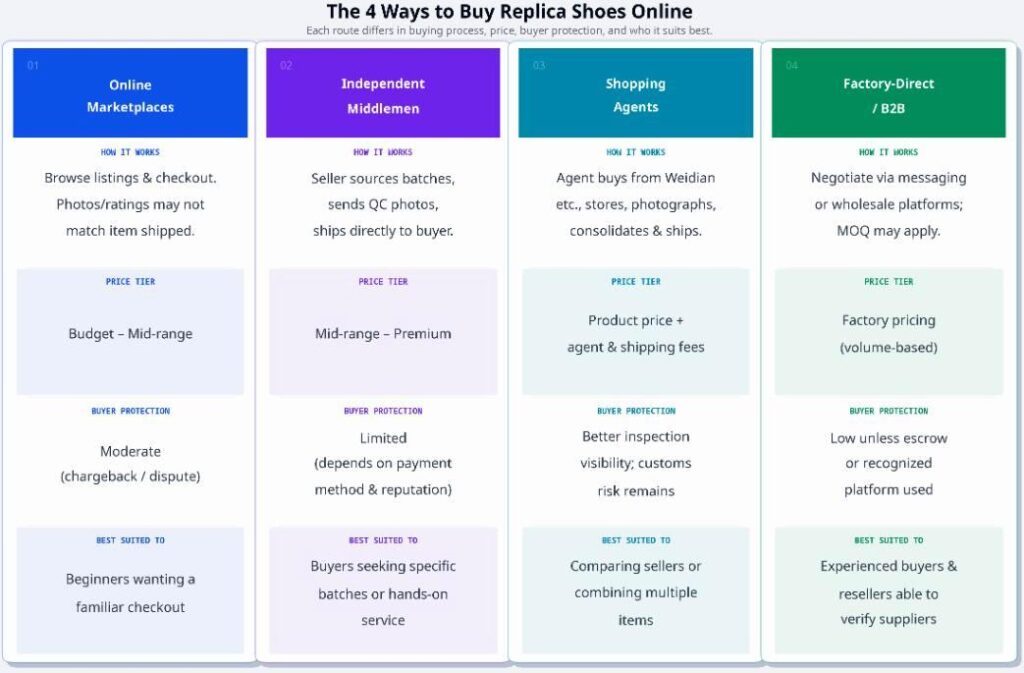
Which Buying Route Is the Safest?
No route removes the legal, payment, or customs risks associated with counterfeit footwear. However, marketplaces with formal dispute systems generally provide stronger payment protection, while shopping agents offer better visibility through warehouse inspection and QC photos.
Independent middlemen may provide more personalized service, but buyers often depend on community reputation rather than enforceable guarantees. Factory-direct claims require the most caution because buyers may have limited recourse if the supplier, batch, or production source is misrepresented.
From a sourcing perspective, we would evaluate each route based on four questions:
- Can you verify the exact product before international shipping?
- Is the payment method reversible if the seller disappears?
- Does the seller clearly explain its replacement or reshipment policy?
- Are you prepared for customs seizure or trademark-related risks?
For commercial sellers, none of these routes provides a stable foundation for building a legitimate footwear business. White-label and private-label manufacturing offer clearer ownership, more reliable quality control, and fewer long-term compliance risks.
How to Identify High Quality Replica Shoes (Are They Worth It?)
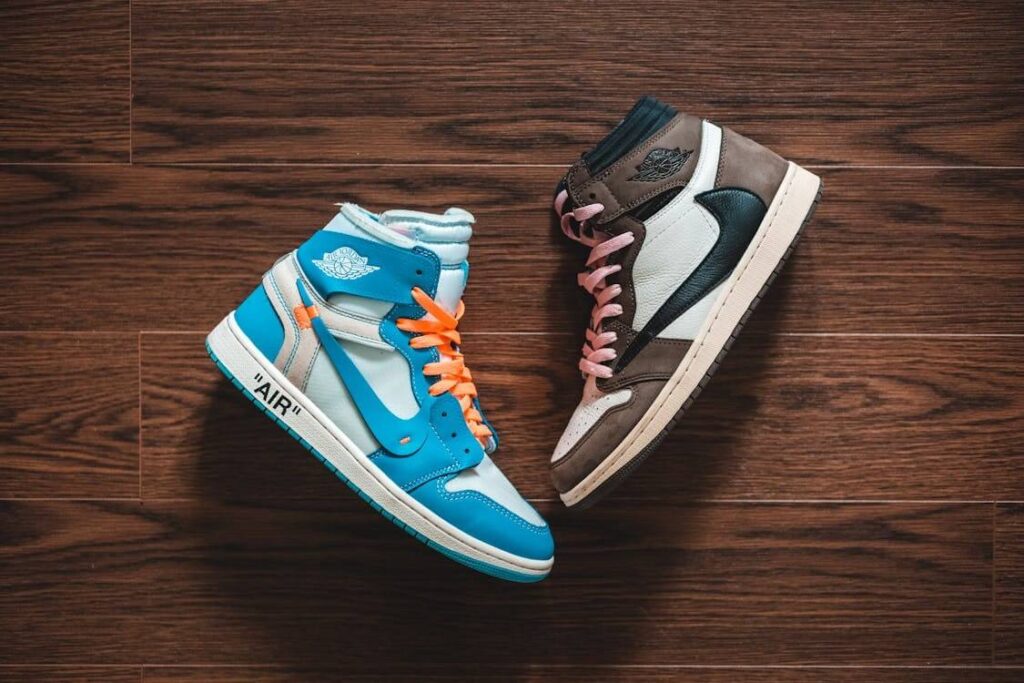
Replica shoes are unbranded, high-quality versions of popular sneakers. They’re designed to look and feel almost identical to originals-think Air Jordan replica shoes, Yeezy lookalikes, or Nike replica silhouettes-without pretending to be the real thing. That’s what sets them apart from counterfeits.
Good replicas don’t carry fake logos or branding. Instead, they offer a more affordable way for sneaker lovers or resellers to enjoy the style and craftsmanship of big-name kicks, without the hefty retail price.
In the replica shoe world, quality varies widely. At one end, you’ll find cheap knockoffs that barely survive a month. On the other hand, there are best 1:1 sneakers-built with the same materials, weight, stitching, and structure as the originals. These are the ones worth paying attention to.
What Makes a Replica Shoe High-Quality?
If you’re considering adding replica shoes to your dropshipping store-or just grabbing a pair for yourself-there are a few key features to look for in a truly high-quality pair:
1. Materials That Match the Original
Top-tier replicas use real leather, suede, or mesh just like the original sneakers. The weight and texture should feel premium in hand, not plastic or flimsy.
2. Attention to Detail
From the shape of the toe box to the spacing of the stitching, high-quality replicas are built with serious attention to detail. Many trusted replica sites even replicate the insole design, tongue padding, and outsole tread.
3. Consistent Sizing
Unlike budget fakes that can run wildly off-size, quality reps stick closely to brand sizing. A size 9 in the replica will feel like a size 9 from Nike or Adidas.
4. Durability
Buy high-quality cheap replica shoes and you’ll see-they can handle everyday wear just like the originals. The glue doesn’t come undone after a week, and the soles don’t peel off after a walk through the city.
Real vs. Replica: Side-by-Side Examples
Let’s take something like the Air Jordan’s.The originals can go for $500+ easily, some even higher at $1,000+ as you can see in the screenshot.
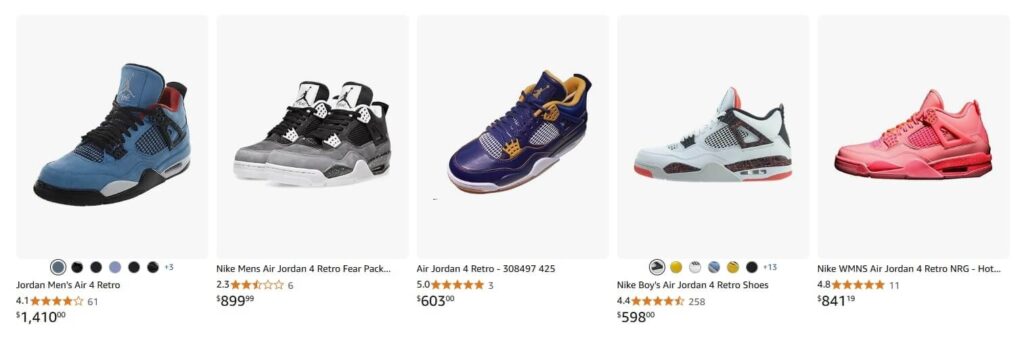
A top-tier replica version-sourced from one of the best replica shoes websites in China-might cost you $90 to $120, yet still deliver 95% of the same feel and finish.
The suede looks smooth and uniform, the shape is dead-on, and even the box presentation can mirror the retail experience.
Now compare that to a lower-end fake you might find on random marketplaces. The heel will often be bulky, the color tone slightly off, and the stitching uneven. It might look okay in photos, but fall apart after a few wears. That’s why choosing trusted replica sites matters so much.
So… Are They Worth It?
If you’re after the hype look without paying resale prices-or you’re building a niche sneaker store without taking on the risk of branded goods-then yes, high-quality replica sneakers are absolutely worth it. They strike the perfect balance between cost, appearance, and wearability.
Whether you’re eyeing Nike replicas or the clean finish of Jordan reps, the trick is knowing what to look for and where to buy them. If that’s something you need help with, we can source them directly for you.
The Best Websites to Purchase Replica Shoes in 2026
We have grouped these replica shoe websites by how buyers actually use them: marketplaces and directories, independent middlemen, shopping agents, and B2B suppliers. This matters because a familiar storefront may offer stronger payment protection, while a specialist seller may provide more batch information and QC support.
The entries below are included for comparison and risk awareness. NicheSources does not source counterfeit footwear, and appearing on this list should not be treated as an endorsement. Seller status, payment options, and community reputation can also change, so buyers should verify every detail before paying.
Replica Shoe Website Comparison
| Site | Type | Best for | Quality or batch access | Payment | Buyer protection |
| DHgate | Marketplace | Beginners | Budget to mid-tier | Card, PayPal | Escrow and disputes |
| Alibaba | B2B marketplace | Bulk buyers | Varies by supplier | Trade Assurance | Platform escrow |
| Made-in-China | B2B directory | Resellers | Varies by factory | B2B terms | Partial |
| PK Kim | Independent middleman | PK batches | Top-tier PK lines | PayPal, crypto | Reputation-based |
| Kickwho | Independent middleman | Storefront buyers | LJR and other premium batches | Card, crypto | Limited |
| TMF | Independent middleman | Competitive pricing | Premium factory batches | PayPal, crypto | Reputation-based |
| Panda Vault | Independent middleman | First-time buyers | Premium batches | Seller-arranged | Limited |
| Repsun | Independent middleman | Customer support | Premium batches | Seller-arranged | Limited |
| LX/LY Factory | Factory-direct seller | Experienced buyers | Premium batches | Seller-arranged | Limited |
| Sugargoo | Shopping agent | Multi-item hauls | Any seller or batch selected | Account balance | Agent-level QC |
| HYD Shoes | B2B manufacturer | Volume buyers | OG, LJR, and PK lines | B2B terms | Contract-dependent |
A. Marketplaces and B2B Directories
Marketplaces are generally easier to navigate than independent rep sneaker sites. Buyers can compare listings, review seller histories, and use platform payment systems, although the quality shown in a listing may not match the pair eventually shipped.
1. DHgate
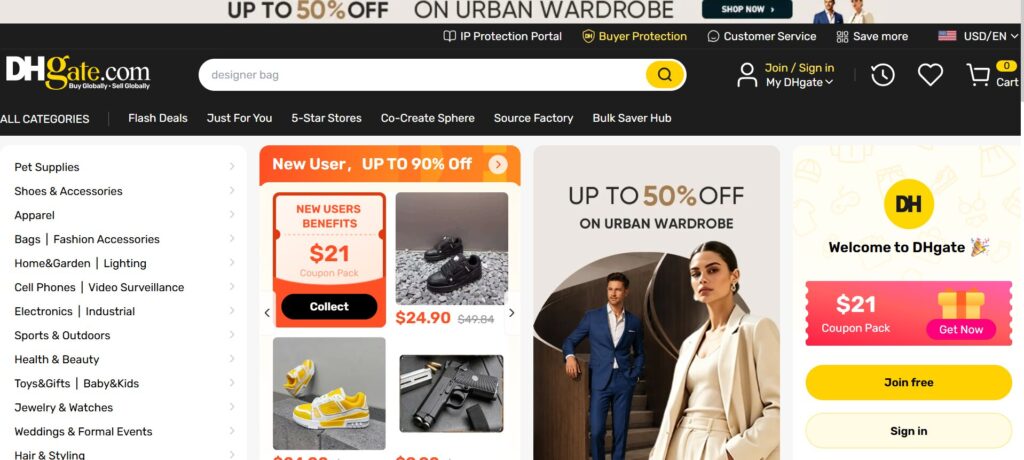
DHgate is a Beijing-based cross-border marketplace commonly used by buyers looking for budget-tier replica sneakers. Because listings containing protected brand terms may be removed, sellers often use coded titles and generic product images.
That makes seller history, completed transactions, buyer photos, and dispute terms more useful than the product title alone.
- Located in: Beijing, China
- Ships from: China, Hong Kong, and some US or UK warehouses
- Key features: Escrow protection, seller-rating filters, card and PayPal payments, ePacket and DHL options
- Ideal for: Beginners who prioritize a standard checkout and platform dispute process
2. Alibaba
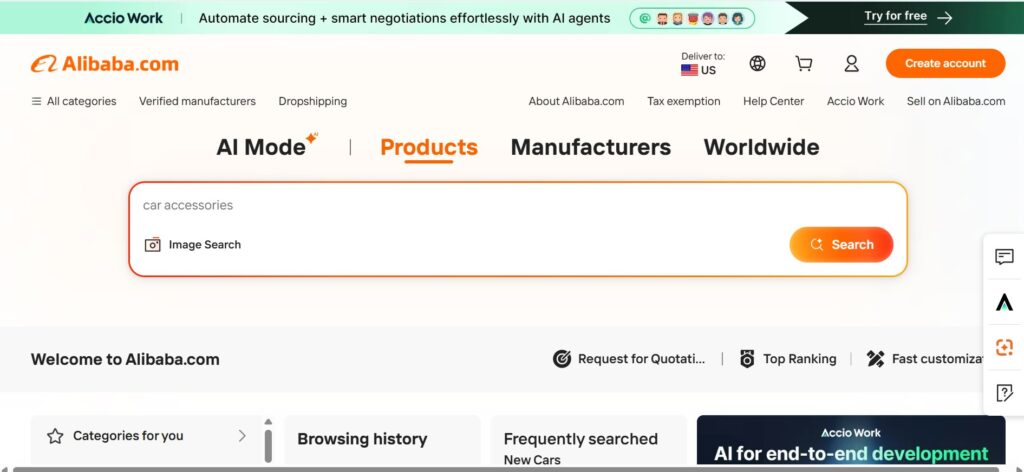
Alibaba is primarily a legitimate B2B sourcing marketplace rather than a dedicated replica shoe website. Counterfeit listings may appear covertly, but its more sustainable value for businesses lies in unbranded footwear, OEM production, and private-label sourcing.
We would approach it as a supplier-discovery platform rather than assume that every listed company is an actual manufacturer.
- Located in: Hangzhou, China
- Ships from: Mainland China, Hong Kong, and occasional overseas warehouses
- Key features: Trade Assurance, MOQ negotiation, supplier profiles, unbranded and private-label options
- Ideal for: Bulk buyers who understand supplier verification and want a possible route toward legal custom production
3. Made-in-China
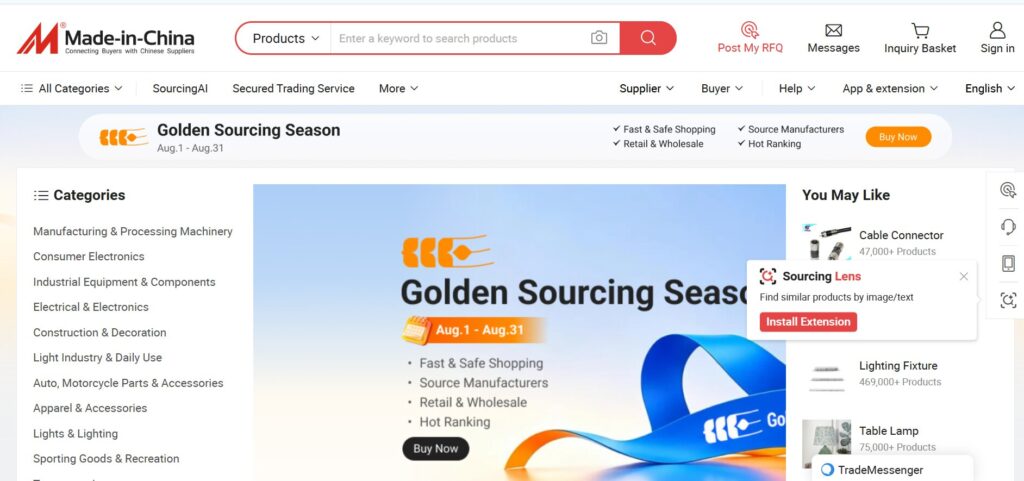
Made-in-China is a B2B manufacturer directory connecting buyers with Chinese factories and trading companies. Footwear suppliers may advertise OEM, ODM, wholesale, or multiple quality grades, but buyers still need to verify whether the company controls production or simply resells from another factory.
Factory audit reports and supplier profiles can help with initial screening, although they do not replace an independent quality inspection.
- Located in: China
- Ships from: China, usually directly from the listed supplier
- Key features: Direct supplier contact, OEM and ODM services, audit information, MOQ-based pricing
- Ideal for: Experienced resellers comparing factories or exploring replica-inspired private-label footwear
B. Community-Known Independent Middlemen
Middlemen source particular factory batches and manage the order from payment through QC and international shipping. Their main advantage is access to specific production lines such as PK, LJR, or OG.
The trade-off is weaker buyer protection. Most transactions depend on seller reputation, community feedback, and the buyer approving QC photos before dispatch.
4. PK Kim
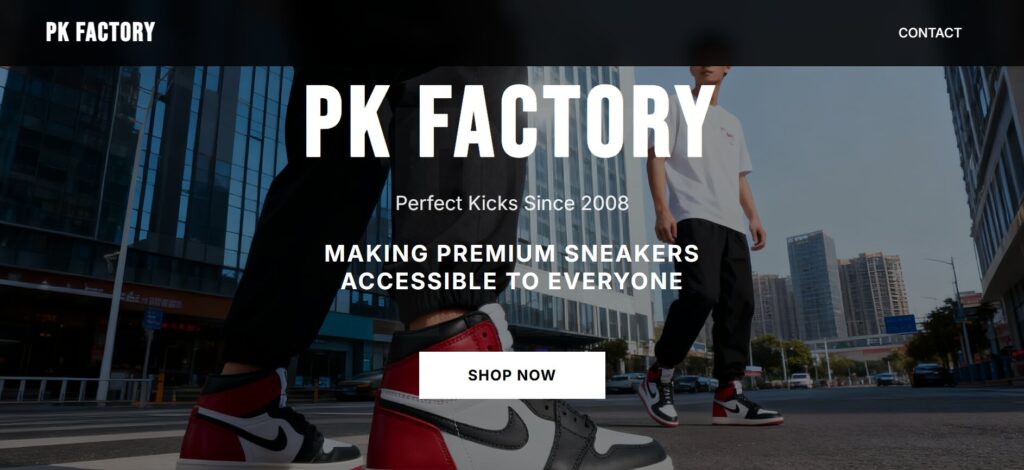
PK Kim is an independent seller associated with PK batches, particularly for Jordan and Yeezy-style models. The seller appears repeatedly in community discussions and trusted-seller lists, although that reputation does not provide the same protection as marketplace escrow.
Buyers generally order through direct communication and approve QC photos before shipping.
- Located in: Not specified in the supplier data
- Ships from: China through express couriers
- Key features: PK-batch specialization, pre-shipment QC photos, WhatsApp-based ordering
- Ideal for: Buyers already familiar with PK batches and reputation-based purchasing
5. Kickwho
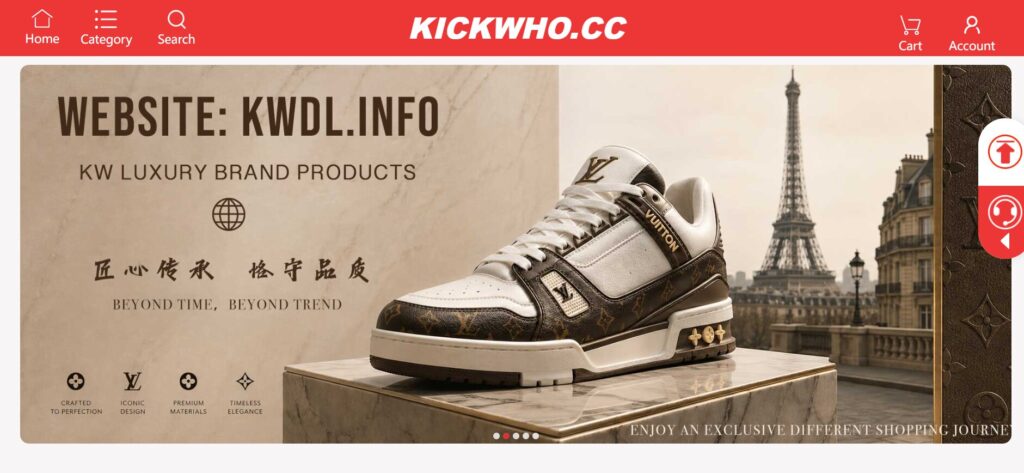
Kickwho differs from many middlemen by operating a conventional website with a browsable product catalog. This gives buyers a more familiar storefront experience while retaining the batch-based QC workflow used by specialist sellers.
Its listed range includes premium batches such as LJR, but buyer protection still depends on the payment method and seller policy.
- Located in: Not specified in the supplier data
- Ships from: China
- Key features: Website catalog, LJR batch access, structured QC process, normal cart-style ordering
- Ideal for: Buyers who prefer a standard storefront over placing the entire order through messaging apps
6. TMF
TMF is known in replica communities for direct access to premium batches at relatively competitive baseline prices. The main reported trade-off is that communication may be slower than with higher-service middlemen.
This route is better suited to buyers who already understand batch names, QC expectations, and direct-seller payment risks.
- Located in: Not specified in the supplier data
- Ships from: China
- Key features: Direct factory access, premium batch options, comparatively competitive pricing
- Ideal for: Price-conscious buyers comfortable with WhatsApp-based ordering and limited hand-holding
7. Panda Vault
Panda Vault uses a Yupoo catalog and direct messaging workflow. It is frequently positioned as a beginner-friendly option in replica communities because buyers can browse product albums before contacting the seller.
Panda Vault is unrelated to PandaBuy, the shopping-agent platform that was shut down following the 2024 enforcement action.
- Located in: Not specified in the supplier data
- Ships from: China
- Key features: Yupoo catalog, WhatsApp ordering, community recognition among first-time buyers
- Ideal for: Beginners following established community buying and QC guides
8. Repsun
Repsun is distinguished in community discussions by its customer communication and QC support. That can be useful for buyers who need more guidance when reviewing stitching, shape, sizing, or other pair-specific details.
The added service may come with higher pricing than sellers competing mainly on cost.
- Located in: Not specified in the supplier data
- Ships from: China
- Key features: Responsive communication, detailed QC assistance, service-focused ordering
- Ideal for: Buyers who value support and clear communication over finding the lowest advertised price
9. LX/LY Factory
LX/LY Factory is presented as a factory-direct seller with access to premium batches and recurring restocks. It offers less guidance than service-focused middlemen, making it more appropriate for buyers who already know the exact model and batch they want.
As with other direct sellers, payment and replacement protection should be confirmed before ordering.
- Located in: Not specified in the supplier data
- Ships from: China
- Key features: Factory-direct batch access, premium lines, recurring product restocks
- Ideal for: Experienced buyers who can assess QC photos without extensive seller assistance
C. Shopping Agents
Shopping agents do not usually manufacture or own the products they display. Instead, they purchase items from domestic Chinese marketplaces, receive them at a warehouse, photograph them, and arrange consolidated international shipping.
10. Sugargoo
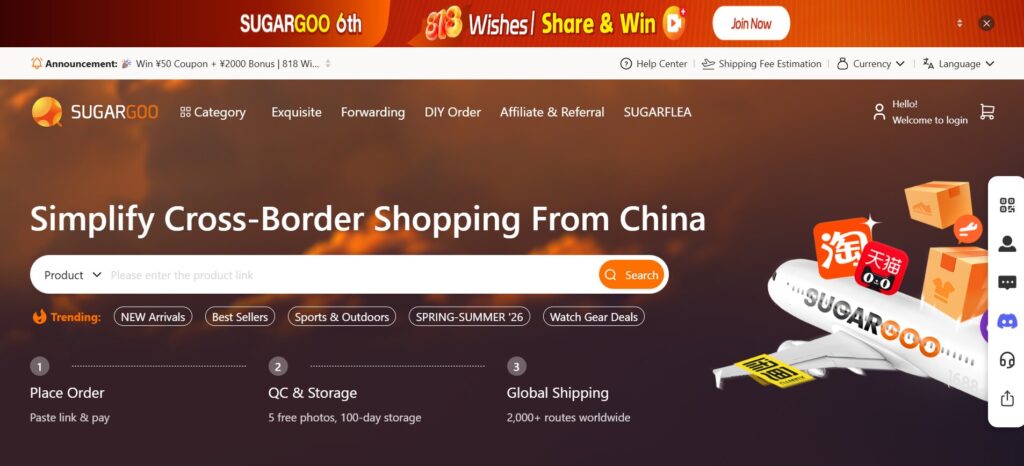
Sugargoo is a Guangzhou-based shopping agent offering access to sellers on Weidian, Taobao, and 1688. The agent purchases the item, receives it at its warehouse, provides QC photos, and lets the buyer choose an international shipping line.
This can reduce the per-item shipping cost for larger hauls, but it adds warehouse handling, service fees, and another party to the transaction.
- Located in: Guangzhou, China
- Ships from: China through options including EMS, DHL, and SAL
- Key features: Domestic marketplace access, five QC photos, warehouse consolidation, repackaging
- Ideal for: Buyers combining several products or accessing sellers that do not ship internationally
D. B2B Footwear Supplier
B2B suppliers differ from consumer-facing rep shoes websites because they focus on samples, MOQs, wholesale tiers, and repeat orders. These arrangements require more supplier verification because claims about factory ownership, batch names, and production capacity may be difficult to confirm remotely.
11. HYD Shoes
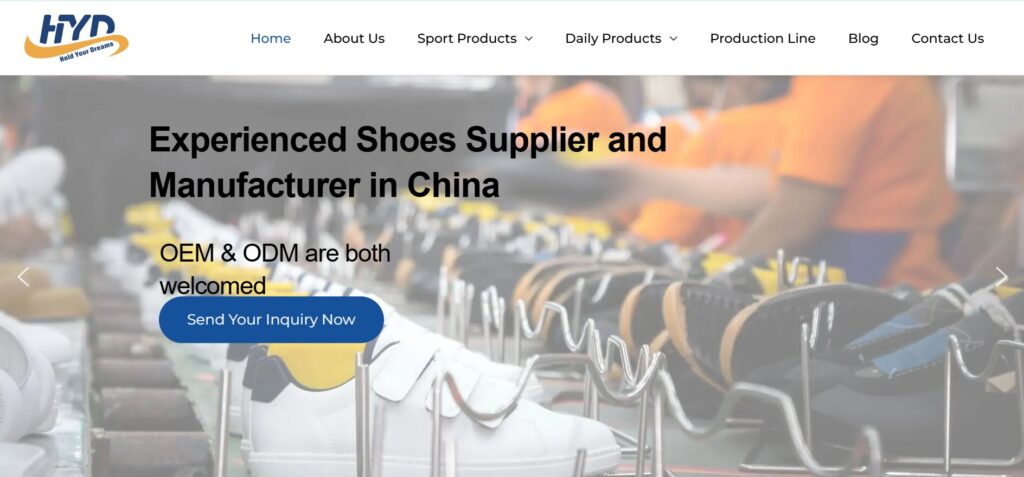
HYD Shoes is described as a Guangzhou footwear manufacturer and wholesaler established in 2008. Its catalog includes several named batch lines, wholesale pricing, sample orders, and packaging options.
Custom projects may require an MOQ of approximately 100 pairs. Businesses should still examine the trademark risks carefully, as custom packaging does not make branded replicas legal to import or resell.
- Located in: Guangzhou, China
- Ships from: China through DHL, EMS, and ePacket
- Key features: OG, LJR, and PK lines, volume pricing, sample orders, custom packaging
- Ideal for: Volume buyers who can verify the supplier, agree on specifications, and arrange pre-shipment inspection
For anyone sourcing footwear commercially, we would compare this route with legitimate unbranded, white-label, and private-label production before committing capital. Those models provide clearer ownership, safer marketplace access, and a more sustainable basis for building a footwear brand.
Top Picks by Category
We selected these category winners based on the buying route they serve, their stated batch access, QC process, buyer protection, and community positioning. These are comparison picks rather than endorsements, and seller status should always be rechecked before payment.
| Category | Top pick | Why it stands out | Main limitation |
| Best for beginners | Panda Vault | Uses a browsable Yupoo catalog and is commonly positioned as a beginner-friendly seller in replica communities. | No marketplace escrow; orders rely on direct communication and seller reputation. |
| Best for 1:1 batches | PK Kim | Specializes in PK batches and provides QC photos before shipping, making it easier to review the actual pair. | Payment protection is limited compared with marketplace platforms. |
| Best for bulk orders | Sugargoo | Can purchase from multiple Weidian, Taobao, or 1688 sellers, combine items in one warehouse, and consolidate international shipping. | Service fees, warehouse handling, and international shipping can significantly increase the final cost. |
| Best customer service | Repsun | Community discussions highlight responsive communication and more detailed support during the QC process. | Prices may be higher than sellers competing mainly on cost. |
| Best for resellers | HYD Shoes | Offers wholesale pricing, sample orders, multiple named batch lines, and custom packaging options for volume buyers. | MOQs may apply, and branded replica products remain legally risky to import or resell. |
For most first-time buyers, the real decision is between convenience and protection. A marketplace offers a more familiar payment process, while middlemen and shopping agents provide more batch choice and QC visibility but fewer formal safeguards.
For businesses, we would avoid building around counterfeit inventory. White-label or private-label footwear offers a more stable route because products can be inspected, branded legally, and sold through mainstream ecommerce and advertising platforms.
Understanding Rep Quality: Batches, Factories, and the Putian Cluster
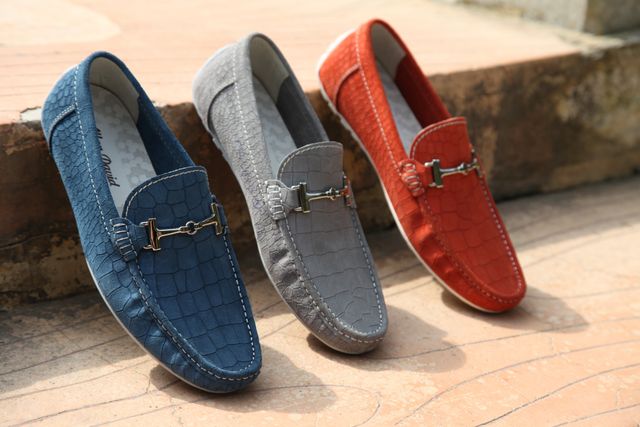
Replica shoe quality is determined less by the website name and more by the factory batch behind the pair. Two sellers may advertise the same model at similar prices but ship shoes made with different molds, materials, stitching standards, and quality-control tolerances.
Terms such as “1:1,” “UA,” and “premium quality” are not regulated grades. Sellers use them freely, so we would never judge a pair from the marketing label alone. Batch name, QC photos, materials, shape, sizing, and construction are more useful indicators.
What Is a Replica Shoe Batch?
A batch is a particular production run of a sneaker model from a specific factory or factory network. Each batch may use different molds, leather, mesh, soles, colors, and assembly methods.
This is why experienced buyers search for a model and batch together, for example, a particular Jordan model from an LJR or PK batch instead of asking only which seller has the “best reps.”
A batch can also change over time. Factories may revise molds, replace materials, or release a new production run, so an older review does not guarantee that the current pair will be identical.
LJR vs. PK vs. OG Batches
The following names are common in replica sneaker communities, but they should be treated as market identifiers rather than independently certified quality standards.
| Batch name | Common market positioning | Typical strengths | Possible limitations |
| LJR | Premium or “1:1” tier | Often associated with accurate shapes, stitching, materials, and popular Jordan models | Availability varies, and sellers may misuse the name |
| PK | Premium specialist batch | Commonly associated with Jordan and Yeezy-style models, detailed construction, and stronger materials | Quality may differ by model and production run |
| OG | Mid- to upper-tier batch | Often offers a balance of price, shape, and material quality | May have small color, sizing, or finishing differences |
| AAA / Class A | Budget-tier marketing label | Lower purchase price and broad model availability | Usually less consistent in shape, materials, comfort, and durability |
A higher-priced batch is not automatically better for every model. Some factories reproduce one sneaker accurately but perform poorly on another, which is why model-specific QC matters.
What Does “1:1 Replica” Actually Mean?
A 1:1 replica is marketed as closely matching the original shoe in appearance, dimensions, weight, materials, and construction. It does not mean the pair is identical, authorized, or produced to the original brand’s quality standards.
Even premium batches can differ in:
- Toe-box shape
- Stitch spacing
- Suede texture or leather thickness
- Logo positioning
- Midsole color
- Insole printing
- Cushioning and support
- Long-term glue and sole durability
From a quality-control perspective, visual accuracy is only one part of the product. A pair can look convincing in photos and still have poor internal support, inconsistent sizing, weak adhesives, or uncomfortable materials.
Why Is Putian Linked to Replica Sneakers?
Putian, in China’s Fujian province, is widely associated with footwear manufacturing and the replica sneaker supply chain. The region developed a deep network of shoe factories, material suppliers, mold makers, component manufacturers, and skilled footwear workers.
This manufacturing concentration makes it easier for suppliers to reproduce complicated designs and source similar-looking components. Guangzhou also acts as an important trading, wholesale, and shipping hub, even when production happens elsewhere.
However, sellers often use “Putian factory” as a broad marketing claim. It does not identify the actual factory or prove the quality of a pair.
How Can You Judge Replica Shoe Quality?
We would review the following checkpoints rather than rely on labels such as “top quality” or “1:1.”
1. Materials
Check whether the upper uses leather, suede, mesh, knit, or synthetic substitutes that resemble the original in texture and thickness. Budget pairs often look acceptable in listing photos but feel thin, overly glossy, or plastic-like in person.
2. Shape and Proportions
The toe box, heel curve, tongue height, sole profile, and panel dimensions should be compared with genuine reference images. Incorrect shape is one of the easiest ways to spot a lower-tier batch.
3. Stitching and Assembly
Look for even stitch spacing, aligned panels, clean edges, and limited glue residue. Small cosmetic flaws may be acceptable, but uneven assembly can also indicate weaker overall factory control.
4. Sizing Consistency
Replica sizing is not always consistent across sellers or batches. Buyers should request the insole length or outsole measurement instead of relying only on the size printed on the box.
5. Comfort and Cushioning
Visual replicas may not reproduce proprietary cushioning or performance technology accurately. We would be especially cautious about using replicas for running, basketball, or other activities where stability and impact protection matter.
6. Durability
Check sole bonding, flex points, stitching around high-stress areas, and reports of separation after wear. Weak adhesives and low-density soles are common failure points in budget-tier shoes.
The key takeaway is simple: the seller controls service, but the batch controls most of the product quality. Buyers should verify both, request QC photos of the actual pair, and avoid treating marketing language as proof of construction quality.
How Buying from a Rep Site Actually Works
Buying from a rep shoe site usually involves more manual verification than ordering from a normal ecommerce store. The process often runs through direct messages, QC photos, and buyer approval before international shipping.
1. Choose the Shoe and Batch
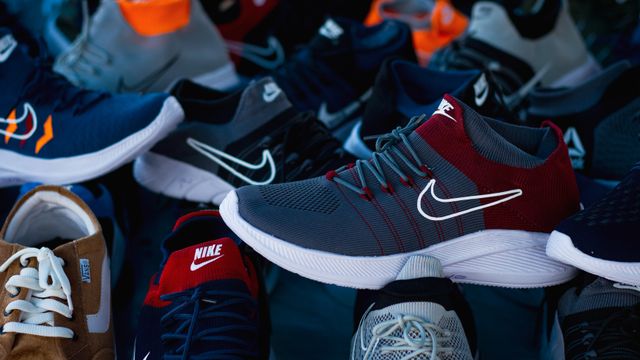
The buyer first selects the model, size, colorway, and batch. Batch names such as LJR, PK, or OG matter because different factories may produce noticeably different versions of the same sneaker.
We would check recent model-specific reviews rather than assume one batch is best across every shoe.
2. Confirm the Seller’s Terms
Before paying, the buyer should confirm:
- Final price, including shipping
- Available payment methods
- QC-photo policy
- Replacement rules after an RL
- Customs-seizure or reshipment policy
- Estimated processing and delivery time
This is especially important with middlemen because terms are often discussed through WhatsApp or another messaging app rather than published clearly on a website.
3. Place the Order or Use a Shopping Agent

With an independent seller, the buyer usually pays the seller directly and waits for the pair to be sourced.
With a shopping agent, the process is different. The agent purchases the item from a domestic platform such as Weidian or Taobao, receives it at a Chinese warehouse, and adds it to the buyer’s account.
4. Review the QC Photos
QC photos should show the actual pair allocated to the order, not generic product images. They normally cover the side profiles, toe boxes, heels, soles, size labels, stitching, and packaging.
We would compare these photos against genuine reference images and recent QC examples from the same batch. Useful checks include shape, panel alignment, color, logo placement, glue marks, and visible sizing errors.
5. Give a GL or RL
GL means “Green Light.” The buyer approves the pair and allows the seller or agent to ship it.
RL means “Red Light.” The buyer rejects the pair because of a clear defect or major accuracy issue and requests a replacement.
An RL does not always guarantee a different batch or a flawless replacement. Buyers should distinguish between minor batch-wide flaws and defects affecting only that individual pair.
6. Select Shipping and Track the Parcel
After approval, a middleman normally ships the pair directly. A shopping agent may first ask the buyer to choose a shipping line, packaging method, parcel declaration, and whether several purchases should be consolidated.
Agent orders usually include an extra warehouse stage, so the full flow is:
Domestic purchase → warehouse receipt → QC photos → GL/RL → parcel submission → international shipping
This QC process gives buyers more visibility than ordering from a listing alone, but it does not guarantee authenticity, legal importation, comfort, or long-term durability. It also cannot remove the risk of payment disputes, parcel loss, or customs seizure.
How to Spot a Scam Site: Red Flags and Payment Safety
Replica shoe websites operate with limited oversight, and many direct sellers rely on private messages rather than formal ecommerce systems. We would never treat a polished website, large social following, or “trusted seller” badge as proof that a seller is legitimate.
The strongest signals are a verifiable order history, clear QC terms, transparent payment conditions, and a payment method that gives the buyer some recourse.
Replica Shoe Scam Red-Flag Checklist
Be cautious when a site or seller shows several of the following warning signs:
- Prices far below normal batch pricing. Claims such as “top-tier 1:1 Jordans” for $30–$40 are usually unrealistic.
- Crypto, gift cards, or Western Union are the only payment options.
- No QC-photo process or refusal to show the actual pair before shipping.
- Stock images presented as customer or QC photos.
- No clear refund, replacement, or customs-seizure policy.
- A newly registered domain paired with claims of many years in business.
- Only perfect reviews, especially when the wording, dates, or images look repetitive.
- No independent discussion outside the seller’s own website or social pages.
- Pressure tactics, such as limited-time payment demands or claims that a batch will disappear within hours.
- Frequent changes in domains, WhatsApp numbers, or payment accounts.
- Requests to mislabel the payment as a personal transfer, gift, or unrelated product.
- Refusal to confirm the batch, size measurements, or total delivered cost in writing.
A secure-looking checkout page is not enough. HTTPS only means the connection is encrypted; it does not prove the seller will deliver the advertised product.
Payment Safety Matrix
| Payment method | Buyer recourse | Main advantage | Main risk | Our assessment |
| Marketplace escrow | Strongest among these options | The platform holds or controls payment and may mediate disputes | Protection can fail if the order is moved off-platform or the listing violates platform rules | Usually the lowest-risk payment structure |
| Credit or debit card | Possible chargeback through the card issuer | Payment is traceable and may be disputed | Chargebacks are not guaranteed, and counterfeit purchases may violate merchant terms | Better than irreversible transfers |
| PayPal Goods & Services | PayPal dispute process may apply | Creates a transaction record and possible buyer claim | Sellers may refuse it, add fees, or describe the order inaccurately; prohibited goods may complicate disputes | More protection than direct transfers, but not risk-free |
| PayPal Friends & Family | Very limited | Fast and widely used by direct sellers | Designed for personal transfers, with little or no purchase protection | High risk unless the buyer fully accepts potential loss |
| Cryptocurrency | None once confirmed | Fast cross-border payment | Irreversible, difficult to trace, and commonly used in scams | Highest-risk option for an unverified seller |
| Western Union or bank transfer | Usually very limited | Accessible for international transactions | Hard to recover after collection; recipient identity may be unclear | Avoid for first-time or unverified sellers |
What Should You Confirm Before Paying?
We would keep the seller’s answers in writing and verify:
- The exact shoe model, size, colorway, and batch
- Whether QC photos are included
- How many replacements are allowed after an RL
- The full price, including shipping and service fees
- The delivery estimate
- The policy for lost or customs-seized parcels
- Whether the payment recipient matches the seller or registered business
No checklist can remove the risk entirely. Replica transactions may also fall outside the normal protections offered by payment platforms, especially when the product violates their acceptable-use rules.
If you’re serious about starting a shoe business, you should also consider learning from existing brands. Here’s a reading list to help you get started: \
Read More
- Where Are Salomon Shoes Made
- Where Are Adidas Made
- Where Are Keen Shoes Made
- Where Are Asics Made
- Where Are Puma Shoes Made
- Where Are Nike Shoes Made
Payment and Shipping: What to Expect When Buying Replica Shoes
Most replica shoe orders ship from China and take around 10–25 days after the pair passes QC. The final timeline depends on the seller’s processing speed, shipping line, customs clearance, and whether a shopping agent handles the order.
We would separate the timeline into two stages:
- Processing and QC: Usually 2–7 days
- International delivery: Usually 5–20 days
Shopping-agent orders may take longer because the shoes first travel to a domestic warehouse for inspection, storage, and parcel consolidation.
Typical Shipping Times
| Shipping method | Typical transit time | What to expect |
| DHL or FedEx Express | 5–10 days | Faster tracking and delivery, usually at a higher cost |
| EMS or ePacket | 10–20 days | More economical, but tracking may update less consistently |
| Agent shipping line | 10–25 days total | Includes warehouse processing, QC, repacking, and international transit |
| Triangular or indirect route | Often longer | Parcel may pass through another country before reaching the destination |
These are estimates rather than guarantees. Customs checks, peak-season congestion, and incomplete address information can add days or weeks.
What Payment Costs Should Buyers Expect?
The product price is only one part of the total cost. Buyers may also pay:
- International shipping
- Shopping-agent service fees
- Warehouse storage or repacking fees
- Payment-processing or currency-conversion charges
- Insurance or optional parcel protection
- Import taxes, depending on the destination
We would compare the delivered cost, not the advertised shoe price. A lower-priced pair can become more expensive once international shipping and agent fees are added.
For a broader comparison of cards, bank transfers, PayPal, and other cross-border options, see our guide to international payment methods compared.
Can Customs Seize Replica Shoes?
Yes. Customs authorities may inspect, detain, seize, or destroy footwear carrying unauthorized trademarks. A small personal order may attract less attention than a commercial shipment, but there is no shipping method that removes this risk.
Some sellers use plain boxes, protective wrapping, or packaging without prominent branding. This is often described as discreet packaging, but it does not make the shipment legal or guarantee customs clearance.
What Happens If the Parcel Is Seized?
Reshipment policies vary widely. Some established sellers may offer one replacement shipment, while others provide no refund or reshipment once tracking shows customs detention.
Before paying, we would ask the seller to confirm in writing:
- Whether customs seizure is covered
- Whether the replacement is free or shipping must be paid again
- How many reshipments are allowed
- What evidence is required to approve a claim
- Whether the policy applies to every destination country
A vague promise such as “customs guaranteed” is not enough. The seller should explain exactly what happens if the parcel does not arrive.
How Should Buyers Handle Tracking Delays?
Tracking may stop updating temporarily while a parcel moves between carriers or clears customs. A gap of several days does not necessarily mean the shipment is lost.
However, buyers should contact the seller or agent when:
- Tracking has not started after the promised dispatch date
- The parcel remains at the same checkpoint for an unusually long period
- Customs requests documentation or payment
- The tracking number does not match the destination country
- The carrier confirms that the parcel is lost
From our sourcing perspective, the biggest weakness in replica shipping is the lack of enforceable terms. Legitimate commercial footwear orders can use accurate customs declarations, cargo insurance, inspected goods, and formal freight agreements, protections that counterfeit shipments usually cannot rely on.
How Sourcing Agents Help with Replica Shoe Orders
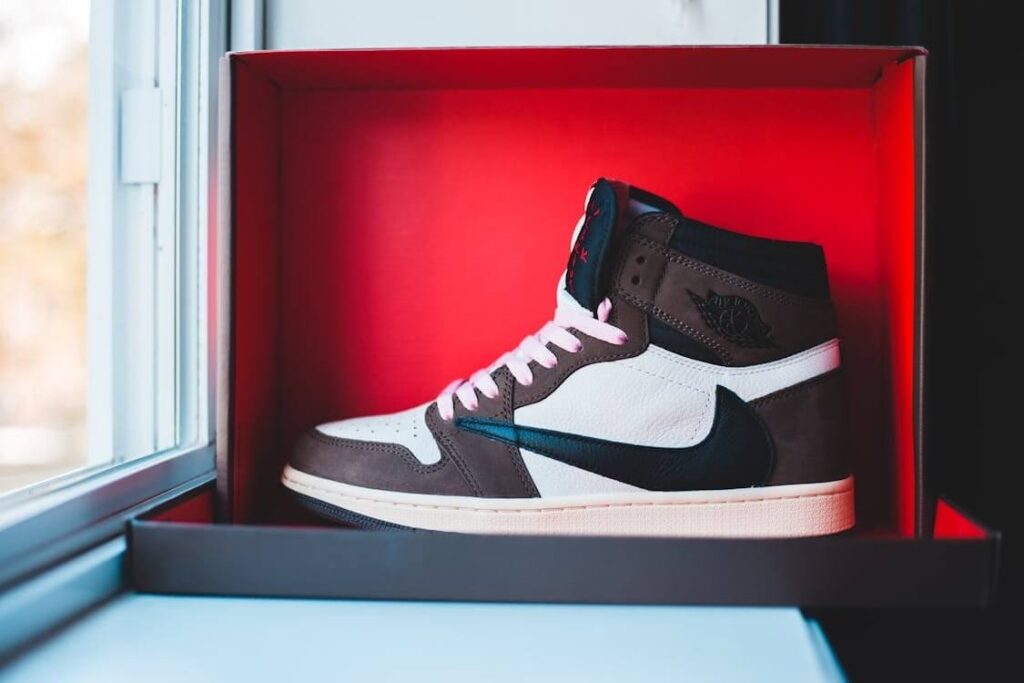
A shopping agent and a professional sourcing agent serve different purposes. Shopping agents mainly purchase from domestic platforms, receive products at a warehouse, provide QC photos, and consolidate parcels. A sourcing agent supports businesses with supplier verification, negotiation, product development, quality inspection, and commercial shipping.
That distinction matters: reputable sourcing agents, including us, do not source counterfeit footwear. Trademark-infringing goods create legal and customs risks for the supplier, agent, importer, and reseller.
For legitimate footwear projects, a China sourcing agent can help you:
- Find verified manufacturers rather than unknown trading companies
- Compare samples, MOQs, pricing, and lead times
- Arrange factory audits and pre-shipment inspections
- Develop unbranded, white-label, or private-label shoes
- Manage compliant packaging, customs documentation, and shipping
From our experience in Yiwu: quality verification is the #1 issue buyers face when sourcing footwear from China. Our on-ground team handles factory audits and pre-shipment inspections so you don’t have to. Discuss your project.
Ready to take your shoe business to the next level? Request a quick quote today, and let’s help you find the right suppliers to grow your brand with confidence.
Frequently Asked Questions
Are Replica Shoes Legal?
In many countries, high-quality replica shoes are legal to own and purchase as long as they don’t use logos, trademarks, or branding that falsely represent them as the original. These are unbranded lookalikes-not counterfeits pretending to be the real thing. Always check your local laws before importing or reselling.
What’s the Difference Between 1:1 and Fake Sneakers?
A 1:1 replica sneaker is made to match the original as closely as possible in materials, stitching, shape, and feel. It’s basically the premium tier of replica shoes. On the other hand, “fakes” often cut corners on quality, may use misleading branding, and typically don’t last as long. If you want something that looks and feels just like the original-without the branding-go for 1:1s.
Why Do Replica Sellers Use Yupoo Instead of a Normal Online Store?
Many replica sellers use Yupoo because it works as a visual catalog without operating like a full ecommerce checkout. Sellers can upload product albums, organize models by category, and direct buyers to WhatsApp or another messaging app to confirm price, batch, size, and availability.
The limitation is that Yupoo does not provide escrow, payment protection, or verified seller identities. Buyers should treat it only as a catalog and independently confirm the seller’s current contact details, QC policy, payment terms, and replacement rules before sending money.
Are Replica Shoes Safe to Buy?
When it comes to safety, not all replica shoes are created equal. High-quality reps should meet the same safety standards as authentic shoes, ensuring they are safe to wear.
Sellers should prioritize sourcing from reputable manufacturers who are transparent about their production processes and materials, thereby guaranteeing product safety for consumers.
Why Do Two Sellers Charge Different Prices for the Same Batch?
Two sellers can charge different prices for the same named batch because their service, shipping, sourcing channel, and profit margins differ. One seller may include express delivery, detailed QC support, replacement handling, or customs reshipment, while other lists only the shoe cost.
Batch names can also be misused, so identical labels do not guarantee identical production. Compare the delivered price, recent QC examples, seller terms, and after-sales support. A lower quote is not automatically better if important costs or protections are excluded.
Do Replica Shoes Have Good Quality?
Replica shoes vary widely in quality. Some mimic the original designer shoes with high-grade materials and craftsmanship, while others fall short. For sellers, offering the highest quality reps can lead to satisfied customers and repeat business.
It’s essential to vet suppliers thoroughly to ensure the replicas you sell are well-made and durable, reflecting positively on your brand.
Can Buyers Request Extra QC Photos Before Approving a Pair?
Yes, many middlemen and shopping agents allow buyers to request extra QC photos before giving a GL. This is useful when the standard images do not clearly show the size label, toe-box shape, heel alignment, outsole, stitching, or a suspected defect.
Some agents include a fixed number of photos and charge a small fee for additional angles. Requests should be specific rather than asking for “more photos.” For example, ask for a close-up of the left heel or an insole measurement beside a ruler.
Can an Order Be Cancelled After Giving a GL?
Cancellation is usually difficult once a buyer gives a GL because the seller may immediately package or dispatch the shoes. Before approval, some sellers or agents may allow an exchange, domestic return, or account credit, often with handling or return-shipping fees.
After international shipping begins, cancellation is normally unavailable. Buyers should confirm the policy before ordering and review every QC image carefully. A GL should be treated as final approval of that specific pair, rather than a temporary step that can easily be reversed later.
Is There a Market for Replica Sneakers?
The market for replica sneakers is vast, with a diverse audience seeking that designer look for less. As a seller, tapping into this market requires a keen eye for trends and customer preferences.
It’s not just about stocking up on popular styles but also about ensuring a catalog of replicas that are legal, safe, and of high quality. Success in this niche means balancing customer satisfaction with the nuances of legality and authenticity.
Can Replica Shoes Be Returned After Delivery?
Returns after delivery are uncommon and often impractical for replica shoes. Independent sellers may accept claims only for the wrong model, wrong size, or a major undisclosed defect, and buyers may need to pay expensive international return shipping.
Minor cosmetic differences are rarely accepted because batch flaws are often considered part of the product. Marketplace disputes may offer more recourse but prohibited-goods policies can complicate claims. Buyers should document the unboxing, photograph any problem immediately, and contact the seller before wearing or altering the shoes.
Do Replica Shoe Sellers Carry Women’s and Children’s Sizes?
Some replica shoe sellers carry women’s and children’s sizes, but availability is usually narrower and less consistent than standard men’s sizing. Sellers may use US men’s, US women’s, EU, or Chinese size charts, and the conversion can differ by batch.
Ask for the insole length in centimeters and compare it with a well-fitting pair rather than relying only on the printed size. Children’s footwear deserves extra caution because fit, materials, cushioning, and structural support are difficult to verify from product or QC photos alone.
Do Replica Shoes Have Resale Value?
Replica shoes generally have little legitimate resale value because they cannot lawfully be marketed as authentic branded products. Selling them as genuine is fraud, while openly describing them as replicas does not remove trademark-infringement risks or platform bans.
Even within informal communities, used pairs usually sell for much less than their purchase price because quality, batch identity, and wear are difficult to verify. Buyers should view replicas as personal-use goods with no dependable investment value, warranty, authentication support, or access to mainstream resale marketplaces
Where Is the Best Place to Discuss and Buy Replica Shoes Online?
For discussions and purchases, Reddit SuperReps community is your go-to platform. It’s a hub where enthusiasts share insights and advice on buying the best replicas.