The best Chinese wholesale websites are platforms that match your order size, product category, and sourcing needs while giving you enough visibility into the supplier and payment process. Some work best for factory-direct bulk orders, while others are better for small test orders, ready-stock products, or domestic China sourcing through an agent.
We re-verified the platforms in this guide in August 2026 because older lists often include websites that have shut down, changed business models, or are no longer practical for wholesale buyers. We also separate the platforms by buyer type so you can narrow your options instead of comparing 20 very different sites side by side.
Quick Facts
- 20 China wholesale websites re-verified in August 2026
- 6 outdated or wrong-category sites removed from the previous list
- Platforms grouped by order size and sourcing model
- Every listing covers MOQ, buyer protection, and whether an agent is needed
If you’re still deciding whether to source independently or work with someone on the ground, our guide to product sourcing explains the different sourcing routes in more detail.
Comparison Table: 20 China Wholesale Websites at a Glance
| Website | Type | Best For | MOQ | English Support | Buyer Protection | Agent Needed? |
| Alibaba | International B2B | Bulk & private label | Supplier-set | Yes | Trade Assurance | No |
| Made-in-China | International B2B | Industrial & audited suppliers | Supplier-set | Yes | Audited reports | No |
| Global Sources | International B2B | Vetted bulk & HK shows | Supplier-set, bulk | Yes | Verified Supplier | No |
| HKTDC | International B2B | HK suppliers & fairs | Supplier-set | Yes | None on-platform | No |
| Canton Fair Online | International B2B | Factory-direct discovery | Supplier-set | Yes | None on-platform | No |
| EC21 | International B2B | Alibaba alternative | Supplier-set | Yes | Verification tools | No |
| 1688 | Domestic wholesale | Lowest-cost sourcing | Low, supplier-set | Mandarin-first | Domestic only | Usually |
| Taobao | Domestic retail | Samples & small lots | 1 piece | Mandarin-first | Platform escrow | Usually |
| Yiwugo | Yiwu online | Small commodities research | Booth-set | Partial | None | Recommended |
| Chinagoods | Yiwu online | Yiwu bulk buying | Booth-set | Partial | Operator-backed | Recommended |
| AliExpress | Cross-border | Testing & single units | 1 piece | Yes | Buyer protection | No |
| DHgate | Cross-border | Small-lot wholesale | Low, seller-set | Yes | Dispute system | No |
| LightInTheBox | Cross-border | Apparel & lifestyle | 1 piece | Yes | Platform protection | No |
| Banggood | Cross-border | Gadgets & dropshipping | 1 piece | Yes | Platform protection | No |
| TomTop | Cross-border | Electronics & regional stock | 1 piece | Yes | 12-month warranty | No |
| Chinavasion | Cross-border | Electronics & dropshipping | 1 piece | Yes | Limited | No |
| TVCMALL | Cross-border | Mobile accessories | 95% no-MOQ | Yes | Limited | No |
| SUNSKY | Cross-border | Electronics & repair parts | Low | Yes | None | No |
| CJDropshipping | Fulfillment | Sourcing & fulfillment | None | Yes | App-level | No |
| Yaaku | Specialized | Guangzhou clothing | ~$1,000 orders | Yes | Limited | No |
30-Second Decision: Which China Wholesale Website Should You Use?
If you’re unsure where to start, we’d narrow the options based on order size, product category, and how much customization you need.
By Order Size
- Under $500 testing: Start with AliExpress, DHgate, or TVCMALL. These platforms support single-unit or small-lot orders, so you can validate a product before committing more capital.
- $500–$5,000 small wholesale: Consider Yiwugo or Chinagoods through a sourcing agent, or use DHgate for straightforward bulk listings.
- $5,000+ or private label: Look at Alibaba, Made-in-China, or Global Sources. At this level, working directly with manufacturers—or having an agent manage sourcing and production—usually makes more sense.
By Product Category
- Electronics and accessories: TVCMALL or SUNSKY
- Clothing: Yaaku for ready-stock wholesale; Alibaba for custom production
- Yiwu small commodities: Yiwugo or Chinagoods
By Customization
- Ready-stock products: AliExpress or Banggood
- Custom logo/private label: Alibaba, Made-in-China, or agent-managed production
The main trade-off is simple: easy international platforms reduce sourcing friction, while domestic and factory-direct channels usually require more work but give you more control over pricing and customization.
Types of China Wholesale Websites
“Chinese wholesale websites” can mean several very different sourcing channels. Some are international marketplaces designed for overseas buyers, while others are domestic Chinese platforms that are much harder to use without local support.
One important distinction: these websites are usually where you find China wholesale suppliers, wholesalers, and vendors they are not the suppliers themselves. The platform gives you access to sellers, but you still need to evaluate the individual company behind each listing.
1. International B2B Marketplaces
Platforms such as Alibaba, Made-in-China, Global Sources, HKTDC, Canton Fair Online, and EC21 are built around bulk sourcing.
They are generally the easiest starting point for overseas importers because communication is English-friendly and suppliers expect export inquiries. The main differences are in supplier verification, transaction protection, and category strength.
2. Domestic Chinese Platforms
1688 and Taobao primarily serve buyers inside China.
The attraction is domestic-market pricing and a huge product range, but the trade-off is more operational friction. Interfaces are Mandarin-first, payment is geared toward Chinese buyers, and overseas buyer protection is limited. For most international buyers, this is where a sourcing agent becomes useful.
3. Yiwu Market Online Platforms
Yiwugo and Chinagoods connect buyers with sellers from the Yiwu small-commodities ecosystem.
These platforms are especially useful for researching products, identifying booths, and sourcing categories such as toys, jewelry, home goods, and other small commodities. In practice, many overseas buyers still use an agent to handle communication, consolidation, inspection, and shipping.
4. Cross-Border Ready-Stock Websites
Sites such as AliExpress, DHgate, Banggood, TomTop, TVCMALL, and SUNSKY are built for simpler cross-border purchasing.
They usually suit buyers who want ready-stock products, low MOQs, and retail-style checkout rather than factory negotiation. The trade-off is less customization and generally higher per-unit costs than true bulk sourcing.
5. Dropshipping and Fulfillment Platforms
Platforms such as CJDropshipping combine sourcing with warehousing and order fulfillment.
This model is useful when you want one system to handle product sourcing, storage, and shipping instead of managing separate suppliers manually.
6. Sourcing Agents
A sourcing agent is the done-for-you route.
Instead of searching, negotiating, inspecting, and coordinating shipments yourself, an agent manages those steps on your behalf. This is especially useful for 1688, Yiwu sourcing, multi-supplier orders, and custom production where execution matters as much as finding the supplier.
Top Picks by Category
| Category | Best Pick | Why |
| Best overall bulk | Alibaba | Broad suppliers, protected bulk sourcing |
| Lowest prices | 1688 | Domestic pricing, huge supplier base |
| Small orders | AliExpress | One-piece orders, buyer protection |
| Electronics | TVCMALL | Deep electronics, mostly no-MOQ |
| Yiwu commodities | Chinagoods | Operator-backed Yiwu market access |
| Clothing | Yaaku | Ready-stock Guangzhou fashion wholesale |
| Dropshipping | CJDropshipping | Sourcing, warehousing, fulfillment combined |
| Trade-show sourcing | Canton Fair Online | Official exhibitor discovery platform |
The 20 Best China Wholesale Websites in 2026
We’ve grouped these websites by how buyers actually use them. The biggest difference is whether you want bulk factory sourcing, domestic Chinese pricing, Yiwu market access, low-MOQ ready stock, or fulfillment built into the platform. All platform details below were re-verified in August 2026.
A. International B2B Marketplaces
1. Alibaba: Best All-Round Platform for Bulk and Private Label
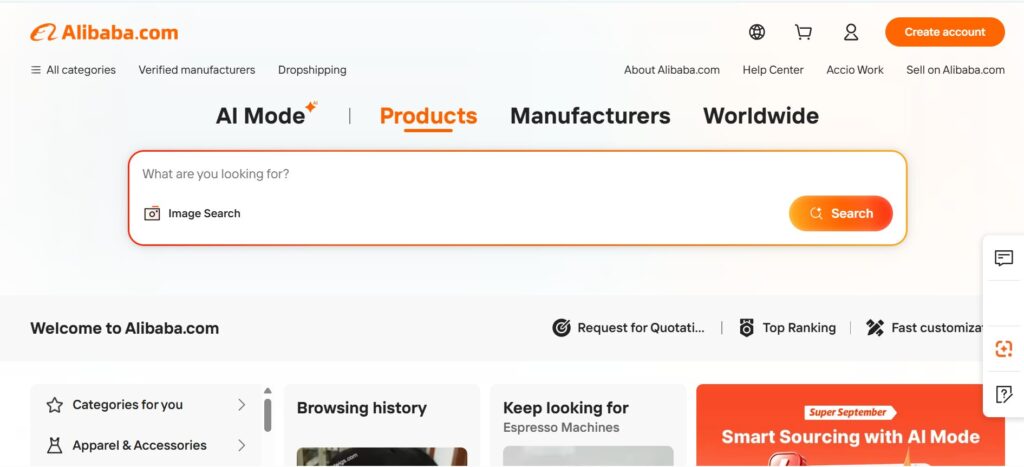
Best For: Bulk orders, private-label products, and comparing suppliers at scale
MOQ: Supplier-set; ranges from 1 unit on some ready-to-ship listings to hundreds for custom production
Buyer Protection: Trade Assurance plus Alibaba Guaranteed
Pros:
- Huge supplier pool covering almost every product category.
- Trade Assurance adds order-level payment protection.
- English interface, RFQs, and built-in supplier messaging make overseas sourcing easier.
Cons:
- Many sellers are trading companies rather than factories, so we always suggest verifying who will actually manufacture the product.
- Verified and Gold supplier labels help with screening, but they do not guarantee consistent production quality.
Ideal For: First-time and experienced importers who want a structured way to compare factories while keeping payment within a protected platform.
For a deeper look at the risks and safeguards, see our guide on whether Alibaba is safe and legitimate.
2. Made-in-China: Strong for Audited and Industrial Suppliers
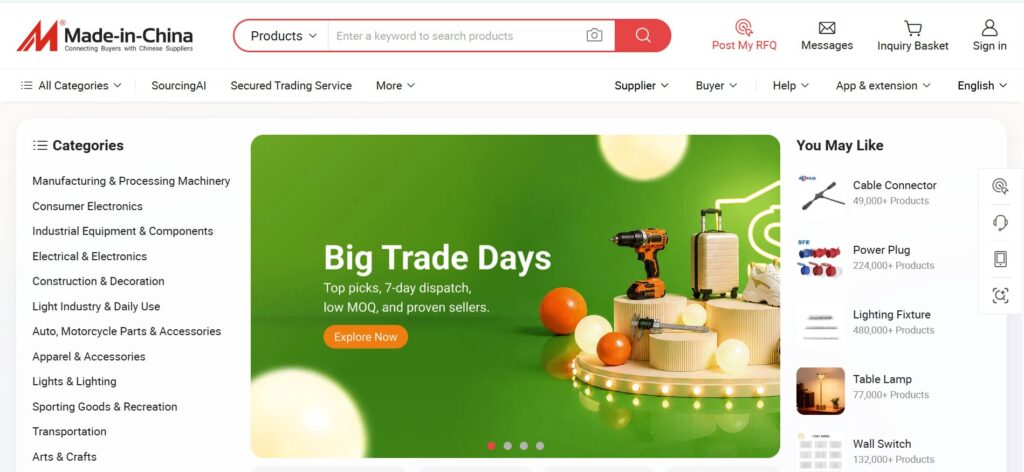
Best For: Machinery, industrial equipment, building materials, and audited manufacturers
MOQ: Supplier-set and generally bulk-oriented
Buyer Protection: Audited Supplier reports from third parties such as SGS, TÜV, and Bureau Veritas
Pros:
- Buyers can review on-site supplier audit reports before sending an inquiry.
- Particularly useful when sourcing industrial categories where supplier capability matters more than catalog size.
- Buyer registration and RFQ tools are available without charge.
Cons:
- Consumer-product selection is smaller than Alibaba’s.
- Supplier response times and the overall interface can feel less streamlined.
For us, the main differentiator is the audit layer. If factory verification is a priority, being able to inspect third-party reports before contacting a supplier can save considerable screening time.
Ideal For: Importers who value documented supplier verification, especially for industrial or technically demanding products.
Read more in our guide to whether Made-in-China is legitimate.
3. Global Sources: Best for Established Exporters and Trade-Show Sourcing
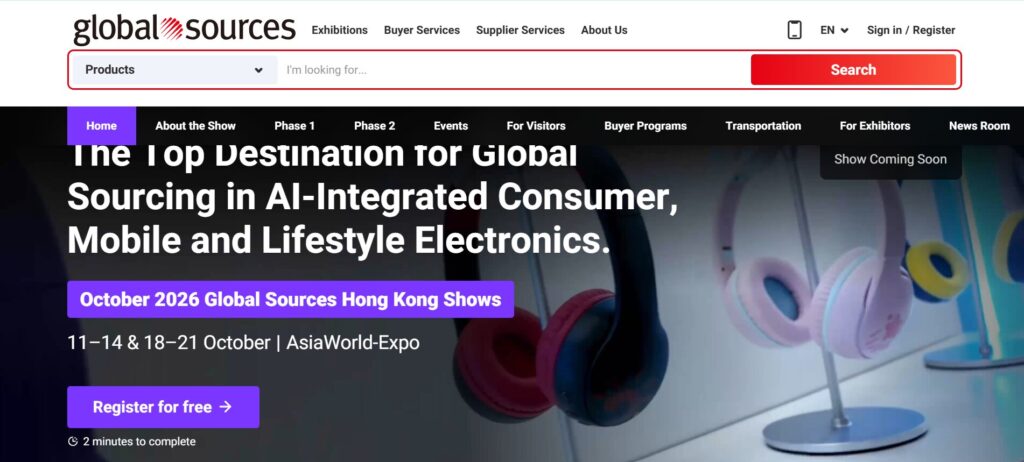
Best For: Electronics, gifts, established exporters, and trade-show sourcing
MOQ: Supplier-set and generally bulk-oriented
Buyer Protection: Verified Supplier program; transactions are arranged directly with suppliers
Pros:
- Global Sources combines its online supplier directory with Hong Kong trade shows held in April and October.
- Its supplier base tends to suit buyers looking for established export-oriented companies.
- Useful if you want to shortlist suppliers online before meeting them at a show.
Cons:
- The supplier pool is smaller than Alibaba’s.
- Small test orders are often harder to arrange because the platform is geared toward bulk sourcing.
One correction matters here: older articles sometimes claim Global Sources offers MOQs starting from 10 units. We would not use that as a platform-wide rule; MOQs are determined by individual suppliers.
Ideal For: Established ecommerce businesses and importers making larger purchases, particularly those combining online sourcing with Hong Kong trade shows.
See our Global Sources vs Alibaba comparison.
4. HKTDC: Useful for Hong Kong Suppliers and Trade-Fair Exhibitors
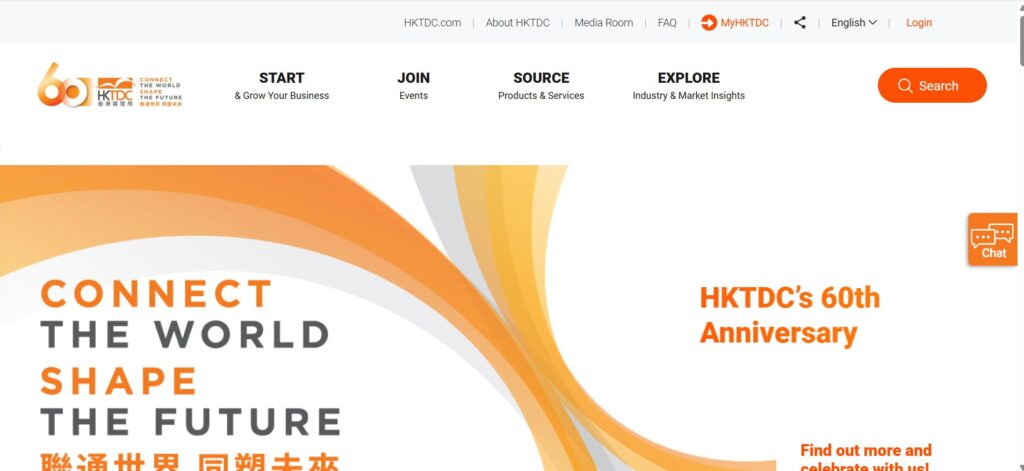
Best For: Hong Kong-based suppliers and trade-fair discovery
MOQ: Supplier-set
Buyer Protection: None on-platform; sourcing is inquiry-based
Pros:
- The sourcing portal is operated by the Hong Kong Trade Development Council, a statutory body.
- Its online supplier listings tie closely into Hong Kong trade fairs and exhibitor discovery.
- It can be useful when you specifically want Hong Kong trading companies or exporters.
Cons:
- HKTDC does not provide an escrow or transaction-protection layer.
- The supplier pool is narrower and more Hong Kong-focused than Alibaba or Made-in-China.
We’d view HKTDC primarily as a supplier discovery tool, rather than a platform where the entire transaction is managed for you. Once you find a supplier, the burden shifts to you to check the company, negotiate terms, and arrange a safe payment method.
Ideal For: Buyers who deliberately want Hong Kong intermediaries, exporters, or trade-fair exhibitors.
5. Canton Fair Online: Best for Finding Trade-Fair Exhibitors
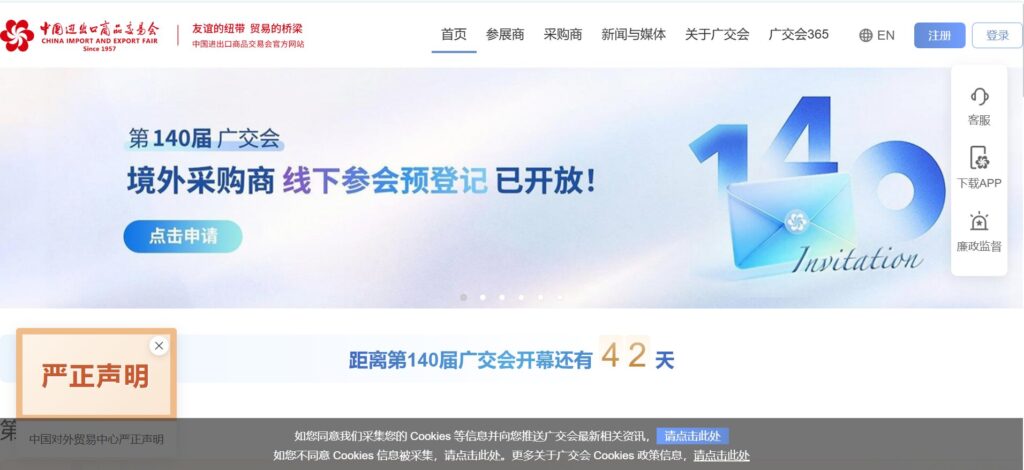
Best For: Factory-direct supplier discovery and Canton Fair exhibitors
MOQ: Supplier-set and generally bulk-oriented
Buyer Protection: None on-platform
Pros:
- It is the official online platform connected to the Canton Fair.
- Buyers can browse exhibitors, search product categories, and use business-matching features.
- It gives you a way to research participating suppliers without relying only on general marketplace listings.
Cons:
- There is no built-in transaction or escrow layer.
- The size of the exhibitor database can be difficult to navigate without a detailed product specification.
We’d use Canton Fair Online differently from Alibaba. It works particularly well when your priority is finding companies that participate in China’s major export trade fair, then contacting and evaluating those suppliers directly.
Ideal For: Serious bulk importers who want factory or exporter discovery and are comfortable handling negotiation, contracts, and payments outside the platform.
6. EC21: An Additional B2B Channel for Second-Source Quotes
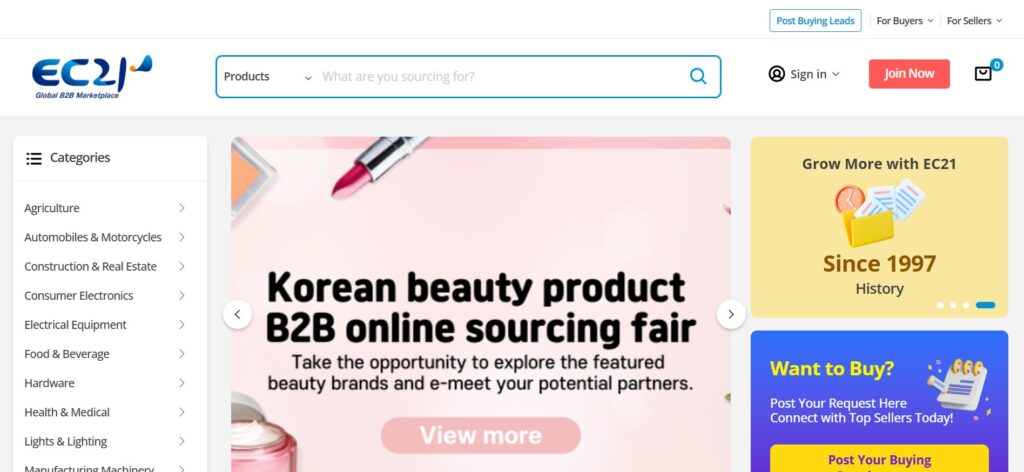
Best For: Expanding supplier searches beyond the largest marketplaces
MOQ: Supplier-set
Buyer Protection: Verified-supplier tools; no escrow
Pros:
- EC21 has operated since 2000 and offers an international supplier base rather than focusing exclusively on China.
- Buyers can access the platform without paying for supplier searches.
- It can produce additional quotes when the usual Alibaba or Made-in-China searches return similar vendors.
Cons:
- Its marketplace is substantially smaller than Alibaba or Made-in-China.
- Listing freshness can vary between categories, so we would confirm that a supplier is still active before doing deeper due diligence.
EC21 is rarely where we would start a broad China sourcing search. Its value is as an additional discovery channel when you want to widen the supplier pool or find an alternative manufacturer.
Ideal For: Buyers who already understand supplier vetting and want more options outside the dominant B2B marketplaces.
B. Domestic Chinese Platforms
7. 1688: China’s Domestic Wholesale Marketplace
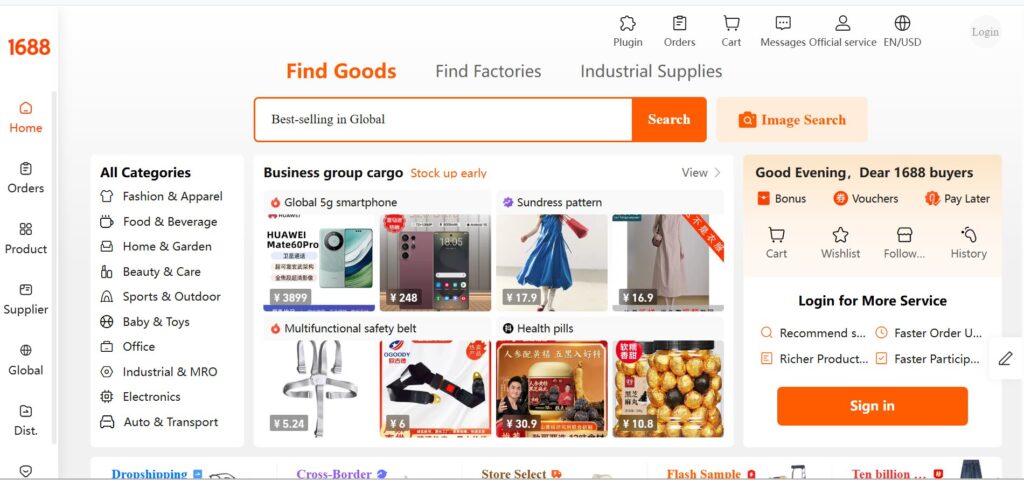
Best For: Cost-optimized domestic sourcing through a Chinese-speaking buyer or agent
MOQ: Low and supplier-set; often 1–10 units domestically
Buyer Protection: Domestic buyer protection only; no equivalent to Alibaba Trade Assurance for overseas buyers
Pros:
- Domestic pricing can be around 20–50% below export-facing platforms.
- The supplier and product selection is extensive.
- 1688overseas, introduced as part of the platform’s cross-border push in 2025, gives international buyers another route into the ecosystem.
Cons:
- The platform remains Mandarin-first, and many sellers do not communicate in English.
- RMB and Alipay-oriented payments create friction for overseas buyers.
The headline price is only part of the calculation. In practice, international buyers often need someone to communicate with suppliers, pay locally, inspect goods, consolidate orders, and arrange export shipping.
Ideal For: Buyers prioritizing domestic Chinese pricing who are comfortable working through an agent.
Our 1688 vs Taobao guide explains the difference in more detail.
8. Taobao: Better for Samples Than True Wholesale
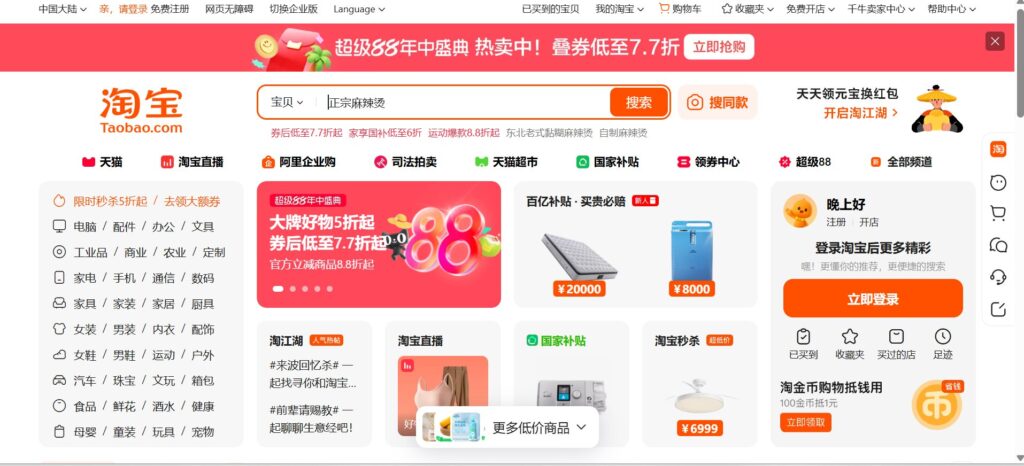
Best For: Product research, samples, and very small domestic-market orders
MOQ: 1 piece
Buyer Protection: Platform escrow within its domestic framework
Pros:
- Huge product selection with domestic Chinese retail pricing.
- Single-piece ordering makes it useful for evaluating products before committing to larger wholesale quantities.
- Its 2024–25 shipping expansion reached 12 overseas markets.
Cons:
- Taobao is fundamentally a consumer marketplace rather than a wholesale platform.
- The interface remains Mandarin-first, and international delivery support is inconsistent outside supported markets.
We would mainly use Taobao as a research and sampling tool. If you find a product that performs well, moving to 1688 or negotiating directly with a supplier usually makes more sense for volume.
Ideal For: Sellers who want to inspect or test individual products before placing larger orders through 1688, Alibaba, or another wholesale channel.
C. Yiwu Market Online
9. Yiwugo: Best for Researching Yiwu Market Booths
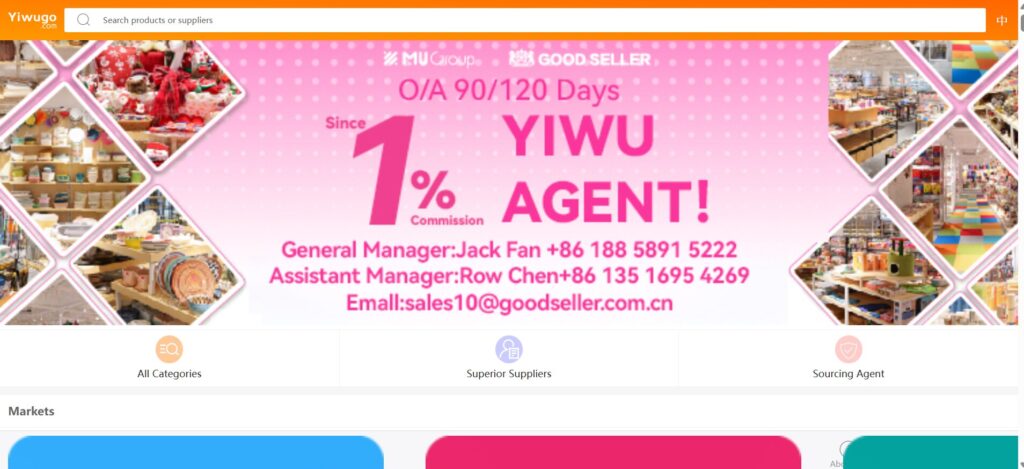
Best For: Small commodities and pre-sourcing research in Yiwu
MOQ: Set by individual booths, typically small-lot
Buyer Protection: None; primarily a directory
Pros:
- Yiwugo is an official online directory for the Yiwu International Trade Market.
- Buyers can search products and identify specific physical market booths.
- It is useful for creating a supplier shortlist before visiting Yiwu or asking an agent to investigate products locally.
Cons:
- Transactions are not protected through a built-in payment layer.
- English functionality is only partial.
Yiwugo makes the most sense when you treat it as a window into the physical Yiwu market rather than an Alibaba-style marketplace. You identify promising booths online, then handle negotiation and purchasing directly or through someone in Yiwu.
It is also closely related to Chinagoods. Both sit within the same Yiwu market ecosystem, but their functions differ.
Ideal For: Small-commodity buyers researching Yiwu suppliers before making contact or appointing an agent.
10. Chinagoods: A More Transaction-Oriented Yiwu Platform
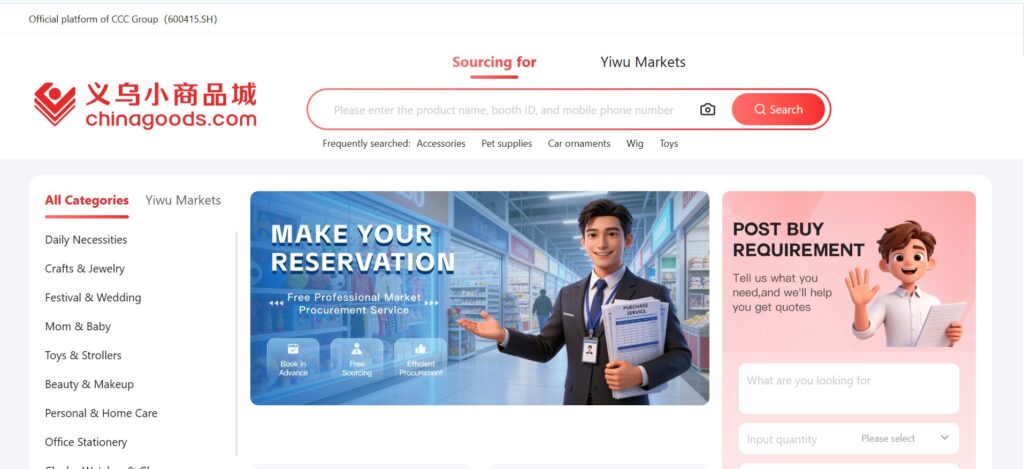
Best For: Buying from Yiwu market sellers with closer operator involvement
MOQ: Booth-set
Buyer Protection: Operator-backed framework; stronger than a directory but weaker than Trade Assurance
Pros:
- Chinagoods is run by the official Yiwu market operator.
- It is designed to move closer to actual online trading rather than functioning only as a booth directory.
- It covers the same physical Yiwu sourcing ecosystem as Yiwugo.
Cons:
- Multilingual functionality remains less developed than major international marketplaces.
- Overseas buyers often still get better results when someone in Yiwu manages the supplier relationship and orders locally.
The relationship between the two Yiwu sites is worth understanding: Yiwugo is better thought of as the directory, while Chinagoods is closer to the online store. They are sibling platforms within the same operator ecosystem rather than unrelated competitors.
Ideal For: Small-commodity importers who want digital access to Yiwu suppliers but may still use an agent for execution.
D. Cross-Border Low-MOQ & Ready-Stock
11. AliExpress: Best for Testing Products One Unit at a Time
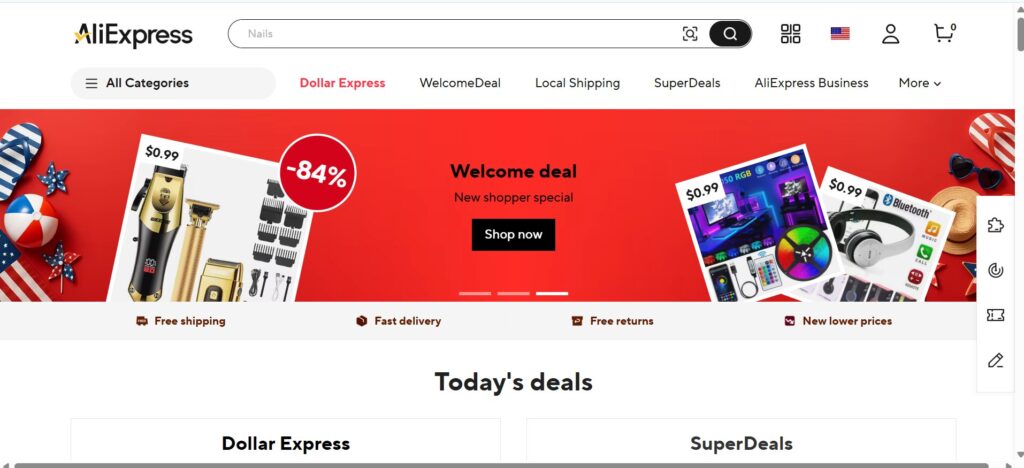
Best For: Single-unit purchases and product testing
MOQ: 1 piece
Buyer Protection: Full platform buyer-protection program
Pros:
- You can order one unit without negotiating with a supplier.
- Retail-style checkout makes it straightforward for international buyers.
- The product range covers a wide variety of consumer categories.
Cons:
- Per-unit pricing is considerably higher than genuine wholesale sourcing.
- Landed-cost calculations for US buyers became less predictable after the US de minimis exemption ended in August 2025.
We’d use AliExpress when the goal is validation rather than margin optimization. Spending more per unit can be reasonable when you are testing whether a product sells and do not yet want hundreds of units in inventory.
Once demand is proven, moving to Alibaba, 1688, or direct factory sourcing usually gives you more room on unit cost and customization.
Ideal For: New sellers testing products with minimal inventory commitment.
12. DHgate: Small-Lot Wholesale With More Marketplace Risk
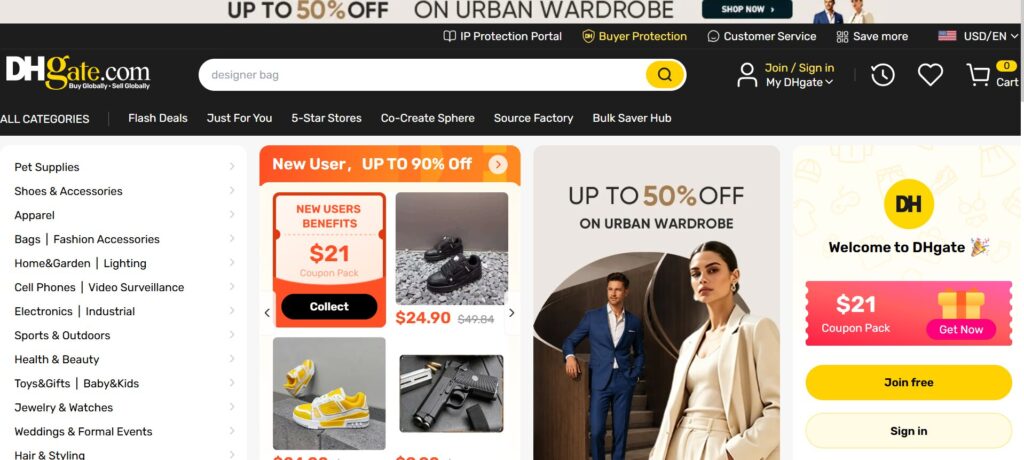
Best For: Unbranded small-lot wholesale orders
MOQ: Low and seller-set, with tiered quantity pricing
Buyer Protection: Platform dispute and escalation system
Pros:
- Designed for quantities between single-unit retail and traditional factory MOQs.
- Sellers can offer DHL, FedEx, UPS, and other courier options for faster shipping.
- Tiered pricing makes it possible to scale quantities without negotiating a full factory order.
Cons:
- Branded categories carry significant counterfeit risk, so we would avoid listings claiming to sell protected brands.
- Dispute outcomes can vary, making order documentation particularly important.
One clarification: offering DHL, FedEx, or UPS shipping options does not mean DHgate has special partnerships with those couriers. They are simply fulfillment methods sellers may provide.
For DHgate, we’d keep specifications, messages, and evidence inside the platform in case a dispute occurs.
Ideal For: Buyers sourcing unbranded products in small wholesale quantities without committing to factory-level MOQs.
13. LightInTheBox: More Retail-Like Than True Wholesale
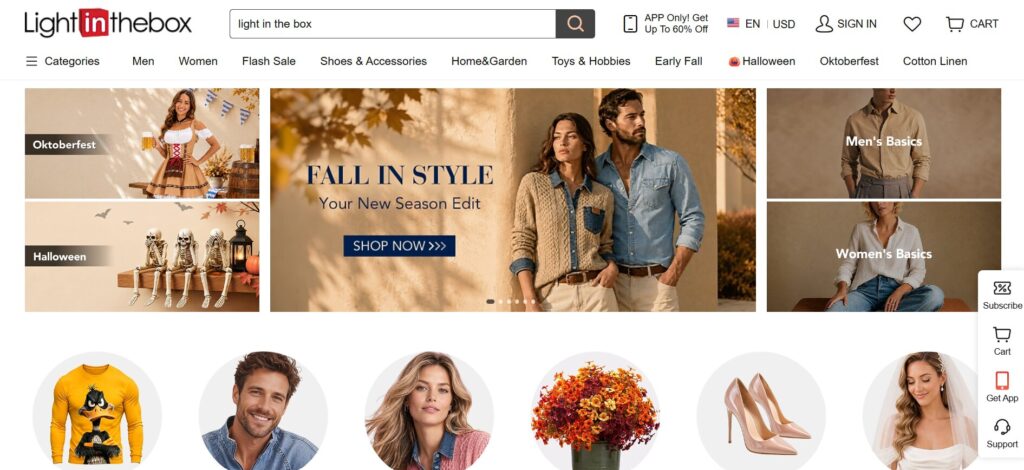
Best For: Small apparel and lifestyle orders
MOQ: 1 piece; some products offer tiered pricing
Buyer Protection: Standard platform protection
Pros:
- Its purchasing experience is closer to a Western ecommerce store than a traditional Chinese B2B marketplace.
- The company has increasingly focused on apparel and lifestyle merchandise.
- Regional warehouse availability can simplify some international orders.
Cons:
- The platform is no longer a broad general-purpose wholesale marketplace.
- There is limited depth for buyers looking for genuine factory-level wholesale sourcing or custom manufacturing.
We would mainly consider LightInTheBox for testing ready-stock apparel or lifestyle products, rather than for building a long-term private-label supply chain.
If your volumes start increasing, supplier-direct sourcing usually gives you more control over specifications, packaging, pricing, and repeat-order consistency.
Ideal For: Small boutique sellers who want to test apparel styles without committing to conventional wholesale quantities.
14. Banggood: Ready-Stock Gadgets With a Dropshipping Program
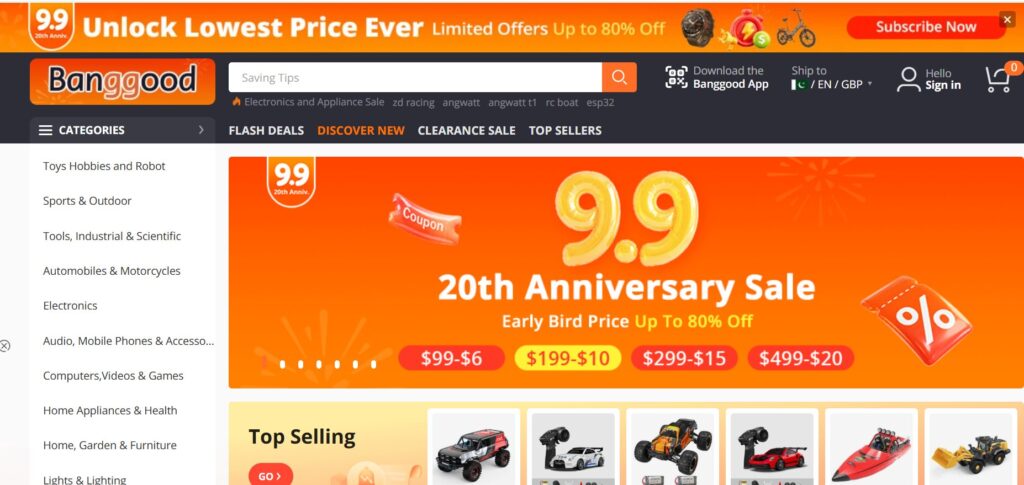
Best For: Consumer electronics, gadgets, and dropshipping
MOQ: 1 piece
Buyer Protection: Standard platform protection
Pros:
- Banggood operates an official dropshipping program with member discounts of 5–12%.
- It has 37 warehouses, including inventory in the US and Europe.
- Single-piece orders make testing products straightforward.
Cons:
- Its category depth has narrowed compared with its earlier years.
- Products supplied through marketplace sellers can be less consistent than Banggood-controlled inventory.
Banggood makes the most sense when you prioritize ready inventory and simple fulfillment over factory negotiation. Regional stock can also be useful when delivery speed is more important than securing the lowest possible factory price.
We would still compare landed costs against other sourcing channels once order volume grows, because convenience can come at a higher per-unit cost.
Ideal For: Electronics sellers who want low-MOQ inventory and access to regional warehouse stock.
15. TomTop: Electronics With Regional Warehouse Options
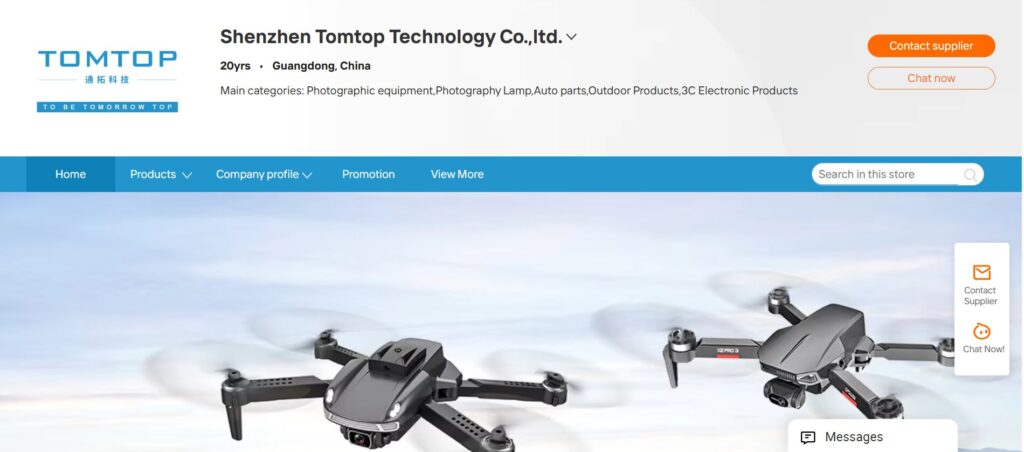
Best For: Electronics and accessories with US or European stock
MOQ: 1 piece
Buyer Protection: 12-month warranty policy
Pros:
- TomTop has operated since 2004 and ships internationally.
- Its US and European warehouse inventory can reduce delivery times compared with shipping every order directly from China.
- One-piece purchasing is suitable for testing standard products.
Cons:
- Its catalog is narrower than AliExpress.
- Review performance is mid-range, so we would look at current category-specific feedback rather than relying only on the platform’s overall reputation.
TomTop is most useful when a product you want is already stocked in a warehouse close to your customer market. That convenience can outweigh a small unit-price difference if faster fulfillment improves the customer experience.
For custom manufacturing or larger wholesale orders, however, it is not a substitute for a B2B marketplace.
Ideal For: Sellers sourcing standard electronics where regional inventory is more important than customization.
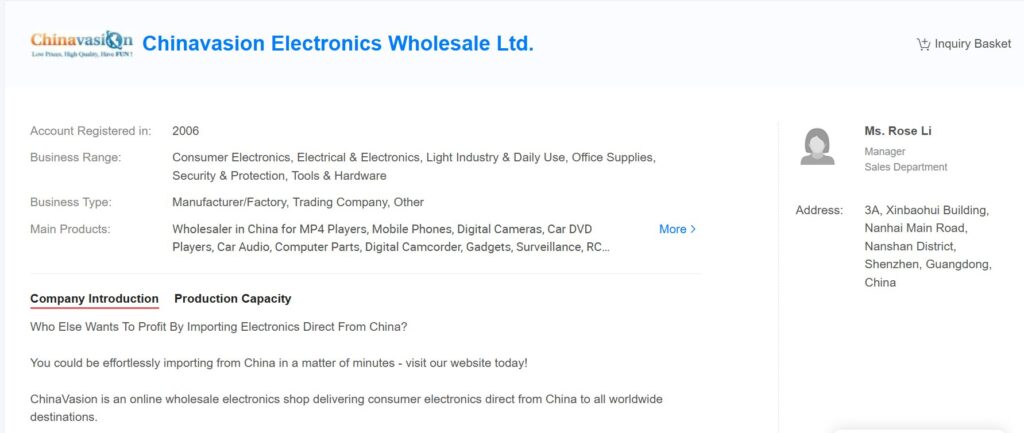
Best For: Shenzhen electronics wholesale and dropshipping
MOQ: 1 piece
Buyer Protection: Limited; confirm current terms before ordering
Pros:
- Chinavasion remains operational and has a long history in Shenzhen electronics sourcing.
- Wholesale and dropshipping workflows are still available.
- Single-unit purchasing keeps the initial commitment low.
Cons:
- Its current catalog and site experience are much smaller and more dated than during its peak years.
- We would test support responsiveness before committing significant order value.
This is one of those platforms where being active does not automatically make it the best first choice. Chinavasion can still be useful if it carries a particular electronics product you cannot source conveniently elsewhere, but we would start with an inquiry or small order before scaling.
Ideal For: Experienced electronics buyers looking for specific products within Chinavasion’s remaining catalog.
17. TVCMALL: Strong for Mobile Accessories With Very Low MOQs
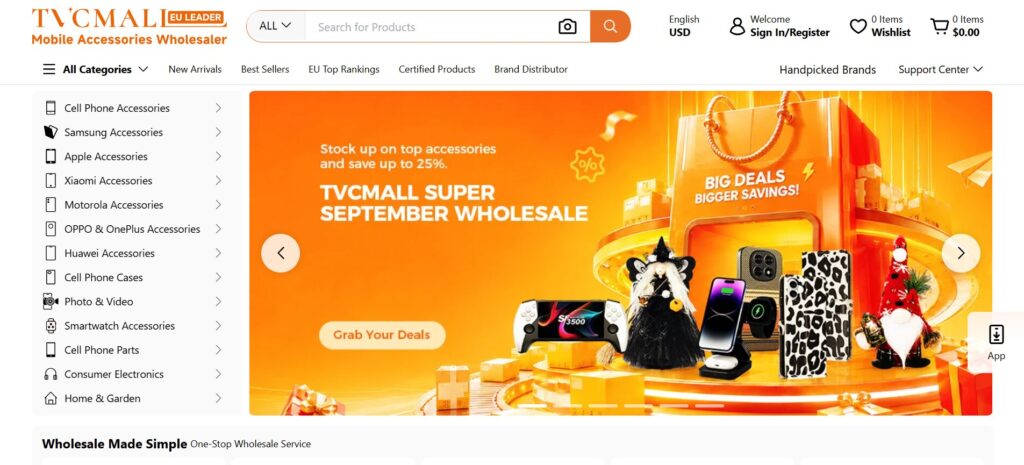
Best For: Phone accessories and consumer electronics
MOQ: Around 95% of its catalog has no MOQ
Buyer Protection: Limited platform-level protection
Pros:
- The platform lists around 1.2 million SKUs focused heavily on mobile accessories and electronics.
- It supports sourcing, labeling, and packaging customization.
- Buyers can use it for both single-unit testing and larger wholesale volumes.
Cons:
- Its category focus makes it unsuitable if you need products outside electronics.
- Buyer protection is thinner than on consumer-oriented platforms such as AliExpress.
TVCMALL stands out because it can follow a seller through several stages: sample testing, small wholesale orders, and eventually higher-volume sourcing without immediately forcing a large MOQ.
The trade-off is risk management. With more limited platform protection, we would be more cautious as order values rise.
Ideal For: Mobile-accessory sellers who want to start small and scale within the same sourcing platform.
18. SUNSKY: Deep Electronics Selection Without Platform-Level Protection
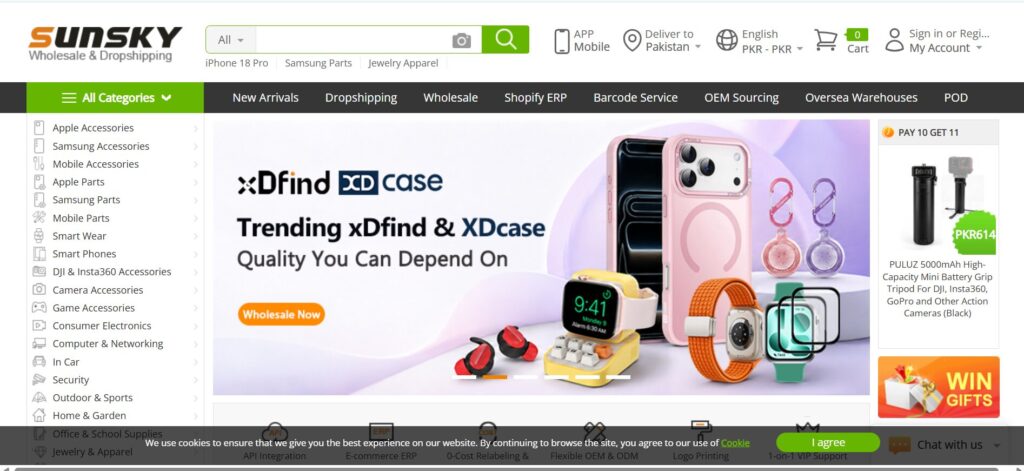
Best For: Electronics, accessories, repair parts, and dropshipping workflows
MOQ: Low
Buyer Protection: None at platform level
Pros:
- SUNSKY carries a deep selection of electronics and repair-related products.
- It supports both wholesale and dropshipping workflows.
- Low order requirements make it accessible for testing products.
Cons:
- There is no platform-level buyer protection, so disputes are handled directly with the seller.
- The website experience is functional rather than polished.
The missing protection layer is the main issue we would factor into any SUNSKY order. With an unfamiliar supplier or product, starting with a small transaction gives you a chance to verify communication, fulfillment, and the product itself before increasing your exposure.
That makes SUNSKY more suitable for buyers who already understand cross-border sourcing risk than for someone placing their first China order.
Ideal For: Experienced electronics sellers comfortable trading stronger catalog depth for weaker transaction protection.
E. Dropshipping & Specialized
19. CJDropshipping: Sourcing and Fulfillment in One Platform
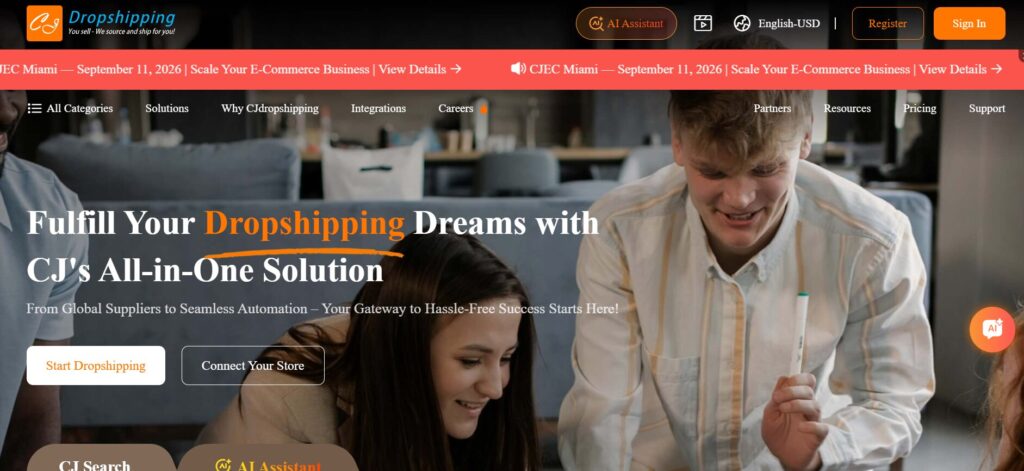
Best For: Dropshippers who want sourcing, warehousing, and fulfillment together
MOQ: None; no setup or monthly fees
Buyer Protection: App-level order management; 4.9★ on the Shopify App Store
Pros:
- Sellers can submit sourcing requests rather than relying only on existing catalog products.
- Product photography and custom-packaging services are available.
- The platform operates 50+ warehouses across China, the US, Europe, and other markets and integrates with Shopify and WooCommerce.
Cons:
- Using one company for both sourcing and fulfillment concentrates operational dependence in a single platform.
- We would still compare its product and fulfillment quotes with another supplier or sourcing route as volume increases.
We would not use Trustpilot as the review benchmark for CJ, because its Trustpilot page has been suspended over review-policy issues. The Shopify App Store rating is the appropriate reference here.
Ideal For: Dropshippers moving beyond manual AliExpress fulfillment who want sourcing and logistics managed in one system.
20. Yaaku: Ready-Stock Guangzhou Fashion With Payment Caveats
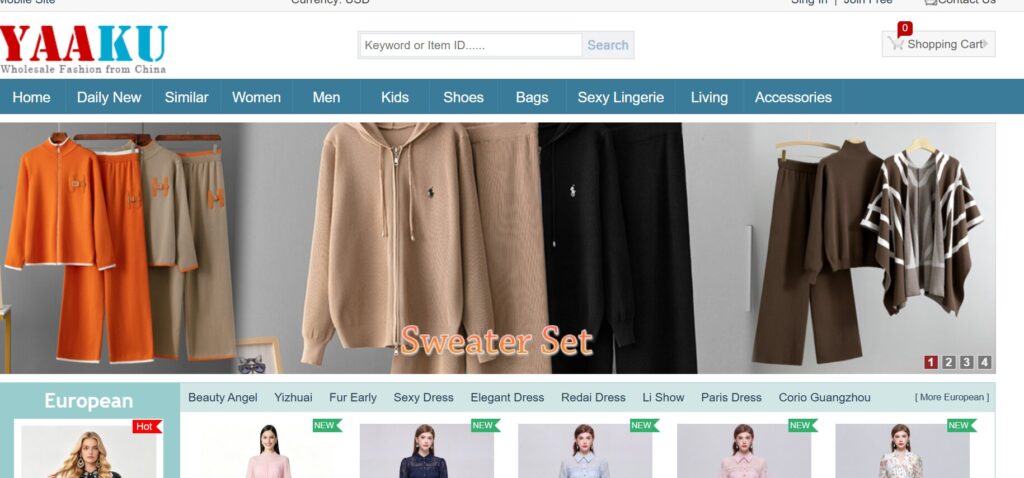
Best For: Ready-stock fashion wholesale from Guangzhou
MOQ: Wholesale-focused; orders above approximately $1,000
Buyer Protection: Limited
Pros:
- The site remains active, with catalog updates continuing through 2026.
- Its focus is Guangzhou apparel-market stock rather than general merchandise.
- Ready-stock products can suit sellers who want fashion inventory without developing a custom collection.
Cons:
- Yaaku lists Western Union payment to a personal name, which we consider a significant payment-risk flag.
- Independent review coverage is limited, while some site information appears dated.
If you decide to test Yaaku, we would keep the first order small and use PayPal or card rather than Western Union. The objective is to verify product accuracy, communication, and fulfillment before increasing the order value.
Ideal For: Experienced fashion resellers who specifically want Guangzhou ready-stock apparel and are comfortable managing more supplier risk.
Sites We Removed From This List (and Why)
We also re-checked several websites that still appear in older “China wholesale websites” lists. Some are no longer operating, while others simply do not fit the wholesale sourcing intent anymore.
| Removed Site | Why We Removed It |
| Gearbest | Shut down in 2021 |
| TBDress | Store dead; domain repurposed |
| Zaful | Active, but B2C only |
| SHEIN | Retail platform, not wholesale |
| DIYTrade | Active, but no buyer protection |
| TradeKey | Scam-history concerns; claims unverified |
The takeaway is simple: an old domain still appearing in search results does not mean it is still a useful sourcing channel. For this update, we removed platforms that are dead, repurposed, retail-only, or too weak on buyer protection and verification to justify keeping them in the main list.
How to Buy Wholesale from China Safely
Buying wholesale from China is much safer when you treat supplier verification, payment protection, and landed cost as part of the sourcing process rather than something to check after you have already chosen a product. Here is the process we would follow with any new supplier.
1. Pick the Right Type of Platform

Start with the sourcing channel that fits your order.
For small test orders, platforms such as AliExpress or DHgate reduce the commitment. For bulk or private-label production, Alibaba, Made-in-China, and Global Sources are better suited. Domestic platforms such as 1688 can offer more cost-optimized sourcing, but international buyers often need an agent to handle communication, payment, consolidation, and export.
Choosing the wrong platform creates unnecessary friction. There is little benefit in negotiating factory terms when you only need five units, just as retail-style sites become inefficient once you are ordering at scale.
2. Vet the Supplier, Not Just the Website
A legitimate marketplace can still contain suppliers that are wrong for your order.
Check the platform’s verification tiers, business details, transaction history where available, and any third-party audit reports. Made-in-China, for example, provides Audited Supplier reports based on on-site inspections.
We would also establish whether you are dealing with a factory or trading company. Trading companies are not automatically a problem—they can be useful when consolidating categories but you should know who is actually producing the goods and who controls quality.
3. Always Order Samples First

A sample gives you a baseline before committing to production.
Check the materials, dimensions, finish, packaging, labeling, functionality, and any other product-specific requirements. If the sample is approved, document those specifications clearly so the bulk order can be evaluated against the same standard.
For custom products, an approved sample is especially important because production misunderstandings become much more expensive once hundreds or thousands of units have been made.
4. Use Protected Payment Methods
Keep payment inside whatever protection system the platform provides.
On Alibaba, that means using Trade Assurance where applicable. Other marketplaces may offer platform escrow or dispute systems. PayPal or card payments can also provide another layer of recourse in some sourcing situations.
Avoid wiring money to a personal bank account, and be cautious if a supplier asks you to move payment off-platform in exchange for a lower price. Once you bypass the platform, its buyer-protection mechanisms may no longer apply.
5. Calculate Shipping and Landed Cost Before Ordering

The supplier’s unit price is only one part of the real cost.
Before paying for production, confirm freight, duties, taxes, customs clearance, and other import charges. Ask for a DDP quote where appropriate so you can compare the delivered cost rather than comparing product prices alone.
This matters even more for US buyers in 2026. The US de minimis exemption ended in August 2025, so low-value China-origin parcels that previously entered duty-free can now face import charges. Confirm the current duty treatment for your product and its HS code before ordering.
For the complete process, see our guide on how to buy wholesale from China. If you are sourcing through 1688, Yiwu, or multiple domestic suppliers, our guide to Yiwu sourcing agents explains when local support becomes useful.
Want Someone to Handle the Sourcing Process?
If you would rather not manage supplier screening, negotiation, inspection, consolidation, and shipping yourself, NicheSources can handle the process from our team in Yiwu.
Tell us what you want to source, and we’ll return a quote within two business days with $0 upfront sourcing cost.
FAQs about China Wholesale Websites
When diving into the world of sourcing products from China, it’s crucial to grasp the best items to buy, the top wholesale platforms, and the strategies for finding and selecting the best suppliers.
Let’s explore some of the most common queries to set you on the right path.
What Are the Best Products to Buy Wholesale from China?
Electronics, fashion apparel, home goods, and accessories rank among the top products to buy wholesale from China.
The combination of affordable prices and high market demand makes these categories popular.
According to market research, consumer electronics and ready-to-wear garments regularly hit high sales figures.
What Is the Largest Wholesale Website in China?
Alibaba stands out as the largest wholesale website in China, boasting a massive user base and voluminous transaction rates. Alibaba’s reach extends globally, cementing its position as a leader in the B2B marketplace space.
How to Find China Wholesale Suppliers Online?
Finding reputable China wholesale suppliers online involves using verified directories on platforms like Alibaba, Global Sources, and Made-in-China.
Read thorough customer reviews and verify supplier certifications to ensure reliability and adherence to quality standards.
What Is the Best Website to Import from China?
When choosing a website for importing goods from China, consider factors like product variety, supplier reliability, and competitive pricing.
Websites like Alibaba and DHgate are often recommended for their wide range of products and reliability. Look at user reviews and expert opinions to help make an informed choice.
How to Choose the Best Chinese Wholesale Website?
Choosing the best Chinese wholesale website requires careful consideration of several factors. Here are some key points to remember when deciding:
Product Quality and Selection: Look for a platform with high-quality products that match your business needs.
Supplier Verification and Reputation: Choose a website that verifies suppliers and has a positive reputation for reliable transactions.
Pricing and Discounts: Compare prices and discounts to find the most competitive rates for your budget.
Minimum Order Quantities (MOQs): Check if the website accommodates your order size, whether you need small quantities or larger bulk orders.
Shipping and Delivery: Evaluate shipping options, costs, and delivery times to ensure efficient and reliable logistics.
Customer Support: Opt for a platform with responsive customer support and effective communication channels.
User-Friendly Interface: Select a website with an intuitive interface for easy navigation and order management.
Payment Options and Security: Ensure the website offers secure payment methods for a safe transaction process.
Return and Refund Policies: Review the website’s policies for returning or exchanging products if needed.
Reviews and Recommendations: Consider feedback from other businesses to hear their experiences and get recommendations.
Which Chinese wholesale websites offer the strongest buyer protection?
For platform-level protection, Alibaba and AliExpress stand out in different ways. Alibaba uses Trade Assurance for eligible B2B orders, while AliExpress provides consumer-style buyer protection for smaller purchases.
DHgate has a dispute and escalation system, but outcomes can be inconsistent. Made-in-China adds value through third-party Audited Supplier reports, although that is supplier verification rather than transaction escrow.
HKTDC, Canton Fair Online, Yiwugo, and SUNSKY do not provide comparable on-platform payment protection, so supplier vetting and payment methods matter more.
What is the lowest-cost China wholesale website?
1688 is generally the lowest-cost option because it serves China’s domestic market rather than overseas buyers. The supplied platform data indicates prices can run roughly 20–50% below export-facing platforms such as Alibaba.
The trade-off is operational friction: 1688 is Mandarin-first, payment is geared toward RMB and Alipay, and overseas buyers do not get an Alibaba-style Trade Assurance layer.
For many international sellers, the practical comparison is therefore 1688 plus an agent’s fee versus buying directly through an export marketplace.
How do I buy on 1688 without speaking Mandarin?
There are three practical routes. You can try 1688overseas, introduced as part of the platform’s cross-border push in 2025, or use browser translation and available cross-border payment workarounds for simpler purchases.
For larger or repeat orders, a sourcing agent is usually the easier route because they can search in Mandarin, communicate with suppliers, make domestic payments, consolidate goods, and arrange export shipping.
The main point is that translation alone does not solve the payment, inspection, and logistics issues that often come with domestic-platform sourcing.
What are the risks of Alibaba Trade Assurance?
Trade Assurance reduces payment risk, but it does not remove the need for a precise purchase contract. Protection depends on the specifications, delivery terms, and other conditions recorded in the order.
Problems become harder to dispute when buyers move conversations or payment off-platform, accept vague product specifications, or fail to document differences between the approved sample and production goods.
We would treat Trade Assurance as one layer of protection, then strengthen it with clear written specifications, an approved sample, and a pre-shipment inspection for higher-value orders.
Is Temu a wholesale website?
No. Temu is a consumer retail marketplace, not a wholesale sourcing platform. According to the supplied research package, it does not provide a general wholesale program or bulk-pricing framework for resellers, and its terms prohibit using the platform for dropshipping fulfillment.
Its low retail prices can make it look like a wholesale channel, but the sourcing model is different. Sellers looking for domestic-style China pricing should compare platforms such as 1688, while buyers who want small English-first wholesale lots can look at options such as DHgate instead.
Can I still order from China to the USA in 2026?
Yes, but US buyers need to calculate landed cost more carefully than before. The US de minimis exemption ended in August 2025, so low-value China-origin parcels that previously entered duty-free can now face import charges. Shipping from China still works through postal, courier, and freight channels; the important change is the economics.
Before ordering, confirm the current duty treatment for your product, identify the correct HS code, and compare DDP quotes where appropriate, so freight, duties, and customs costs are included in your purchasing decision.
Do I need a sourcing agent to buy from China?
Not for every order. Alibaba, AliExpress, and DHgate are designed so international buyers can place orders directly, making DIY sourcing practical for samples and simpler purchases.
An agent becomes more useful when you move to Mandarin-first platforms such as 1688, buy from several suppliers, need goods consolidated, require pre-shipment inspection, or want custom production managed locally.
The trade-off is cost: an agent adds a commission, while DIY gives you more direct control. We would base the decision on order complexity and risk rather than assuming one route is always better.
Which China wholesale websites let me start with one unit?
Several cross-border platforms in this guide support one-piece purchasing. AliExpress, LightInTheBox, Banggood, TomTop, and Chinavasion all list a 1-piece MOQ, while around 95% of TVCMALL’s catalog is described as no-MOQ.
Taobao also allows single-piece purchases, although it is a domestic Chinese retail platform rather than a true wholesale marketplace. These sites are useful for samples and product testing.
Once volume increases, compare bulk-oriented platforms because single-unit convenience usually comes with a higher per-unit cost.